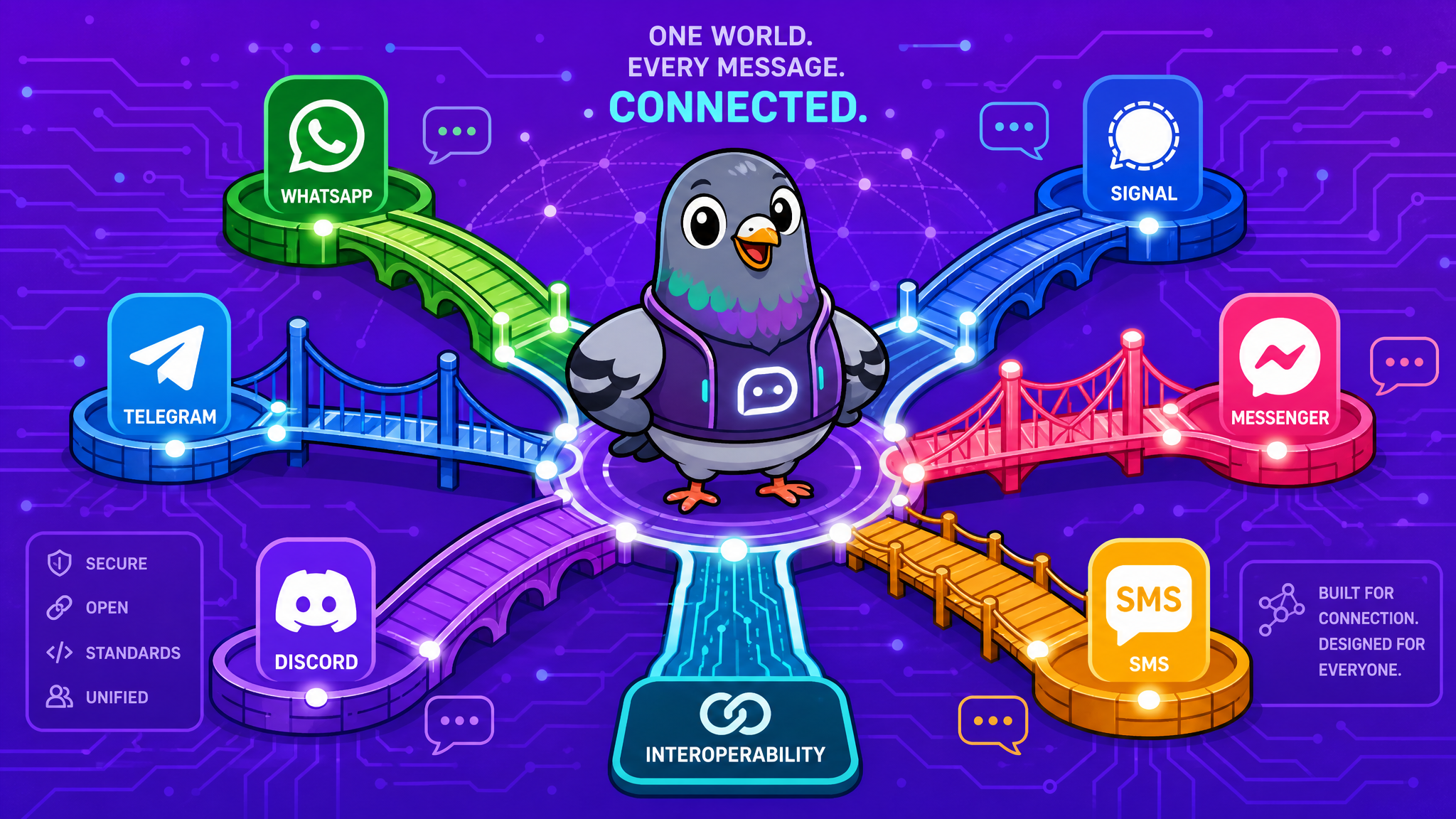
Why Interoperability Between Messaging Apps Matters More Than Ever
Tired of juggling five messaging apps? Learn why messaging interoperability is the biggest tech battle of 2026 and how it could change everything.
The Messaging Fragmentation Problem
How many messaging apps are on your phone right now? Three? Five? Seven? You probably use one for family, another for work, a third for your friend group, a fourth for that one community, and a fifth because that one person only uses that specific app. Each has its own notifications, its own interface, and its own login. Your conversations are scattered across isolated digital islands with no bridges between them.
This is the messaging fragmentation problem, and it's getting worse. As of 2026, there are over 50 messaging platforms with more than 10 million active users each. The average smartphone user has 4.2 messaging apps installed. This fragmentation isn't just annoying — it's fundamentally broken.
What Interoperability Actually Means
Messaging interoperability means the ability to send messages between different messaging platforms seamlessly. Imagine texting someone on PigeonChat from your Signal account, or receiving a group chat message from a Telegram group in your iMessage inbox. Just as you can email anyone regardless of whether they use Gmail, Outlook, or Yahoo, interoperability would let you message anyone regardless of which app they prefer.
This isn't a new concept. SMS already works this way — you can text any phone number from any carrier. But modern rich messaging apps have built walled gardens that make cross-platform communication impossible.
The EU's Digital Markets Act: A Regulatory Push
The European Union's Digital Markets Act (DMA) is the biggest regulatory force pushing for interoperability. Enacted in 2024, it requires designated "gatekeeper" platforms to open their messaging services to third-party interoperability. This means the largest messaging platforms must provide technical interfaces that allow smaller apps to exchange messages with their users.
The implementation has been gradual: one-on-one text messaging interoperability was required first, followed by group messaging support, and eventually rich media (images, video, voice notes) exchange. By 2026, the framework is in place, though adoption and user experience vary significantly.
Why Users Want It
User surveys consistently show overwhelming support for interoperability:
- 73% of users say they would prefer to use one messaging app for all conversations
- 68% have felt forced to download an app they didn't want just to communicate with specific people
- 81% believe they should be able to choose their messaging app without losing access to contacts on other platforms
The user demand is clear: people want freedom of choice without the penalty of isolation.
The Technical Challenges
Building interoperability between messaging apps is technically complex, especially when end-to-end encryption is involved. The core challenges include:
Encryption compatibility. Different apps use different encryption protocols. Signal uses the Signal Protocol. Others use proprietary systems. For interoperable messages to remain encrypted, apps need to agree on shared cryptographic standards or implement complex protocol bridges.
Feature parity. App A supports disappearing messages and emoji reactions. App B supports polls and message editing. What happens when a feature available on one platform doesn't exist on the other? Degraded experience, confused users, and potential security gaps.
Identity verification. How do you verify that the person on another platform is who they claim to be? Cross-platform identity management is a significant challenge that impacts both security and user trust.
Spam and abuse prevention. Each app has its own moderation and spam detection systems. Interoperability creates new attack vectors for spammers and bad actors who can exploit the seams between platforms.
The Privacy Debate
Privacy advocates are split on interoperability. Some argue it's essential for user freedom — you shouldn't be locked into a platform to communicate securely. Others worry that bridging between platforms introduces new attack surfaces and potentially weakens the security guarantees of privacy-focused apps.
The nuanced truth: interoperability done well can enhance both freedom and privacy. Done poorly, it can undermine both. The implementation details — not the concept itself — determine the outcome.
What This Means for Smaller Platforms
For smaller messaging apps like PigeonChat, interoperability is a double-edged sword. On one hand, it levels the playing field — users can choose PigeonChat for its features and experience without worrying that their contacts are on bigger platforms. On the other hand, it means competing directly on quality rather than network effects, which requires constant innovation.
The likely outcome is positive for users: platforms that survive interoperability will be the ones that offer the best experience, not just the biggest network. Competition drives innovation, and innovation drives better apps for everyone.
The Bridge Protocols Emerging
Several technical standards are emerging to make interoperability practical. The Matrix protocol, MIMI (More Instant Messaging Interoperability), and extended XMPP implementations are all competing to become the lingua franca of cross-platform messaging. Each approach has trade-offs between security, feature support, and implementation complexity.
A Future Without Walled Gardens
The trajectory is clear: the era of completely walled messaging gardens is ending. Whether driven by regulation, user demand, or competitive pressure, the messaging ecosystem is slowly moving toward a more open, interoperable future. It won't happen overnight, and the transition will be messy. But the end result — choosing your messaging app based on which one you like rather than which one your contacts are stuck on — is worth the complexity. Your messages should follow your preferences, not the other way around.

Writer & Editor at PigeonChat
Related Articles

Why people search for the best chat app UAE option

Why users search for a best chat app UAE option

Why users search for a best chat app UAE option

What makes a pigeon chat app different online
Why chat folders matter for busy group conversations