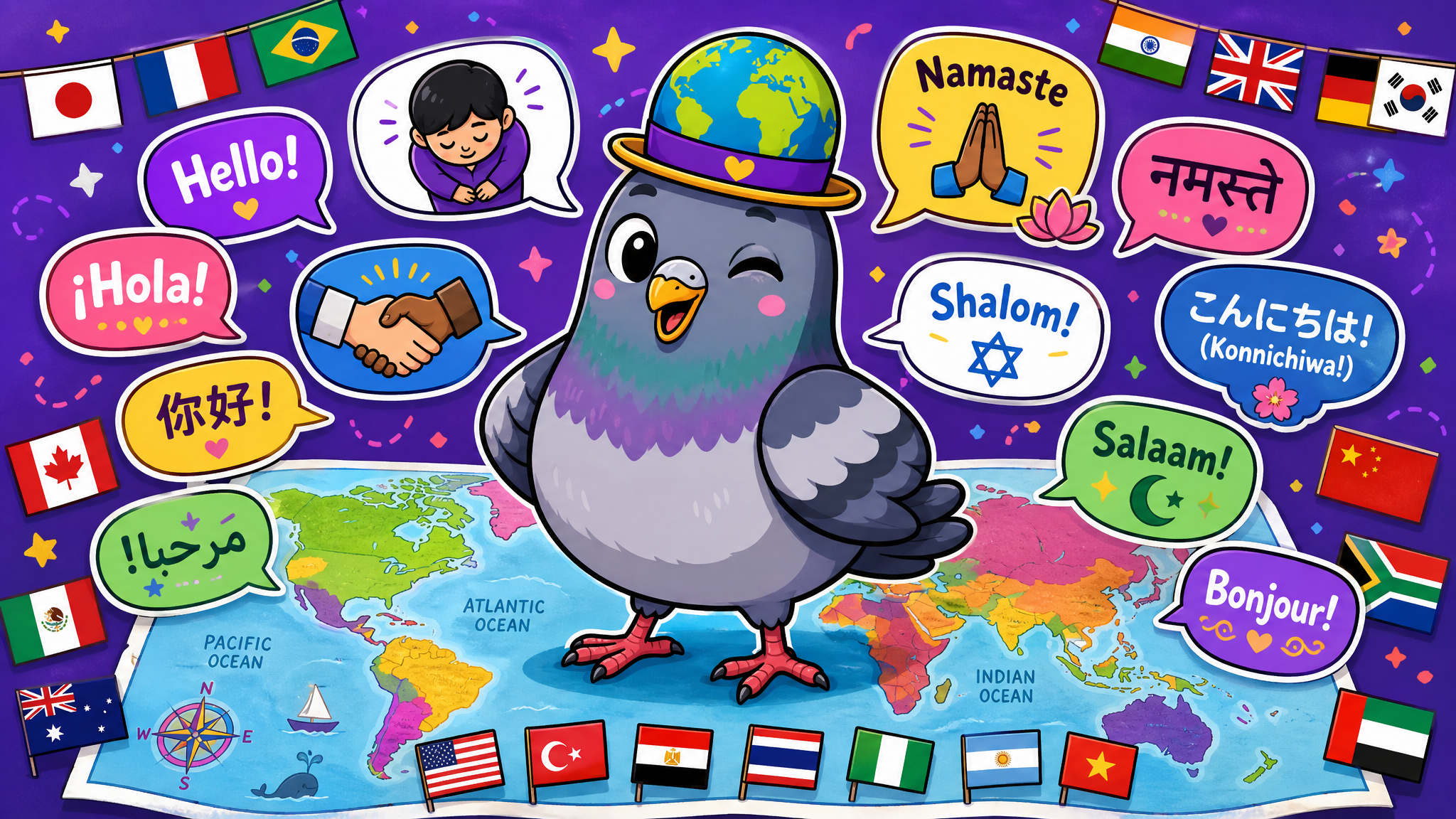
The Complete Guide to Messaging Etiquette Across Cultures: A Global Perspective
Navigate the fascinating world of cross-cultural messaging — from emoji minefields and voice message divides to response time expectations and formality levels around the globe.
One Planet, Many Rules: Navigating Messaging Across Cultures
You fire off a quick thumbs-up emoji to your colleague in Greece and think nothing of it. Hours later, you learn that in Greek culture, the thumbs-up gesture is equivalent to a middle finger. A simple message just became an international incident.
As messaging apps connect billions of people across borders, understanding cultural differences in digital communication has never been more important. What's polite in Tokyo might be rude in São Paulo. What's expected in New York might be considered intrusive in Helsinki. This guide will help you navigate the fascinating, sometimes treacherous waters of cross-cultural messaging etiquette.
Why Cultural Context Matters in Digital Communication
In face-to-face communication, cultural differences are often softened by visual cues — a warm smile, open body language, an apologetic gesture. Remove those cues, as messaging does, and cultural misunderstandings become far more likely and far more consequential.
Edward T. Hall's concept of high-context versus low-context cultures is particularly relevant to messaging. In high-context cultures (Japan, China, Korea, much of the Middle East), communication relies heavily on implied meaning, shared understanding, and what's left unsaid. In low-context cultures (United States, Germany, Scandinavia), communication is expected to be explicit, direct, and literal.
When someone from a high-context culture messages someone from a low-context culture, the results can be bewildering. The high-context communicator may feel the other person is blunt or rude. The low-context communicator may feel the other is evasive or unclear. Neither is wrong — they're simply operating from different cultural programming.
Response Time Expectations Around the World
Perhaps no aspect of messaging etiquette varies more dramatically across cultures than response time expectations.
Brazil and Latin America: Communication is warm, frequent, and immediate. Not responding within an hour during active hours can be perceived as cold or disinterested. Messaging is deeply social, and conversations flow continuously throughout the day with friends, family, and colleagues alike.
Japan: Prompt responses are valued as a sign of respect, particularly in professional contexts. However, the content is carefully considered before sending — rushing a response at the expense of thoughtfulness would be worse than a short delay. The Japanese concept of "kuuki wo yomu" (reading the air) extends to messaging, where understanding the appropriate timing and tone is essential.
Germany and Northern Europe: Efficiency is prized over speed. A well-considered response sent the next business day is perfectly acceptable for professional messages. Personal messages have more flexibility, but the cultural value of respecting others' time and space means that instant responses are not expected or pressured.
Middle East: Relationships take priority over schedules. Messages from friends and family often receive immediate responses regardless of what else is happening. Professional messages follow a more formal timeline but are always preceded by personal pleasantries — jumping straight to business would be considered rude.
United States: Expectations vary by relationship and context, but there's a general assumption that messages will be seen and responded to within a few hours. The "always-on" culture means that extended silence can create anxiety, particularly in professional settings.
The Emoji Minefield: Gestures That Don't Translate
Emojis were supposed to be a universal language — visual symbols that transcend linguistic barriers. In practice, they've created a whole new category of cross-cultural miscommunication.
The thumbs-up (👍): Positive in most Western cultures, but offensive in parts of the Middle East, West Africa, and Greece where it's equivalent to an obscene gesture. In some East Asian professional contexts, it can feel dismissive — as if the topic doesn't warrant a written response.
The OK sign (👌): Means "perfect" in North America and most of Europe, but is considered vulgar in Brazil. In France, it can mean "zero" or "worthless." It's also been co-opted by certain fringe groups online, adding another layer of potential misinterpretation.
The folded hands (🙏): Interpreted as "prayer" or "please" in Western cultures, but as a respectful greeting or "thank you" in Japanese and Indian contexts. Using it to say "I'm praying for you" in a conversation with someone who reads it as "thank you" creates a subtle but real communication gap.
The slightly smiling face (🙂): One of the most culturally contentious emojis. In many Western countries, especially among younger users, this emoji has acquired a passive-aggressive or sarcastic connotation. In other cultures, it's taken at face value as a simple, friendly smile. The same emoji can convey warmth or hostility depending entirely on cultural context.
Red and white hearts (❤️ and 🤍): In most cultures, hearts symbolize love and affection. However, in China, the color red is associated with luck and celebration, while white is associated with mourning. Sending a white heart to a Chinese friend might carry unintended somber connotations.
Formality Levels: When to Use Titles, Honorifics, and Formal Language
The level of formality expected in messaging varies enormously by culture and can be a significant source of friction in international communication.
Korean and Japanese: Both languages have elaborate honorific systems that extend fully into messaging. Using informal speech with someone older or of higher status — even in a casual chat — can be seriously offensive. Young Koreans carefully navigate between "jondaenmal" (formal speech) and "banmal" (informal speech) even in text messages.
French: The distinction between "tu" (informal you) and "vous" (formal you) carries into messaging. Using "tu" prematurely with a French colleague can be perceived as presumptuous. Many French professionals maintain "vous" in messaging until explicitly invited to switch to "tu."
American English: Tends toward informality, especially in tech and startup cultures. First names, casual greetings, and emoji are acceptable even in many professional contexts. However, this informality can clash with cultures that expect more formal digital communication.
Arabic: Professional messaging often begins with elaborate greetings and blessings before any business content. Skipping these pleasantries to "get to the point" is considered disrespectful. The greeting portion of a message might be longer than the business content itself, and this is expected and appreciated.
Group Chat Culture Around the Globe
Group chats function very differently across cultures, and understanding these differences is crucial for anyone working in international teams or maintaining multicultural friendships.
In India, group chats are vibrant, high-volume spaces. Good morning messages, religious greetings, motivational quotes, and forwarded content are standard. Silence in a group chat can be interpreted as disengagement. Groups often have dozens or even hundreds of members and serve as community hubs.
In Japan, group chats tend to be more structured and purposeful. Messages are concise and relevant to the group's purpose. Sending irrelevant content or too many messages is considered inconsiderate of others' time and attention.
In Brazil, group chats are extensions of social life — lively, humorous, and deeply personal. Audio messages are extremely popular (Brazil is one of the world's top voice message markets), and a single group chat might receive hundreds of messages per day.
In Scandinavian countries, group chats tend to be efficient and respectful of boundaries. Members communicate when necessary and aren't expected to respond to every message. The cultural value of personal space extends into digital communication.
Voice Messages: Cultural Love or Loathe
Voice messages are perhaps the most culturally polarizing feature of modern messaging apps. Their acceptance varies dramatically by region.
In Brazil, Turkey, and much of the Middle East, voice messages are the preferred mode of communication. They're seen as more personal, more expressive, and more efficient than typing. A Brazilian friend might send you a three-minute voice note about their day without thinking twice.
In Germany, the UK, and parts of East Asia, voice messages are often considered intrusive or inconsiderate. They require the recipient to be in a quiet environment with available audio, and they can't be quickly scanned like text. Many people in these cultures find it rude to receive voice messages without prior agreement.
The cultural divide around voice messages extends to professional settings. In many Latin American and Middle Eastern businesses, voice messages between colleagues are perfectly normal. In most Northern European or East Asian corporate environments, they would be considered unprofessional.
Digital Gifting and Sharing Etiquette
Many messaging platforms now support digital gifting — sending money, virtual gifts, or redeemable codes through chat. The etiquette around this varies significantly.
In China, sending "red envelopes" (hongbao) through messaging apps like WeChat is deeply ingrained in culture. It's appropriate for holidays, celebrations, and even casual social interactions. The amounts are symbolic, and the gesture matters more than the value.
In Western cultures, sending money through messaging can feel awkward or presumptuous depending on the relationship. It's generally acceptable between close friends for splitting bills or sending birthday gifts, but less comfortable in professional or new relationships.
Building Cross-Cultural Messaging Competence
The good news is that cross-cultural messaging competence is a learnable skill. Here are practical strategies for improving your global messaging fluency:
Research before you reach out. When messaging someone from a culture you're unfamiliar with, spend five minutes researching basic communication norms. This small investment prevents potentially significant misunderstandings.
Mirror and adapt. Pay attention to how the other person communicates — their formality level, emoji usage, response timing, and message length — and adjust your style accordingly. This natural mirroring builds rapport and shows respect.
When in doubt, err on the side of formality. It's easier to become more casual over time than to recover from being too informal too soon. Start formal and let the other person set the pace for relaxation.
Ask directly. There's no shame in saying, "I want to make sure I'm communicating in a way that feels comfortable for you. Is there anything I should know about your communication preferences?" This directness is appreciated across virtually all cultures.
Use platforms that support expression. Messaging apps like PigeonChat that offer rich sticker collections, reactions, and multimedia sharing give you more tools to express warmth and personality beyond the limitations of text alone.
The Convergence Ahead
As global messaging continues to connect cultures, we're seeing a fascinating convergence. Young people worldwide are developing a shared digital communication style influenced by internet culture, memes, and global media. Emoji usage is becoming more standardized. Messaging norms are slowly harmonizing.
But convergence doesn't mean homogenization. Cultural nuances will always shape how we communicate, and that's something to celebrate, not eliminate. The richness of global messaging culture — from Brazilian voice notes to Japanese sticker etiquette to Arabic greeting traditions — makes our digital conversations richer and more human.
Understanding these differences isn't just about avoiding embarrassment — it's about building genuine connections across the beautiful diversity of human communication. And in a world connected by messaging apps, that understanding has never been more valuable.

Writer & Editor at PigeonChat
Related Articles

Why people search for a pigeon chat app online

Why users search for a pigeon chat app online

Why people call pigeons a messaging app joke
Dating, Community & Making Money on PigeonChat.site
Why chat folders matter for busy group conversations