Messaging Burnout at Work: How to Communicate Efficiently Without the Fatigue
Workplace messaging overload is real and it's crushing productivity. Learn evidence-based strategies to communicate more effectively with less digital exhaustion.
The Workplace Messaging Epidemic
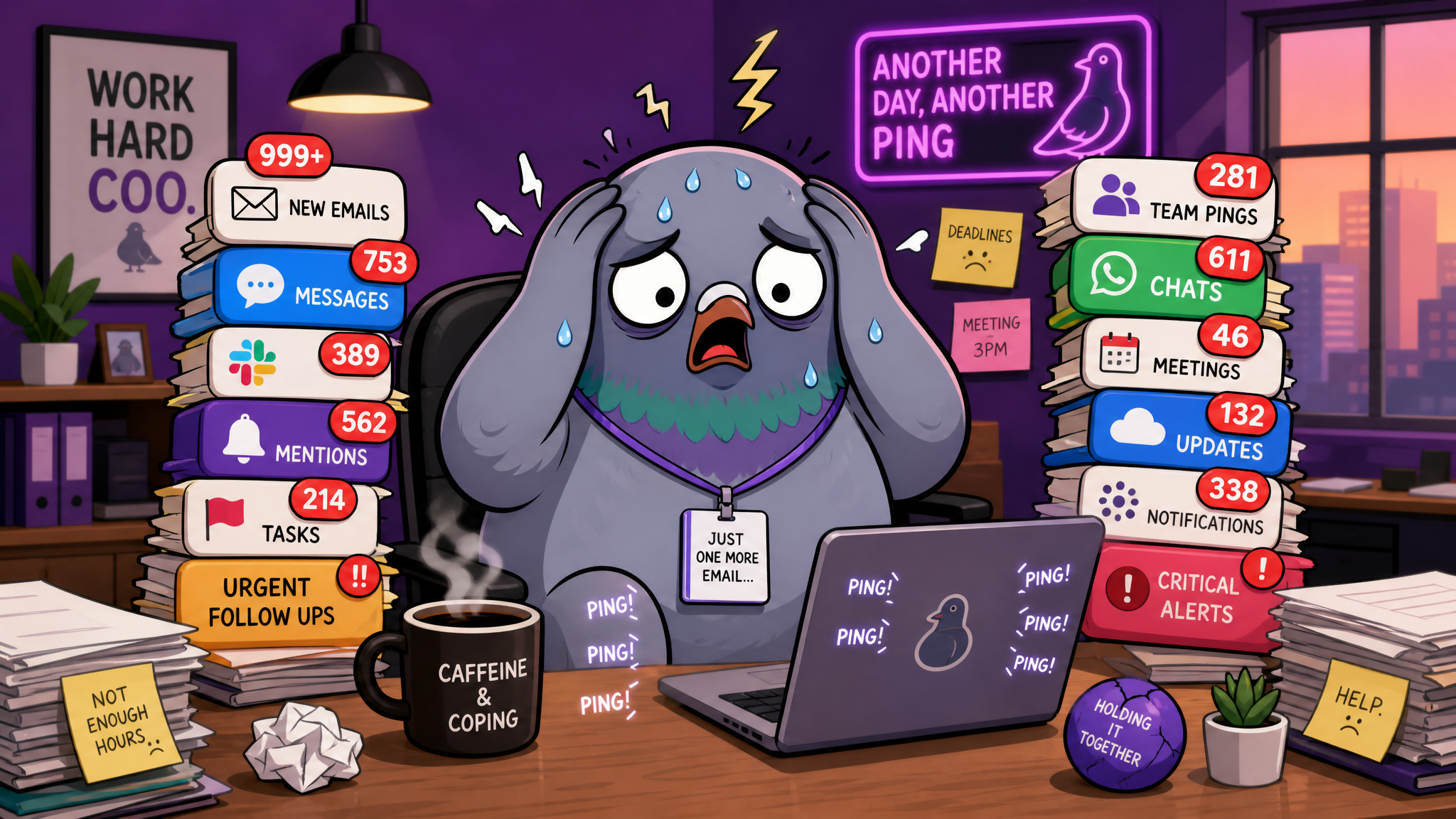
The average knowledge worker now receives over 200 messages per day across workplace messaging platforms. That's one message every 2.4 minutes during an 8-hour workday. Each message triggers a notification, a context switch, a decision (respond now or later?), and a return to whatever you were doing before. By 3 PM, you're mentally exhausted — and you've barely touched your actual work.
Messaging burnout isn't about laziness or inability to handle communication. It's the predictable result of a system designed for real-time responsiveness applied to a workforce that also needs to think deeply, create, and solve complex problems.
The Real Cost of Message Overload
Microsoft's 2025 Work Trend Index revealed that employees who experience high messaging volume report 47% lower productivity and 56% higher stress levels. The research is clear: more messages do not equal better communication. In fact, the relationship is often inverse — the more messages a team sends, the less aligned and productive they tend to be.
The cost isn't just individual. Teams that over-rely on messaging create information silos (important decisions buried in chat history), duplication of effort (asking the same question in multiple channels), and a culture of performative responsiveness (appearing busy by typing rather than actually working).
Identifying Your Burnout Triggers
Messaging burnout manifests differently for different people. Common symptoms include:
- Notification dread — That sinking feeling when you see unread message counts climbing
- Phantom vibrations — Feeling your phone buzz when it hasn't, because your nervous system is conditioned to expect messages
- Decision fatigue — Inability to decide which messages to respond to first, leading to paralysis
- After-hours anxiety — Compulsively checking work messages outside business hours
- Communication avoidance — Delaying responses not out of busyness but out of exhaustion
Strategy 1: Batch Your Communication
The single most effective strategy for reducing messaging burnout is batching — checking and responding to messages in defined blocks rather than continuously. Set three daily check-in windows: morning, midday, and late afternoon. Between these windows, close your messaging app entirely.
This feels radical at first, but the reality is that very few workplace messages are genuinely time-sensitive. Most can wait 2-3 hours without any negative consequences. The messages that truly can't wait should be escalated via phone call or in-person conversation — and establishing this norm actually improves response to genuine emergencies.
Strategy 2: Write Better Messages
Much of workplace messaging burnout is caused by low-quality messages that generate unnecessary back-and-forth. A message that says "Hey, got a sec?" creates anxiety and requires a response before any actual information is exchanged. A message that says "When you have a chance, could you review the Q3 report? Specifically looking for feedback on slide 7. No rush — by Thursday works" communicates everything the recipient needs in a single message.
The BLUF principle (Bottom Line Up Front) works wonders: lead with what you need, then provide context. This reduces message chains dramatically.
Strategy 3: Channel Discipline
If your team uses a platform with multiple channels, strict channel discipline is essential. Every message should go to exactly one appropriate channel. Random messages in general channels create noise for everyone. Create a clear channel map: which topics go where, what each channel is for, and which channels require monitoring versus which are optional.
Ruthlessly leave or mute channels that aren't relevant to your work. You're not obligated to monitor every channel just because you were added to it.
Strategy 4: Normalize Slow Responses
The culture of instant response is the root cause of messaging burnout. Actively work to normalize delayed responses within your team. When you respond to a non-urgent message hours later, you're not being rude — you're modeling healthy communication patterns.
Some teams have adopted response-time expectations by channel: #urgent (within 30 minutes), #projects (within same business day), #general (whenever you get to it). Making these expectations explicit removes the pressure to respond instantly to everything.
Strategy 5: Move Conversations Off Messaging
If a message exchange has gone back and forth more than 5 times, it should become a call or meeting. Long text-based discussions are inefficient and exhausting. A 5-minute call can resolve what 30 minutes of typing cannot.
Similarly, complex decisions, emotional conversations, and performance feedback should never happen over messaging. These require the richness of voice tone and real-time dialogue that text strips away.
Strategy 6: Protect Your Focus Time
Block "no-meeting, no-messaging" focus time on your calendar. During these blocks, set your status to unavailable and close all messaging applications. Protect this time as fiercely as you would protect a meeting with your CEO. Your deep work is just as important — more so, probably.
Building a Healthier Team Communication Culture
Individual strategies help, but lasting change requires team-level shifts. Have an honest conversation with your team about messaging norms. Agree on response time expectations. Establish quiet hours. Celebrate thorough, well-written messages over rapid-fire pings. Measure team success by outcomes, not message volume.
Messaging is a tool, not a lifestyle. When wielded with intention and discipline, it enhances collaboration. When left unmanaged, it replaces collaboration with an exhausting performance of availability. The difference is entirely in how you choose to use it.

Writer & Editor at PigeonChat
Related Articles
Best Free Team Chat App for Small Businesses and Remote Teams in 2026

Best Free Team Chat Apps for Small Businesses in 2026
The Best Slack Alternatives in 2026: Free Team Chat Apps

Best Business Group Chat Apps in 2026: How Teams Actually Communicate
Why chat folders matter for busy group conversations