Understanding Metadata: The Privacy Risk Hiding in Your Messages
Even with encryption, your messages reveal more than you think. Metadata — the data about your data — can expose who you talk to, when, and where. Here's what it is and how to protect yourself.
Here's a privacy fact that surprises almost everyone: even if no one can read the contents of your messages, they can still learn an astonishing amount about your life. The secret lies in something called metadata — the quiet, invisible data about your data. And in many ways, metadata can be even more revealing than the words you actually type.
Most privacy conversations focus on encryption: protecting the content of messages so only the intended recipient can read them. That's vital. But metadata is the blind spot that even privacy-conscious people overlook. Understanding what it is, why it matters, and how to protect yourself is one of the most important steps you can take toward genuine digital privacy. Let's pull back the curtain.
What Exactly Is Metadata?
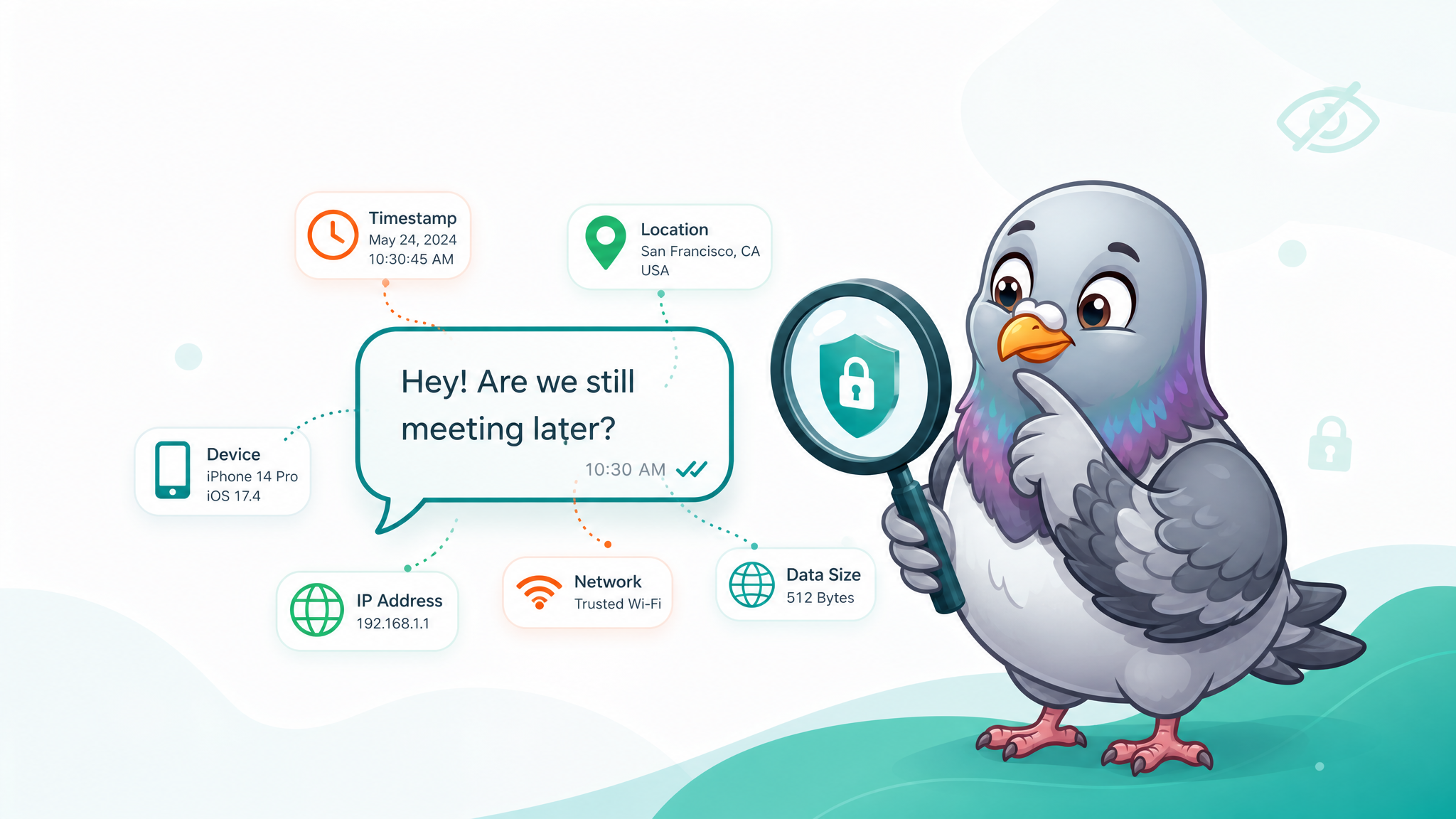
Metadata is information that describes other information. In the context of messaging, it's everything about a message except the actual content. Think of a sealed envelope sent through the post. Encryption is like sealing the envelope so no one can read the letter inside. But the outside of the envelope still shows the sender, the recipient, the postmark date, the origin and destination locations, and the size of the letter. That's metadata — and it tells a story all by itself.
For your digital messages, metadata can include:
- Who you communicated with — the identities of the people in your conversations.
- When you messaged — precise timestamps of every interaction.
- How often and how long — the frequency and duration of your contact.
- Where you were — location data tied to your messages or device.
- What device you used — your phone model, operating system, and network.
- The size and type of what you sent — whether it was a quick text, a long voice note, or a large file.
Why Metadata Is So Revealing
It's tempting to think, "So what? They know I messaged someone at 9pm — who cares?" But metadata becomes extraordinarily powerful when aggregated over time. Patterns emerge that paint a detailed portrait of your life without anyone ever reading a single word.
Consider what metadata alone can reveal. The fact that you messaged a particular doctor's office, then a pharmacy, then a family member late at night suggests a health situation — no content required. A sudden flurry of late-night messages with one person, followed by messages to a lawyer, tells a story about your relationships. The locations and timestamps of your messages map your daily routine, your workplace, your home, and the places you frequent.
Security experts have long noted that metadata can be more revealing than content precisely because it's structured, easy to analyse at scale, and hard to disguise. Content is messy and ambiguous; metadata is clean and patterned. This is why protecting it matters so much.
The Two Kinds of Metadata You Should Know
1. Communication Metadata
This is the metadata generated by the act of messaging itself — who, when, where, and how often. It's typically handled by the messaging service, and how much of it is collected and retained varies enormously between apps. Some services hoover up and store vast amounts of communication metadata; privacy-respecting services deliberately minimise what they collect and keep.
2. File Metadata
This is the metadata embedded inside the files you share. A photo can contain the exact GPS coordinates where it was taken, the date and time, and the device used. A document can carry the author's name, edit history, and software details. When you share a file, you may be unknowingly handing over this hidden information along with it.
How to Protect Yourself From Metadata Exposure
You can't eliminate metadata entirely — some is inherent to how communication works — but you can dramatically reduce your exposure with the right choices and habits.
Choose a Service That Minimises Metadata Collection
This is the single most impactful decision. Some messaging providers are built to collect and retain as little metadata as possible, while others treat it as a valuable asset to be harvested. Look for services that are transparent about what they collect, that minimise data retention by design, and that don't build profiles of who you talk to. The right app does most of this protection for you automatically.
Strip Metadata From Files Before Sharing
Before sharing sensitive photos or documents, remove their embedded metadata. Many devices now offer an option to share images without location data. For documents, use built-in tools to inspect and clear hidden properties. This prevents you from accidentally revealing your home address through a photo's GPS tag.
Use Disappearing Messages
Self-destructing messages limit not just the lifespan of content but also the trail of data left behind. The less that persists, the less metadata accumulates over time.
Be Mindful of Location Features
Turn off location sharing when you don't need it, and be cautious about features that broadcast where you are. Your location is one of the most sensitive pieces of metadata you generate.
Limit Third-Party Access
Be careful about which apps and services you connect to your messaging, and review the permissions you grant. Every connection is a potential channel for metadata to leak.
The Bigger Picture: Why This Matters for Everyone
You might feel you have "nothing to hide," but metadata privacy isn't really about hiding — it's about dignity, autonomy, and protection from misuse. Detailed patterns of who you talk to and where you go can be exploited for manipulation, discrimination, surveillance, or simply sold to the highest bidder. Privacy is a right that protects everyone, not just those with secrets.
When you protect your metadata, you're not being paranoid. You're recognising that the shape of your communications — the patterns, the connections, the routines — is deeply personal, and deserves protection just as much as the words themselves.
How PigeonChat Approaches Metadata
At PigeonChat, we understand that true privacy goes beyond just encrypting message content — it means respecting the data about your conversations too. We're built on a privacy-first philosophy that means minimising what we collect and never treating your communication patterns as a product to be profiled and sold. Features like disappearing messages help limit the trail you leave behind, and our commitment to transparency means we're honest about how your data is handled.
We believe you shouldn't have to be a privacy expert to be protected. By choosing an app that takes metadata seriously, you get meaningful protection without having to think about it every day.
The Bottom Line
Metadata is the privacy risk hiding in plain sight. Even when your message content is locked away by encryption, the data about your conversations — who, when, where, and how often — can reveal a startlingly complete picture of your life. Understanding this is the first step toward protecting yourself.
Choose a service that minimises metadata collection, strip hidden data from the files you share, use disappearing messages, and be mindful of location features. Genuine privacy means protecting not just what you say, but the entire shape of how you communicate. Now that you know metadata exists, you're already ahead of most people — and far better equipped to protect what matters.

Writer & Editor at PigeonChat
Related Articles
What a European chat app should offer now

What an EU chat app needs beyond privacy claims
What a browser-based end to end encryption chat app needs
How PigeonChat.site fits the EU privacy app search
Why browsers are becoming the new private chat home