How PigeonChat Helps Bring Remote Communities Together: Bridging the Digital Divide in 2026
Discover how PigeonChat is connecting remote and underserved communities worldwide — from rural villages to diaspora networks — through privacy-first messaging, channels, and group features designed for people who need connection most.
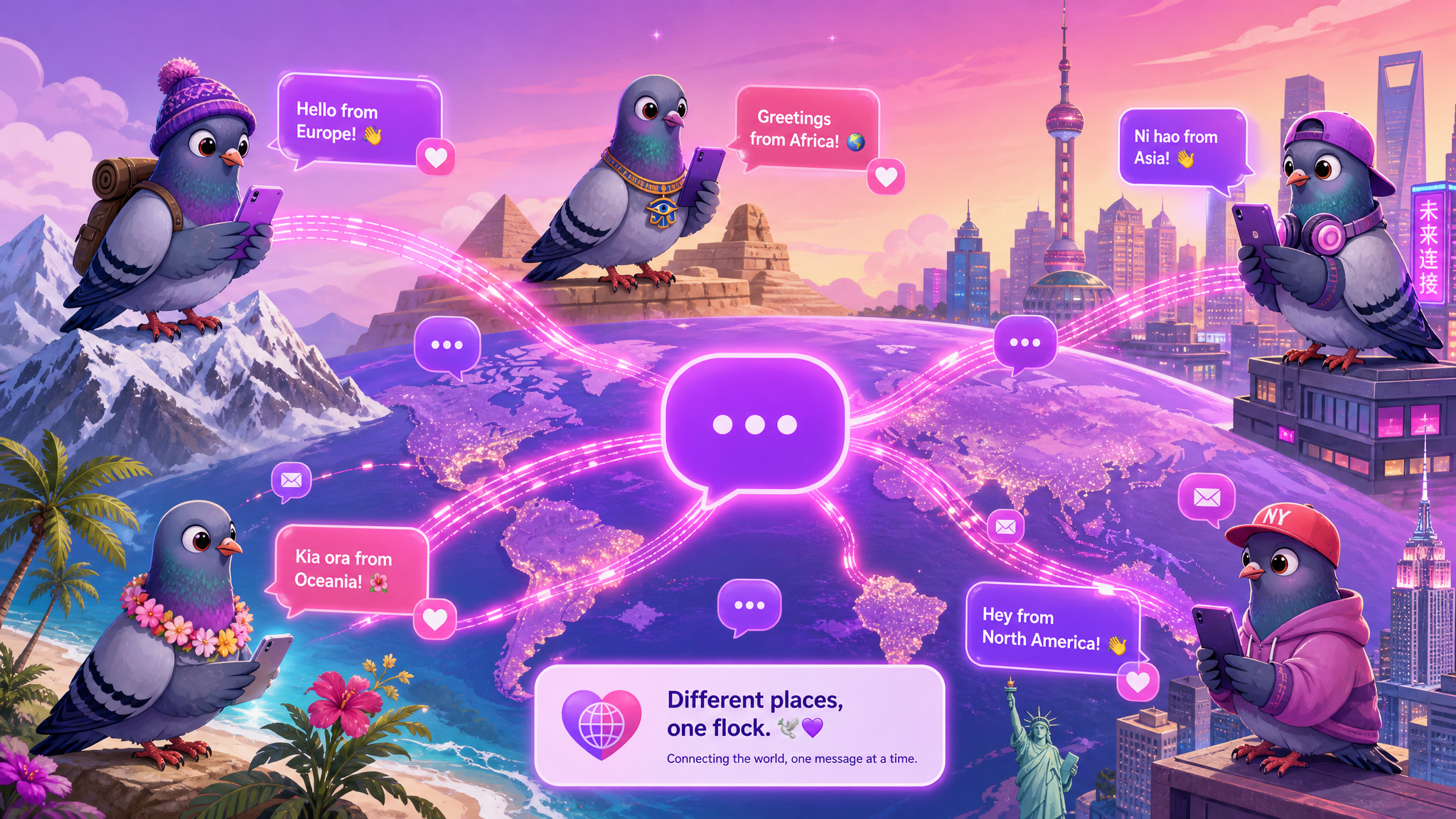
In a world where 4.9 billion people use messaging apps daily, it's easy to assume everyone is connected. But the reality is far more complicated. Hundreds of millions of people — living in remote communities, rural areas, island nations, and diaspora networks scattered across continents — struggle with the most basic digital need: staying in touch with the people who matter.
The digital divide isn't just about access to the internet. It's about whether the tools available actually work for communities that don't fit into the Silicon Valley mould. Mainstream messaging platforms like WhatsApp, Telegram, and Facebook Messenger were designed for dense urban populations with reliable broadband. They assume constant connectivity, unlimited storage, and a willingness to trade personal data for convenience.
PigeonChat was built with a different philosophy. We believe that private messaging should work for everyone — whether you're on a high-speed connection in London or a shared mobile hotspot in a mountain village in Nepal. This post explores how PigeonChat is helping remote communities stay connected, organised, and empowered.
The Invisible Crisis: Why Remote Communities Are Still Disconnected
When we talk about the digital divide in 2026, we're not just talking about whether someone owns a smartphone. We're talking about meaningful connectivity — the ability to participate fully in digital life, not just passively consume it.
According to the International Telecommunication Union (ITU), approximately 2.6 billion people still lack reliable internet access. But even among those who are "connected," millions face:
- Intermittent connectivity — Wi-Fi drops frequently, mobile data is expensive or throttled
- Device limitations — older smartphones with limited storage and processing power
- Language barriers — most apps default to English with limited localisation
- Platform lock-in — forced to use apps that harvest their data because "everyone else is on it"
- Cultural misalignment — features designed for Western social norms that don't translate to collectivist or community-centric cultures
These aren't edge cases. They represent hundreds of millions of people for whom mainstream chat apps simply don't work well enough.
How PigeonChat Approaches Community Building Differently
Most messaging apps are designed around individual conversations. You open the app, you message a friend, you close it. Community features — group chats, channels, broadcast lists — are afterthoughts, bolted on to platforms that were fundamentally built for one-to-one communication.
PigeonChat takes a different approach. From the very first line of code, we designed our platform to support communities as first-class citizens. Here's what that means in practice:
Group Chats That Actually Scale
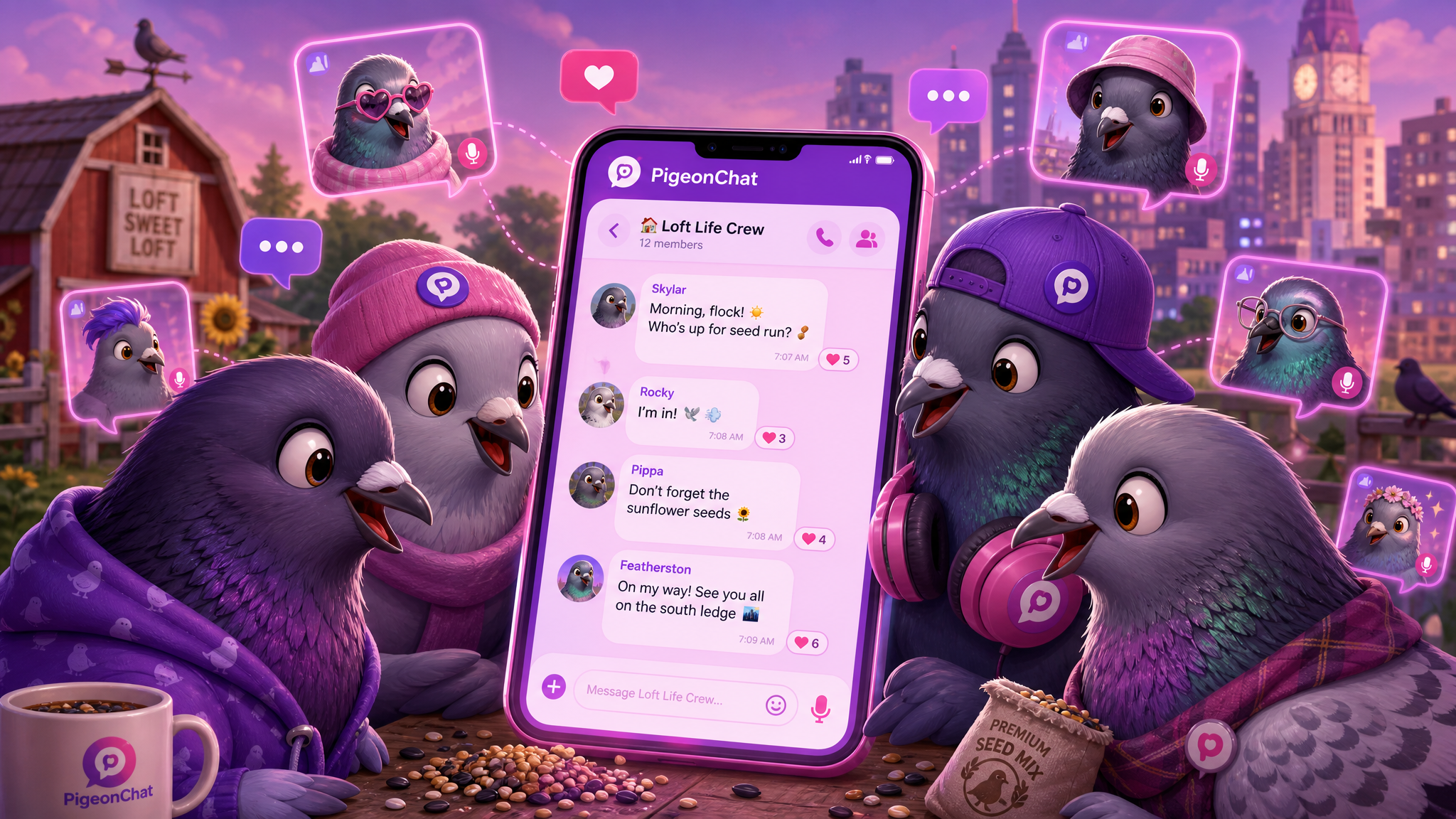
Many remote communities need to coordinate across dozens or even hundreds of members. Whether it's a village council, a farming cooperative, a diaspora support network, or a distributed volunteer team, the group chat is the digital town square.
PigeonChat's group chats support rich features without the bloat:
- Threaded replies — so conversations don't become an unreadable wall of text
- Pinned messages — critical announcements stay visible to everyone
- Read receipts — coordinators know who has seen important updates
- Admin controls — manage who can post, invite, or modify the group
- No phone number requirement — members join with email or username, protecting their privacy
Unlike WhatsApp groups that cap at 1,024 members and require phone numbers, or Telegram groups that become chaotic at scale, PigeonChat groups are designed for purposeful community communication.
Channels for One-to-Many Communication
PigeonChat Channels give community leaders a powerful broadcast tool. Unlike social media posts that get buried in algorithmic feeds, channel messages are delivered directly to subscribers with no algorithm deciding who sees what.
This makes channels perfect for:
- Local news — village updates, weather warnings, market prices
- Health information — vaccination drives, clinic hours, disease prevention
- Educational content — lesson schedules, homework assignments, exam results
- Emergency alerts — natural disaster warnings, evacuation routes, safety instructions
- Cultural preservation — sharing stories, songs, and traditions with younger generations
For remote communities where a single trusted leader often serves as the information hub, channels provide a structured, reliable way to reach everyone at once.
Stories That Build Community Identity
PigeonChat Stories let community members share moments from their daily lives — harvest celebrations, school graduations, religious festivals, local landscapes. Unlike Instagram or Facebook stories that are designed to drive engagement metrics, PigeonChat stories are private by default and visible only to your contacts.
For diaspora communities — people who have migrated away from their homeland but want to stay connected — stories provide a powerful emotional bridge. A grandmother in a Philippine village can share a video of her garden, and her grandchildren in Dubai see it instantly, without any algorithm deciding it's not "engaging enough" to show.
Real-World Impact: Communities Using PigeonChat
Connecting Diaspora Networks Across Borders
The global diaspora population — people living outside their country of origin — exceeds 280 million worldwide. For these communities, staying connected to family and cultural roots is a daily challenge.
Mainstream apps create friction: WhatsApp requires phone numbers (making it hard when family members change SIMs), Facebook Messenger ties communication to social media profiles that not everyone wants, and Telegram groups can feel impersonal at scale.
PigeonChat's username-based system means family members can stay connected regardless of which country's SIM card they're using. A single family group chat can include members in five different countries without anyone needing to share their phone number.
Rural Education Networks
In many developing regions, teachers and students rely on messaging apps for education delivery. During and after the pandemic, chat-based learning became a critical educational infrastructure, especially where video conferencing isn't feasible due to bandwidth limitations.
PigeonChat's lightweight design makes it ideal for educational networks:
- Text-first messaging works even on 2G/3G connections
- File sharing supports documents, PDFs, and images for lesson materials
- Voice messages let teachers explain concepts when typing isn't practical
- Group chats create virtual classrooms for each subject or grade level
Volunteer and Aid Coordination
Humanitarian organisations and volunteer networks operating in remote areas need messaging tools that are both secure and reliable. Sensitive information about vulnerable populations, supply chains, and operational logistics must be protected from surveillance.
PigeonChat's end-to-end encryption and no-phone-number requirement make it a strong choice for organisations operating in regions where communications may be monitored by hostile actors. Aid workers can create accounts using email addresses, communicate securely, and leave no phone-number trail.
Privacy-First Design: Why It Matters for Remote Communities
Privacy isn't a luxury — it's a necessity, especially for remote and marginalised communities. Here's why:
Protection from Surveillance
In many regions, governments and local authorities monitor communications on mainstream platforms. For indigenous communities, political minorities, religious groups, and LGBTQ+ individuals in hostile environments, message privacy can be a matter of personal safety.
PigeonChat's end-to-end encryption means that only the sender and recipient can read messages. We don't store message content on our servers, and we can't hand it over to anyone — because we don't have it.
No Data Harvesting
When Facebook Messenger or WhatsApp collects metadata about who you talk to, when, and how often, that data becomes a commodity. For remote communities with limited digital literacy, this extraction happens without meaningful consent.
PigeonChat doesn't monetise user data. Period. We don't sell metadata, we don't profile users for advertising, and we don't share information with third parties. Our business model is built on optional premium features, not on turning your conversations into someone else's revenue stream.
Identity Protection
Unlike WhatsApp and Signal, which require a phone number to register, PigeonChat allows sign-up with just an email address. This is critical for:
- Activists and journalists working in dangerous environments
- Domestic violence survivors who need to communicate without their number being traced
- Refugees and displaced persons who may not have a stable phone number
- Anyone who simply values their phone number privacy
Bridging the Digital Divide: PigeonChat's Technical Approach
Building a messaging app that works for remote communities requires more than good intentions. It requires deliberate technical decisions.
Lightweight by Design
PigeonChat is available as a Progressive Web App (PWA), which means users can access it directly from their browser without needing to download a large app from the Play Store or App Store. The PWA is significantly lighter than native apps — crucial for devices with limited storage.
For communities where every megabyte of storage matters, this is a game-changer. No more deleting photos to make room for app updates.
Works on Any Device
PigeonChat runs on any device with a modern browser — Android, iOS, Windows, macOS, Linux. There's no need for the latest flagship phone. If your device can open a web page, it can run PigeonChat.
Designed for Shared Devices
In many remote communities, devices are shared among family members or even neighbours. PigeonChat's account-based system (rather than phone-number-based) means multiple users can maintain separate accounts on the same device, simply by logging in and out.
The Social Architecture of Connection
Technology alone doesn't build community. It's the social architecture — the way tools are designed to facilitate human interaction — that determines whether a platform brings people together or pushes them apart.
PigeonChat's social architecture is built on three principles:
1. Intentional Interaction
There are no algorithmic feeds, no "suggested contacts," no "people you may know" nudges driven by data mining. Every connection on PigeonChat is intentional. You choose who to talk to, which groups to join, and what channels to follow. The platform respects your agency.
2. Equal Access
PigeonChat's core features — messaging, groups, channels, stories, voice messages, file sharing — are completely free. Premium features exist for those who want them, but they're never required. A community leader in rural Bangladesh has access to the same communication tools as a startup founder in Berlin.
3. Cultural Neutrality
We don't impose cultural assumptions about how people should communicate. PigeonChat supports text, voice, images, stickers, files, and video — because different cultures prefer different modes of expression. The expressive pigeon sticker packs are universally understood, transcending language barriers with humour and warmth.
Comparing PigeonChat to Other Messaging Apps for Community Use
Here's how PigeonChat stacks up against popular alternatives when it comes to serving remote community needs:
| Feature | PigeonChat | Telegram | Signal | |
|---|---|---|---|---|
| No phone number required | ✅ | ❌ | ❌ | ❌ |
| End-to-end encryption | ✅ | ✅ | ❌ (opt-in) | ✅ |
| PWA / browser access | ✅ | Limited | ✅ | ❌ |
| No data harvesting | ✅ | ❌ | Partial | ✅ |
| Channels | ✅ | ✅ | ✅ | ❌ |
| Free core features | ✅ | ✅ | ✅ | ✅ |
| Works on shared devices | ✅ | ❌ | ✅ | ❌ |
The Road Ahead: PigeonChat's Community Vision
We're just getting started. Our roadmap for remote community support includes:
- Offline message queuing — compose and queue messages when offline, automatically sent when connectivity returns
- Community directories — searchable local listings for services, contacts, and resources
- Multilingual interface — expanding language support based on community feedback
- Low-bandwidth mode — optimised for 2G/3G connections with compressed media and text-priority delivery
- Community moderation tools — empowering local leaders to manage their spaces effectively
How to Get Started
If you're part of a remote community, a diaspora network, a volunteer organisation, or any group that needs reliable, private, free messaging, getting started with PigeonChat takes less than two minutes:
- Visit pigeonchat.site
- Create an account with your email — no phone number needed
- Create a group for your community
- Share the invite link with your members
- Start communicating securely and privately
No app store downloads required. No personal data harvested. No algorithms deciding what your community sees.
Conclusion: Connection Is a Human Need, Not a Luxury
The ability to communicate freely and privately isn't a feature — it's a fundamental human need. For remote communities around the world, mainstream messaging apps have created an illusion of connectivity while extracting data, imposing cultural assumptions, and ignoring the unique challenges of life outside major cities.
PigeonChat exists to change that equation. We believe that a private messaging app should work for the farmer in rural India as well as it works for the executive in New York. We believe that community communication shouldn't require surrendering your phone number, your metadata, or your dignity.
Because when remote communities are truly connected — on their own terms, with their own tools, under their own control — extraordinary things happen. Knowledge spreads. Culture survives. People thrive.
And that's exactly what we're building. 🐦

Writer & Editor at PigeonChat