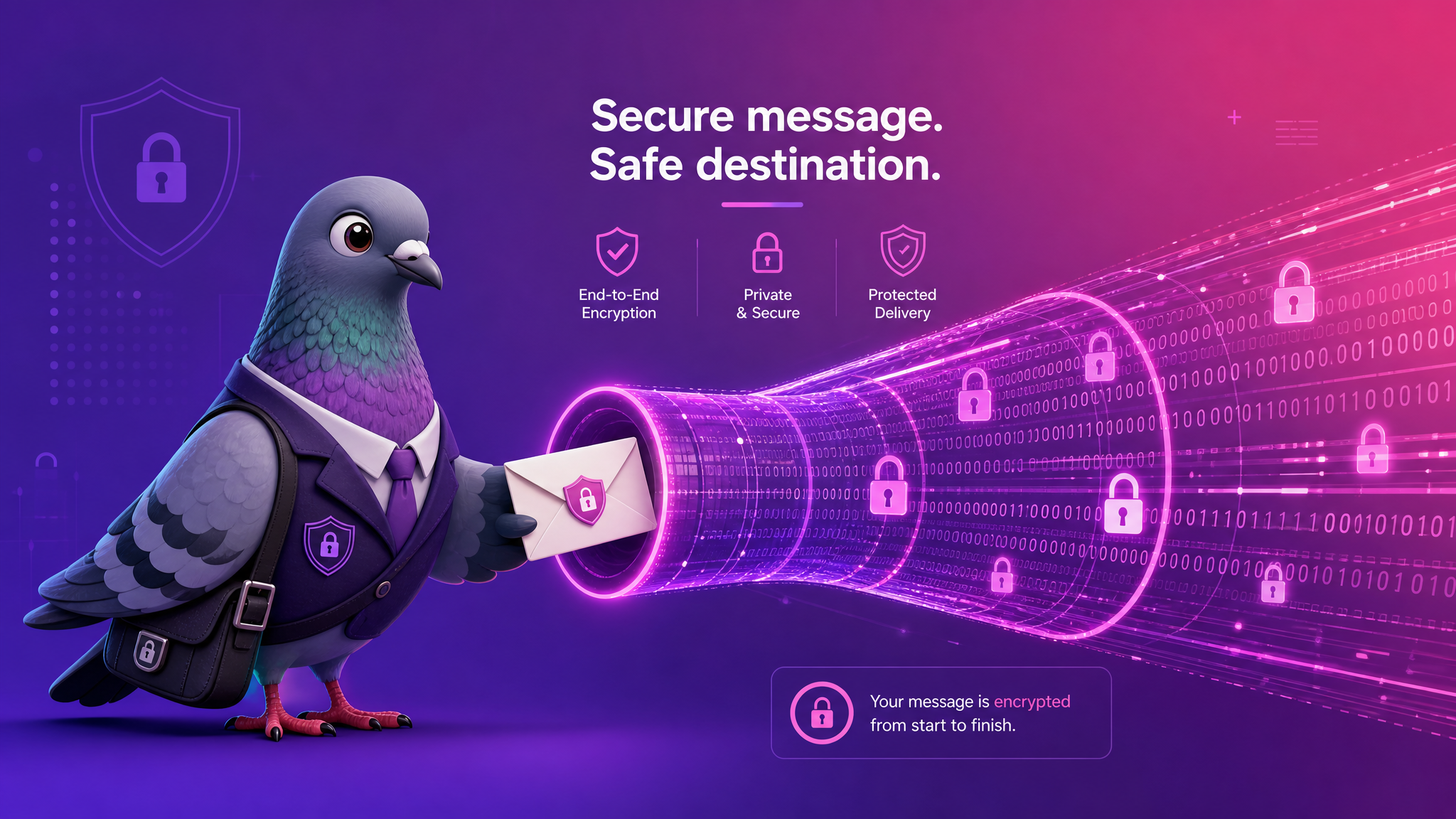
End-to-End Encryption Explained: How Secure Messaging Really Protects Your Privacy in 2026
A deep dive into how end-to-end encryption works, why it matters more than ever, and how PigeonChat and other messaging apps use it to keep your conversations truly private — explained in plain language.
In an era where data breaches make headlines weekly and governments worldwide debate surveillance legislation, the question of messaging privacy has never been more relevant. Whether you're sharing family photos, discussing business strategy, or simply texting a friend about dinner plans, you deserve to know exactly who can read your messages — and who can't.
That's where end-to-end encryption (E2EE) comes in. It's the gold standard of digital privacy, and it's the technology that separates truly secure messaging apps from those that merely claim to be safe. But what does it actually mean? How does it work under the hood? And can you really trust it?
This comprehensive guide breaks down everything you need to know about end-to-end encryption — from the cryptographic fundamentals to the real-world implications for your daily messaging habits.
What Is End-to-End Encryption? The Basics
At its core, end-to-end encryption is a method of securing communication so that only the sender and the intended recipient(s) can read the message. Not the app developer. Not the server hosting the data. Not your internet service provider. Not even a government with a court order.
Here's the simplest analogy: imagine putting a letter inside a locked box. You have the key, and your friend has an identical key. You send the box through the postal service. The postal workers can carry the box, but they can never open it or read what's inside. That locked box is end-to-end encryption.
How It Differs From Regular Encryption
Most websites and apps use encryption in transit (TLS/SSL — the padlock icon in your browser). This encrypts data between your device and the server. But here's the critical difference: the server itself can decrypt and read your data. It's like sending that letter in a sealed envelope — the postal service could steam it open if they wanted to.
With E2EE, the server never has the ability to decrypt. It handles encrypted blobs it cannot read. Even if a hacker breaches the server, or a company receives a legal subpoena, the messages remain indecipherable without the recipients' private keys.
| Feature | Encryption in Transit (TLS) | End-to-End Encryption (E2EE) |
|---|---|---|
| Encrypted between you and server | ✅ Yes | ✅ Yes |
| Server can read messages | ✅ Yes | ❌ No |
| Protected from server breaches | ❌ No | ✅ Yes |
| Protected from legal subpoenas | ❌ No | ✅ Yes |
| Only sender/recipient can read | ❌ No | ✅ Yes |
The Cryptography Behind E2EE: How It Actually Works
Understanding the mechanics doesn't require a computer science degree. The core concept relies on something called asymmetric cryptography, also known as public-key cryptography.
Step 1: Key Generation
When you install a secure messaging app like PigeonChat, your device automatically generates a pair of cryptographic keys:
- Public Key: This is shared openly. Anyone can use it to encrypt a message intended for you.
- Private Key: This never leaves your device. It's the only key that can decrypt messages encrypted with your public key.
Step 2: The Key Exchange
When you start a conversation, your device and the recipient's device exchange public keys. This usually happens automatically in the background. The server facilitates this exchange but never sees the private keys.
Step 3: Message Encryption
When you type "Hey, are you free for dinner tonight?" and hit send, here's what happens in milliseconds:
- Your app takes the plaintext message
- It encrypts the message using the recipient's public key
- The encrypted ciphertext is sent through the server
- The server stores and forwards the ciphertext — which looks like random gibberish
- The recipient's device uses their private key to decrypt it back to readable text
Step 4: Perfect Forward Secrecy
Modern E2EE implementations go even further with a concept called Perfect Forward Secrecy (PFS). Instead of using the same keys for every message, the protocol generates new temporary session keys for each message exchange. This means even if someone somehow obtains a private key, they can only decrypt that one specific message — not your entire conversation history.
The most widely used protocol for this is the Signal Protocol, originally developed by Open Whisper Systems and now used by Signal, WhatsApp, and many other apps including PigeonChat.
Why End-to-End Encryption Matters More Than Ever in 2026
The Rising Tide of Data Breaches
In 2025 alone, over 8.2 billion records were exposed in data breaches globally, according to cybersecurity firm Risk Based Security. Messaging platforms are high-value targets because they contain intimate personal information — relationship details, financial discussions, medical conversations, and location data.
Without E2EE, a single server breach could expose millions of private conversations. With it, breached servers yield nothing but encrypted noise.
Government Surveillance and Legal Pressure
Governments around the world have intensified efforts to gain access to encrypted communications. The UK's Online Safety Act, the EU's proposed "Chat Control" regulation, and similar legislation in Australia and India all seek to create mechanisms for law enforcement to access encrypted messages.
The technical reality, however, is that you cannot create a "back door" for law enforcement without creating one for hackers, foreign intelligence agencies, and malicious insiders. Encryption is either secure for everyone, or secure for no one.
Corporate Data Mining
Some messaging platforms — even popular ones — scan your messages to serve targeted advertising or train AI models. Without end-to-end encryption, your private conversations become a data source for corporate profit. E2EE ensures your messages are yours alone.
What E2EE Protects — and What It Doesn't
It's important to understand the boundaries of encryption. E2EE is powerful, but it's not a silver bullet for all security concerns.
E2EE Does Protect:
- Message content — text, images, videos, voice notes, files
- Against server-side breaches — compromised servers can't reveal your messages
- Against man-in-the-middle attacks — intercepted data is unreadable
- Against unauthorized access by the platform — the company can't read your chats
E2EE Does NOT Protect:
- Metadata — who you messaged, when, how often, and sometimes from where (though some apps minimize this)
- Device compromise — if someone has physical access to your unlocked phone, encryption is bypassed
- Screenshots — the recipient can always screenshot or photograph the screen
- Social engineering — phishing attacks trick you into revealing information voluntarily
- Backup vulnerabilities — cloud backups of chats may not be encrypted unless specifically configured
How PigeonChat Implements End-to-End Encryption
At PigeonChat, we believe privacy is a fundamental right, not a premium feature. Here's how we implement E2EE across every aspect of the platform:
All Messages Are E2EE by Default
Unlike some platforms that require you to manually start a "secret chat," PigeonChat encrypts every message, in every conversation, automatically. There's no "secure mode" because insecure mode doesn't exist. This includes:
- Text messages
- Images and videos
- Voice messages
- File attachments
- Sticker messages
- Group chats
Zero-Knowledge Architecture
Our servers are designed on a zero-knowledge principle. We store encrypted data we cannot read. We don't have a master key. We cannot decrypt your messages even if we wanted to — because the mathematical framework makes it impossible without your device's private key.
Key Verification
PigeonChat provides safety numbers — unique codes you can verify in person with your contacts to ensure no one is intercepting your key exchange. This prevents sophisticated man-in-the-middle attacks where an adversary might try to substitute their own public key during the exchange.
Comparing Encryption Across Popular Messaging Apps
Not all messaging apps treat encryption equally. Here's how the landscape looks in 2026:
| App | E2EE by Default | E2EE for Groups | Open Source Protocol | Metadata Collection |
|---|---|---|---|---|
| PigeonChat | ✅ All chats | ✅ Yes | ✅ Signal Protocol | Minimal |
| Signal | ✅ All chats | ✅ Yes | ✅ Signal Protocol | Minimal |
| ✅ All chats | ✅ Yes | ✅ Signal Protocol | Extensive (Meta) | |
| Telegram | ❌ Secret chats only | ❌ No | ❌ MTProto | Moderate |
| Facebook Messenger | ✅ Recently added | ⚠️ Limited | ✅ Signal Protocol | Extensive (Meta) |
| iMessage | ✅ Apple-to-Apple | ✅ Yes | ❌ Proprietary | Moderate |
| Discord | ❌ No | ❌ No | ❌ N/A | Extensive |
Common Myths About End-to-End Encryption
Myth 1: "Only Criminals Need Encryption"
This is perhaps the most dangerous myth. Everyone deserves privacy — just as you close the bathroom door not because you're doing something illegal, but because privacy is a basic human expectation. Encryption protects journalists, activists, abuse survivors, whistleblowers, businesses, and ordinary citizens alike.
Myth 2: "The Government Can Break Any Encryption"
Properly implemented modern encryption (AES-256, for example) would take a supercomputer billions of years to crack through brute force. Government agencies typically bypass encryption through other means — malware on devices, social engineering, or legal compulsion of the user — not by breaking the math itself.
Myth 3: "E2EE Makes Apps Slower"
Modern encryption operations are so fast that the encryption/decryption process adds less than a millisecond to message delivery. You'll never notice the difference in speed, but you'll benefit enormously from the security.
Myth 4: "If I Have Nothing to Hide, I Don't Need Encryption"
You have curtains on your windows. You have a PIN on your bank card. You whisper sensitive things to friends. Privacy isn't about hiding wrongdoing — it's about maintaining personal autonomy and dignity in a digital world.
How to Verify Your Messaging App Is Truly Encrypted
Don't just take an app's word for it. Here's how to verify:
- Check for open-source code: Apps that publish their encryption source code allow independent security researchers to verify the implementation. PigeonChat's encryption layer is fully auditable.
- Look for independent audits: Reputable apps commission third-party security audits and publish the results.
- Verify safety numbers: If the app provides a way to verify encryption keys with contacts (QR codes or number comparison), use it.
- Read the privacy policy: Does the company claim they "cannot read your messages"? Or do they say they "don't read your messages" (implying they could if they wanted to)?
- Check for E2EE in all contexts: Some apps encrypt only 1-on-1 chats but not groups. Some encrypt text but not media. True E2EE should cover everything.
The Future of Encrypted Messaging
Post-Quantum Cryptography
The biggest looming challenge for encryption is quantum computing. Theoretical quantum computers could break current asymmetric encryption algorithms. The cryptographic community is already developing post-quantum encryption standards — and forward-thinking messaging apps are beginning to implement hybrid encryption schemes that protect against both current and future quantum threats.
Decentralized Messaging
The next evolution may be fully decentralized messaging protocols that eliminate central servers entirely. Projects like Matrix/Element are exploring this space, where messages travel peer-to-peer or through distributed nodes, making surveillance even more difficult.
Encrypted AI Processing
An exciting development is homomorphic encryption — a technique that allows AI to process encrypted data without ever decrypting it. This could enable smart reply suggestions and AI features within messaging apps without compromising E2EE. The AI processes encrypted inputs and produces encrypted outputs, never seeing your plaintext messages.
Practical Tips for Maximum Messaging Security
- Use an E2EE messenger for everything: Make it your default. PigeonChat provides E2EE for all messages by default.
- Enable disappearing messages: Set messages to auto-delete after a period for sensitive conversations.
- Verify contact keys: Use safety numbers to verify you're really talking to who you think you are.
- Keep your app updated: Security patches fix vulnerabilities. Always run the latest version.
- Secure your device: Use a strong PIN, biometric lock, and enable full-disk encryption on your phone.
- Be cautious with backups: Ensure cloud backups of your chats are also encrypted.
- Watch for phishing: No encryption can protect you if you voluntarily share information with an attacker posing as someone you trust.
- Use two-factor authentication: Protect your messaging account itself with 2FA to prevent unauthorized login.
Why Privacy-First Messaging Matters for Society
Beyond individual benefits, end-to-end encryption serves a vital societal function. It enables:
- Press freedom: Journalists can communicate with sources without risking their exposure
- Democratic participation: Citizens can organize and discuss political views without fear of surveillance
- Business confidentiality: Trade secrets, strategy discussions, and client information remain protected
- Personal safety: Domestic abuse survivors, political dissidents, and LGBTQ+ individuals in hostile environments can communicate safely
- Innovation: Researchers and developers can share ideas freely without corporate espionage concerns
End-to-end encryption isn't just a technical feature — it's a cornerstone of digital freedom. At PigeonChat, we're committed to providing the strongest possible encryption while keeping the app intuitive, beautiful, and fun to use. Because security and simplicity aren't mutually exclusive — they're both essential.
Ready to experience truly private messaging? Download PigeonChat and start your first encrypted conversation today.

Writer & Editor at PigeonChat