Snapchat vs PigeonChat 2026: Ephemeral Messaging Meets Lasting Connections
Snapchat pioneered disappearing messages, but PigeonChat proves you can have privacy without sacrificing your conversation history. See how they compare in 2026.
The Disappearing Message Pioneer vs. The Complete Messenger
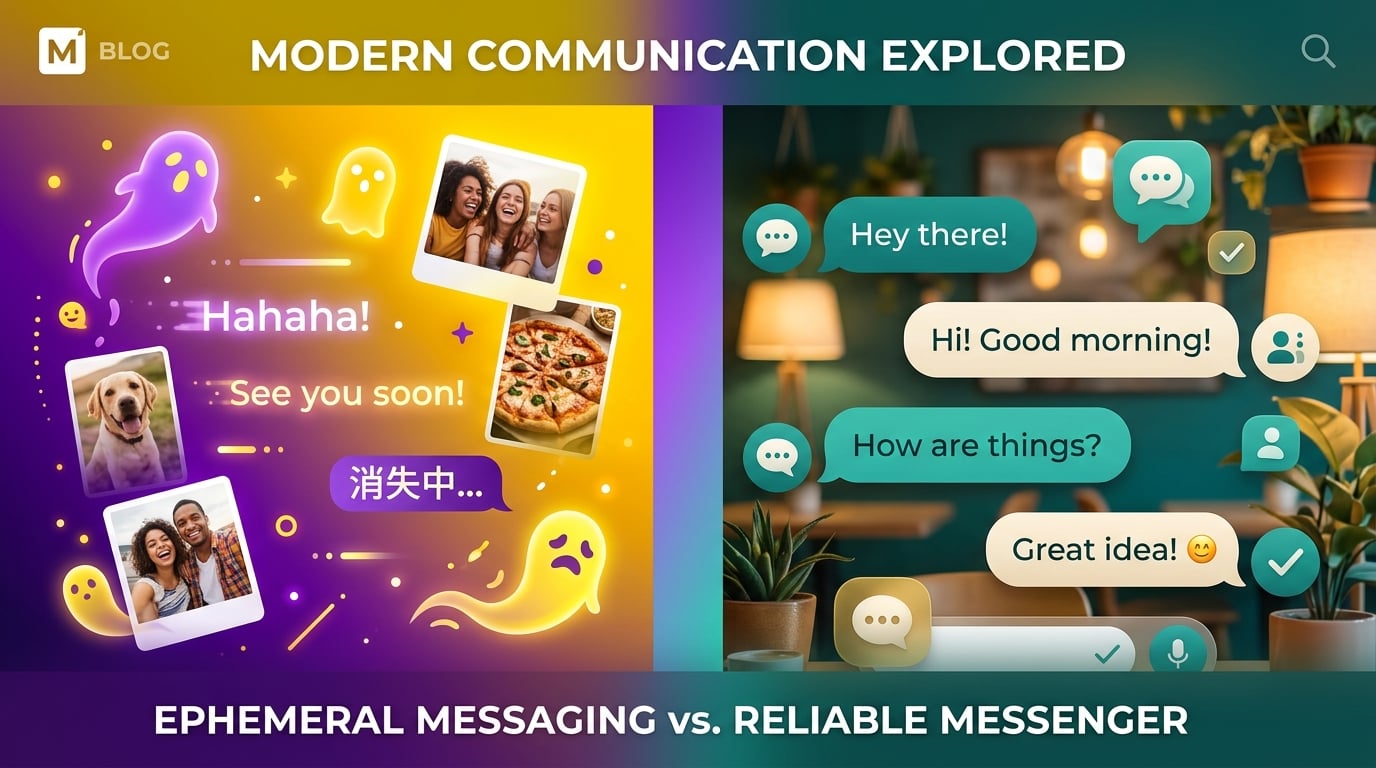
Snapchat revolutionized how we think about digital communication when it introduced disappearing messages back in 2011. The idea was simple but profound: not every message needs to live forever. Fast forward to 2026, and the messaging landscape looks dramatically different. PigeonChat has emerged as a comprehensive messaging platform that gives users control over message permanence — without forcing an all-or-nothing approach.
This comparison isn't about declaring a winner. Snapchat and PigeonChat serve overlapping but distinct audiences. However, if you're evaluating which platform better serves your daily communication needs in 2026, the differences matter more than you might expect.
Core Philosophy: Ephemeral vs. Flexible
Snapchat's DNA is built around impermanence. Messages disappear, stories expire after 24 hours, and the entire UX is designed around the assumption that content should be temporary. This creates a low-pressure environment for sharing casual moments — you don't need to worry about that silly face filter haunting you years later.
PigeonChat takes a fundamentally different approach. Your messages persist by default, giving you a searchable conversation history you can reference anytime. But here's where it gets interesting: PigeonChat also offers auto-disappearing messages for conversations where you want that ephemeral quality. You get to choose on a per-conversation basis, rather than having the platform decide for you.
This flexibility matters in practice. Think about how you actually use messaging throughout the day. Some conversations — coordinating dinner plans, sharing a quick reaction — don't need permanence. But others — sharing an address, discussing project details, exchanging important information — absolutely do. PigeonChat lets you handle both without switching apps.
Stories and Status Updates
Snapchat essentially invented the Stories format that every social platform subsequently copied. In 2026, Snap's Stories remain highly polished with a rich library of AR lenses, filters, Bitmoji integrations, and interactive elements. The creative tools are genuinely impressive — Snapchat has invested billions in AR technology, and it shows.
PigeonChat's Stories feature is newer and more streamlined. You won't find the same depth of AR filters, but you will find something Snapchat Stories lack: integration with your actual conversations. When someone views your PigeonChat story, there's a natural pathway into a conversation. Stories feel less like a broadcast and more like a conversation starter. The analytics tools also give creators insights into who's engaging with their content.
For users who primarily want Stories as a creative expression tool, Snapchat still leads. For users who want Stories as a way to stay connected with their chat contacts, PigeonChat's integration is more cohesive.
Privacy and Security Comparison
Snapchat's privacy approach centers on content impermanence. Messages disappear, and screenshot notifications alert you when someone captures your content. However, Snapchat's actual encryption implementation has drawn criticism from privacy researchers. Messages are encrypted in transit, but Snapchat retains the ability to access message content on their servers. The Snap Map feature, while useful, also raises location privacy concerns when users don't carefully manage their settings.
PigeonChat implements end-to-end encryption for all messages by default. Your conversations are encrypted before they leave your device, and only the intended recipient can decrypt them. PigeonChat cannot read your messages even if compelled to — they simply don't have the keys. Combined with optional disappearing messages, you get both technical privacy (encryption) and practical privacy (message expiration) without compromise.
Screenshot notifications? PigeonChat doesn't currently offer them, which is a legitimate trade-off. But the argument is that if messages are properly encrypted and you trust your contacts, screenshot alerts are solving a social problem with a technical band-aid.
Messaging Features Head-to-Head
| Feature | Snapchat | PigeonChat |
|---|---|---|
| Text Messaging | Basic, ephemeral by default | Rich text, persistent with optional auto-delete |
| Group Chats | Up to 200 members | Up to 512 members with admin controls |
| Voice/Video Calls | Yes, with AR lenses | Yes, with screen sharing |
| Message Search | Limited (messages disappear) | Full-text search across all conversations |
| Stickers | Bitmoji-based | Curated animated packs with custom pigeon mascot |
| Channels | Discover section | Full channel system with live streaming |
| Read Receipts | Yes | Yes, configurable |
| Typing Indicators | Yes | Yes |
The Audience Factor
Let's be honest about demographics. Snapchat's core audience skews younger — the platform dominates among 13-24 year olds in many markets. The streaks feature, the emphasis on daily engagement, and the gamification elements are designed to appeal to younger users who prioritize social status within the app.
PigeonChat attracts a broader age range, partly because it doesn't gamify communication. There are no streaks to maintain, no snap scores to obsess over. Communication is communication — not a game. For users who find Snapchat's engagement hooks more stressful than fun, PigeonChat's straightforward approach is refreshing.
That said, PigeonChat's sticker system and Stories feature ensure the platform isn't boring. There's personality and fun built into the experience — it's just not designed to create anxiety about maintaining daily engagement metrics.
Platform Stability and Performance
Snapchat has historically had significant performance differences between iOS and Android. The Android app, while dramatically improved from its early days, still occasionally feels like a second-class citizen compared to the iOS version. Battery drain and storage usage remain common complaints.
PigeonChat is built as a cross-platform application from the ground up. The web app, desktop client, and mobile versions share a consistent feature set and performance profile. Whether you're on an older Android device or the latest iPhone, the experience is functionally identical. This cross-platform parity matters for users who switch between devices throughout the day.
Who Should Switch?
If you use Snapchat primarily for AR lenses, creative Stories, and maintaining streaks with friends, PigeonChat probably isn't trying to replace that experience. Snapchat excels as a creative camera app with messaging attached.
But if you use Snapchat as your primary messaging tool and find yourself frustrated by disappearing messages, limited group functionality, or the inability to search past conversations, PigeonChat addresses every one of those pain points. You get the option of ephemeral messaging when you want it, plus the reliability of a full-featured messenger when you need it.
The question isn't really "which app is better" — it's "what do you actually need from your messenger?" If the answer is creative expression and ephemeral sharing, Snapchat remains strong. If the answer is reliable, private, feature-rich communication, PigeonChat is the clear choice.

Writer & Editor at PigeonChat
Related Articles

Viber, Telegram, and Messenger compared for private chat

Signal alternative chat app: what users actually want

What a true WhatsApp alternative should include
WhatsApp, Signal, Viber, and Telegram compared

Why chat folders matter for busy group conversations