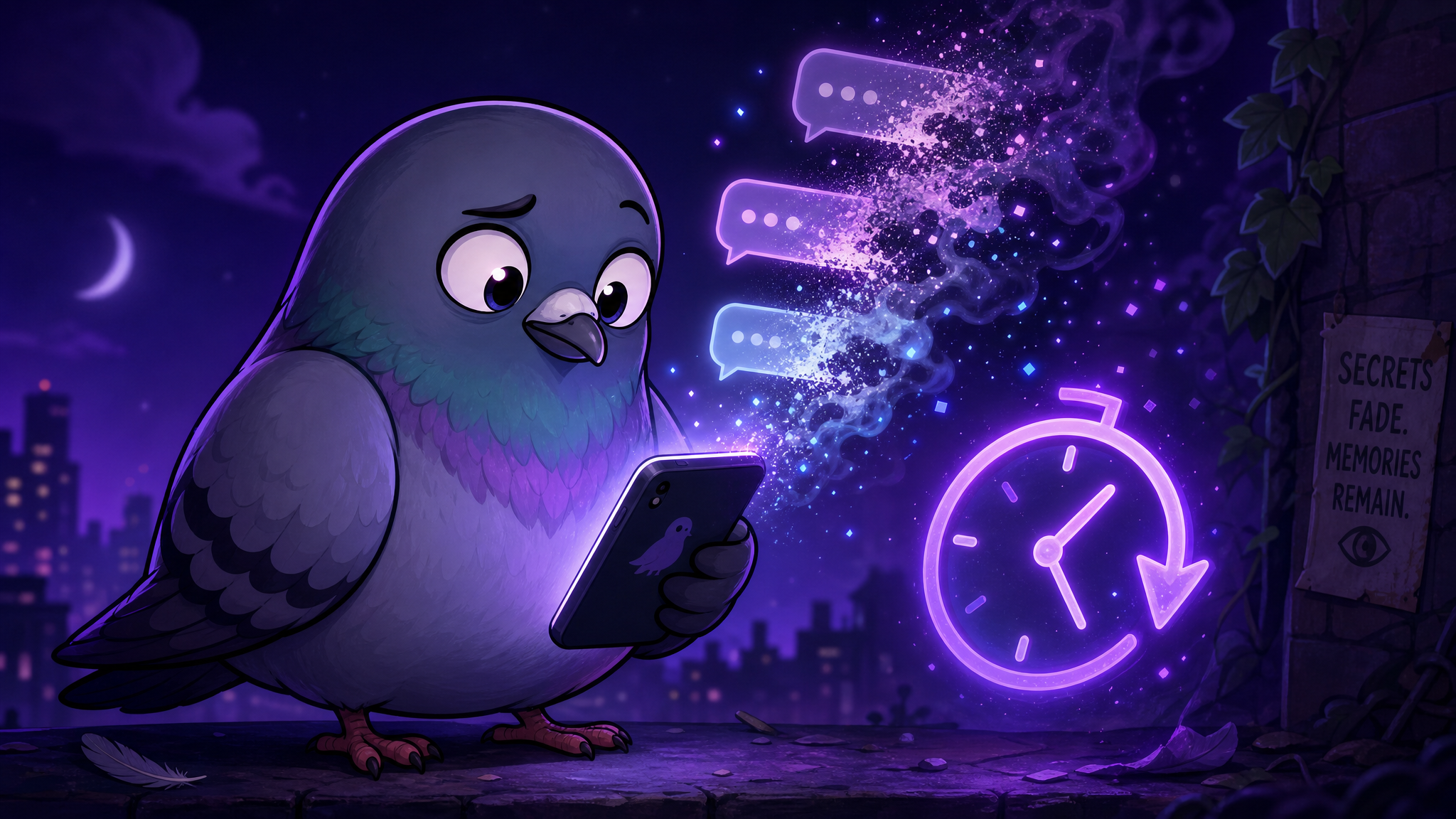
Why Disappearing Messages Are the Future of Private Communication
Explore the rise of ephemeral messaging — the psychology of impermanence, how disappearing messages work, and why self-destructing chats are becoming the gold standard for digital privacy.
Now You See It, Now You Don't: The Rise of Ephemeral Messaging
In a world where every tweet is archived, every photo is searchable, and digital footprints last forever, a quiet revolution is taking place. Disappearing messages — communications that automatically delete after being read or after a set time period — are rapidly moving from niche feature to mainstream expectation. And they might just be the most important innovation in digital privacy since end-to-end encryption.
From Snapchat's pioneering Stories to WhatsApp's disappearing messages to PigeonChat's auto-expiring conversations, the concept of impermanent digital communication is resonating with billions of users worldwide. But why? What's driving the demand for messages that vanish, and what does this trend mean for the future of how we communicate?
The Psychology of Impermanence
To understand why disappearing messages appeal to so many people, we need to understand the psychological burden of permanence. Every message you've ever sent exists somewhere — on servers, in backups, on recipients' devices. That knowledge, even when subconscious, shapes how we communicate.
Permanence creates self-censorship. When you know your words might be screenshotted, forwarded, or pulled up in an argument three years from now, you naturally filter what you say. You choose safer words, avoid vulnerability, and present a polished version of yourself rather than an authentic one.
Disappearing messages remove this weight. When you know a message will cease to exist after a certain time, you communicate more freely, more honestly, and more naturally. Research from Cornell University found that users of ephemeral messaging platforms report 31% higher levels of conversational authenticity compared to permanent messaging platforms.
This mirrors how humans have communicated for the vast majority of history. Spoken conversations — the primary mode of human communication for hundreds of thousands of years — are inherently ephemeral. Words are said, heard, processed, and then they fade. Permanent written records of everyday conversation are actually the historical anomaly, not the norm.
Privacy in the Age of Data Harvesting
The demand for disappearing messages is also driven by growing awareness of how digital data is collected, stored, and used. Every permanent message represents a data point — potentially valuable to advertisers, accessible to hackers, and available to legal discovery processes.
High-profile data breaches have made the risks tangible. When millions of private messages are exposed in a security breach, every user of that platform feels the vulnerability of permanent records. Disappearing messages offer a form of insurance — even if a platform is compromised, expired messages can't be leaked because they no longer exist.
The legal implications are significant too. In professional contexts, permanent messages can be subpoenaed, audited, and used as evidence. While this serves important accountability purposes, it also means that casual workplace banter or off-the-record discussions carry risks that their spoken equivalents don't. Disappearing messages in professional messaging tools offer a digital equivalent of the off-the-record conversation.
Privacy-conscious platforms like PigeonChat are leading the charge by integrating disappearing messages as a core feature rather than an afterthought. When ephemeral communication is built into the platform's DNA, users can trust that their privacy is a priority, not a marketing checkbox.
How Disappearing Messages Work: The Technical Reality
Not all disappearing messages are created equal. Understanding the technical differences between implementations helps users make informed choices about their privacy.
Timer-based deletion: Messages are deleted from all devices after a predetermined time period — 24 hours, 7 days, 30 days, etc. The timer typically starts when the message is sent. This is the simplest and most common implementation.
View-once messages: Messages are deleted immediately after the recipient opens them. This is ideal for sharing sensitive information like passwords, addresses, or financial details that only need to be communicated once.
Session-based expiry: All messages in a conversation are deleted when the conversation ends — similar to how a phone call leaves no record. This approach treats each conversation as a discrete, complete interaction.
Server-side vs. device-side deletion: Some platforms delete messages from their servers but leave copies on recipients' devices. Others delete from all locations simultaneously. True privacy requires both — server-side deletion protects against data breaches, while device-side deletion protects against device theft or unauthorized access.
It's important to understand the limitations. Screenshots can capture any message before it disappears. Some implementations notify the sender when a screenshot is taken, but this isn't a foolproof prevention mechanism. Disappearing messages reduce the risk of exposure but don't eliminate it entirely.
Use Cases: When Disappearing Messages Shine
Disappearing messages aren't appropriate for every conversation, but there are scenarios where they're invaluable:
Sensitive personal conversations: Discussions about health, finances, relationships, or other private matters benefit from the added protection of automatic deletion. You shouldn't have to worry that a vulnerable moment shared with a trusted friend could surface years later.
Professional brainstorming: Early-stage ideas, rough drafts, and blue-sky thinking are best shared without the pressure of permanence. Disappearing messages create a safe space for creative risk-taking without the fear that half-formed ideas will be taken out of context.
Sharing temporary information: Meeting locations, one-time passwords, flight details, hotel room numbers — information that's useful for a limited time and becomes a privacy risk when retained indefinitely.
Maintaining digital hygiene: For users who value a clean digital footprint, disappearing messages reduce the accumulation of stored data without requiring manual cleanup. Your messaging history stays relevant and manageable without periodic purging.
Conflict resolution: Heated conversations are less likely to escalate when both parties know the exchange won't be preserved as ammunition for future arguments. The impermanence encourages resolution rather than documentation.
The Generational Divide
Attitudes toward disappearing messages split notably along generational lines. Gen Z and younger Millennials, who grew up watching older generations suffer consequences from permanent social media posts, have embraced ephemeral communication enthusiastically. For them, impermanence isn't a feature — it's an expectation.
Snapchat's early success with this demographic proved the appetite. When given the choice between permanent and ephemeral communication, younger users overwhelmingly chose ephemeral for their casual social interactions. Instagram Stories overtaking Instagram posts in engagement was another data point confirming the trend.
Older users tend to be more ambivalent. Many value the ability to scroll back through years of messaging history — it serves as a digital memory bank, preserving conversations with loved ones, important decisions, and shared experiences. For these users, disappearing messages feel like losing something valuable.
The best messaging platforms accommodate both preferences, offering disappearing messages as an option rather than a mandate. Users can choose permanence or impermanence on a per-conversation basis, reflecting the reality that different conversations have different privacy needs.
Disappearing Messages and Trust
An interesting paradox surrounds disappearing messages and trust. On one hand, choosing to use disappearing messages signals that you trust the conversation to exist only between the participants — no screenshots, no forwarding, no saving. On the other hand, suggesting disappearing messages can sometimes trigger suspicion: "What do you have to hide?"
This paradox reflects a broader cultural tension between privacy and transparency. In healthy relationships — romantic, platonic, and professional — privacy and trust coexist. You can value someone's trust while also maintaining boundaries around what information persists indefinitely.
As disappearing messages become more normalized, the "something to hide" stigma is fading. Just as closing your bathroom door doesn't imply you're doing something wrong, choosing ephemeral communication is increasingly understood as a reasonable privacy preference rather than an admission of guilt.
The Business Case for Ephemeral Communication
Businesses are increasingly adopting disappearing messages for internal communication, driven by both privacy concerns and practical benefits.
From a legal perspective, fewer stored messages means less exposure in litigation discovery. Companies spend millions annually on document retention and discovery compliance — ephemeral messaging reduces this burden significantly.
From a security perspective, disappearing messages limit the damage of data breaches. If internal communications automatically expire, a compromised account yields far less sensitive information than one with years of message history.
From a cultural perspective, ephemeral messaging encourages more open internal communication. Employees who know their casual messages won't be permanently archived feel more comfortable sharing honest feedback, admitting mistakes, and engaging in the kind of candid communication that drives organizational improvement.
Challenges and Criticisms
Disappearing messages aren't without criticism. Law enforcement agencies argue that ephemeral communication hampers criminal investigations by destroying potential evidence. Regulators in the financial sector have raised concerns about accountability when business communications vanish.
There are also concerns about enabling harmful behavior. Disappearing messages can be used to evade accountability for harassment, threats, or deception. The same privacy that protects honest users also shields bad actors.
These are legitimate concerns that require thoughtful solutions rather than outright rejection of the technology. Options include regulatory exceptions for certain industries, abuse reporting mechanisms that preserve flagged messages, and legal frameworks that balance privacy rights with public safety needs.
What's Next for Ephemeral Messaging
The future of disappearing messages is evolving rapidly. Upcoming innovations include granular expiry controls (different timers for text, images, and files within the same conversation), AI-powered content classification that suggests appropriate retention periods, and blockchain-verified deletion that provides cryptographic proof that a message has been permanently removed.
Some platforms are experimenting with "fading" messages — text that gradually becomes harder to read over time, mimicking the natural fading of memory. Others are exploring "conditional permanence" — messages that remain accessible only while both parties keep the conversation active.
Embracing the Ephemeral
Disappearing messages aren't about secrecy — they're about reclaiming the natural impermanence of human conversation. For most of human history, words spoken between people lived only in memory. The digital age created an unprecedented exception to this rule, storing every casual thought alongside every important declaration.
Disappearing messages restore balance. They give us permission to be casual, vulnerable, imperfect, and spontaneous in our digital communication — just as we've always been in our spoken words. In a world that remembers everything, choosing to let some things go isn't just smart privacy practice — it's an act of digital wisdom.

Writer & Editor at PigeonChat
Related Articles
What makes an end to end encryption chat app secure

What a fully compliant EU chat app should include

Why people search for a WhatsApp alternative without a number
What end to end encryption chat really protects

Why chat folders matter for busy group conversations