7 Chat Apps That Don't Sell Your Data in 2026: Messaging Without the Surveillance
Tired of your messaging app selling your data to advertisers? These 7 chat apps in 2026 genuinely respect your privacy — no data harvesting, no ad targeting, no surveillance.
Here's an uncomfortable truth: if you're using a free messaging app from a major tech company, your conversations are almost certainly being used to build an advertising profile about you. WhatsApp shares your metadata with Meta. Facebook Messenger scans your messages for ad targeting. Google Messages collects data across your Google account. Even apps that claim to be "secure" often collect more data than you'd expect.
But it doesn't have to be this way. Several messaging apps in 2026 have built sustainable business models that don't depend on selling your data, scanning your messages, or feeding your communication patterns into advertising algorithms. These apps prove that it's possible to build a great messaging experience while genuinely respecting user privacy.
How Chat Apps Monetize Your Data
Before listing the alternatives, it's worth understanding exactly what popular chat apps do with your data. The methods are more sophisticated than most users realize:
- Direct message scanning: Some apps analyze your message content to serve targeted ads. Even without reading exact words, AI can infer topics, sentiments, and interests.
- Metadata harvesting: Who you talk to, how often, at what times, from which locations. This metadata creates a detailed behavioral profile even if message content is encrypted.
- Contact graph analysis: Your contact list reveals your social network — family relationships, professional connections, close friends — all valuable for ad targeting.
- Cross-platform tracking: Companies that own multiple products (Meta owns WhatsApp, Instagram, and Facebook) combine data across platforms for comprehensive profiling.
- Device fingerprinting: Your phone model, OS version, screen resolution, installed apps — all collected to identify and track you across services.
1. PigeonChat — Privacy With Personality
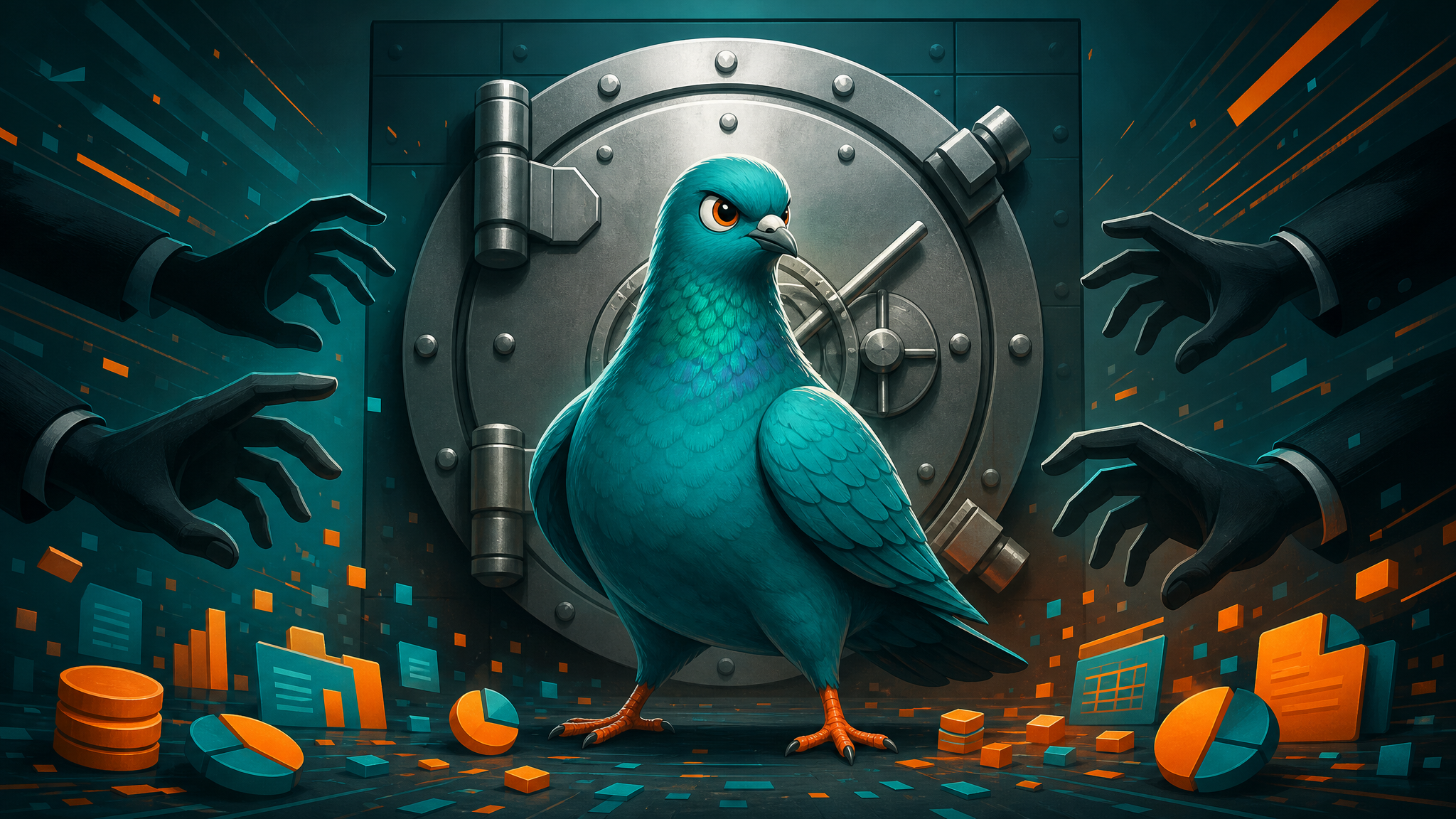
PigeonChat has built its entire platform around a simple principle: your conversations are yours, not ours. End-to-end encryption protects every message, file, and media shared through the platform. PigeonChat cannot read your messages, cannot analyze your conversation patterns for advertising, and cannot sell your data to third parties — because it doesn't have access to your data in the first place.
The business model is transparent: PigeonChat offers a free tier with all core messaging features and a premium subscription that unlocks additional sticker packs, enhanced file sharing, and exclusive features. Revenue comes from users who value the service enough to pay for extras — not from advertising or data monetization.
What makes PigeonChat particularly compelling is that privacy doesn't come at the cost of enjoyment. Animated sticker packs, Stories, channels with live streaming, and a playful pigeon mascot make the app genuinely fun to use. You don't feel like you're making a sacrifice by choosing a private messenger — you feel like you've upgraded.
Data collected: Email address (for account recovery). That's essentially it. No phone number required, no contact list uploads, no device fingerprinting for ad purposes.
2. Signal — The Nonprofit Standard
Signal is operated by the Signal Foundation, a 501(c)(3) nonprofit. The organization is funded by donations and a $50 million initial investment from WhatsApp co-founder Brian Acton. There are no investors demanding returns, no advertising business to feed, and no incentive to monetize user data.
Signal collects almost nothing: your phone number (required for registration, unfortunately) and the date you last connected to Signal's servers. That's it. No contact lists, no message metadata, no usage analytics. When the U.S. government subpoenaed Signal's records, the company could only produce two data points per user: phone number and last connection date.
Data collected: Phone number, last connection timestamp. Nothing else.
3. Threema — Pay Once, Private Forever
Threema's business model is refreshingly simple: you pay once for the app, and the company uses that revenue to operate the service. No advertising, no data mining, no venture capital investors pushing for growth-at-all-costs strategies.
Threema doesn't even know who you are. No phone number or email required — you get a random Threema ID. All messages are end-to-end encrypted using the NaCl cryptographic library. Threema's enterprise product provides additional revenue through business licensing.
Data collected: Random Threema ID. Phone and email can optionally be linked but are hashed before storage.
4. Wire — Enterprise-Funded Privacy
Wire's revenue comes from enterprise customers who pay per-user monthly fees for secure team communication. This business model funds the personal tier, which remains free to use. Wire doesn't show ads, doesn't sell data, and doesn't profile users.
The company is transparent about its architecture: all messages are end-to-end encrypted, the code is open-source, and independent audits verify the implementation. Wire is headquartered in Germany and complies with EU data protection regulations.
Data collected: Email or phone number (for registration), basic account metadata.
5. Session — Decentralized and Anonymous
Session takes data minimization to the extreme. Messages are routed through a decentralized onion-routing network — there are no central servers that could be compelled to produce data. No phone number, no email, no personal information of any kind is required to create an account.
Session is funded by the OPTF (Oxen Privacy Tech Foundation), a nonprofit. The business model relies on donations and grants rather than data monetization.
Data collected: Nothing. Literally nothing. No registration data, no metadata, no IP addresses.
6. Element (Matrix) — Federation for Privacy
Element, built on the open-source Matrix protocol, allows users to host their own servers — meaning your data never touches a corporate server at all. If you use the default Matrix.org server, the Matrix.org Foundation (a UK nonprofit) operates it without advertising or data sales.
Element Vector (the company behind Element) generates revenue through enterprise hosting and consulting. The consumer product is free and doesn't monetize user data.
Data collected: Depends on server — self-hosted means you control everything. Matrix.org collects basic account information.
7. Briar — Serverless Privacy
Briar eliminates servers entirely. Messages are transmitted peer-to-peer via Tor, Bluetooth, or Wi-Fi. There is no company that could sell your data even if it wanted to, because no company ever has your data. Everything is stored locally on your device.
Funded by grants and donations, Briar is a nonprofit project developed by the Briar Project. It's Android-only, which limits adoption, but the privacy protections are absolute.
Data collected: Nothing. No servers, no company, no data collection of any kind.
The Bottom Line
You shouldn't have to read your messaging app's privacy policy with a law degree to understand whether your data is being sold. In 2026, excellent alternatives exist that treat your conversations as genuinely private.
For most users, PigeonChat offers the ideal combination: strong encryption that keeps your data private, a sustainable business model that doesn't depend on selling your information, and a messaging experience that's genuinely enjoyable. You don't have to choose between privacy and fun — PigeonChat proves you can have both.
The choice is yours. But if your current messaging app is free, has no premium tier, and is owned by an advertising company — you're not the customer. You're the product.

Writer & Editor at PigeonChat
Related Articles

What makes an end to end encryption chat app secure

What a fully compliant EU chat app should include

Why people search for a WhatsApp alternative without a number

What end to end encryption chat really protects
Why chat folders matter for busy group conversations