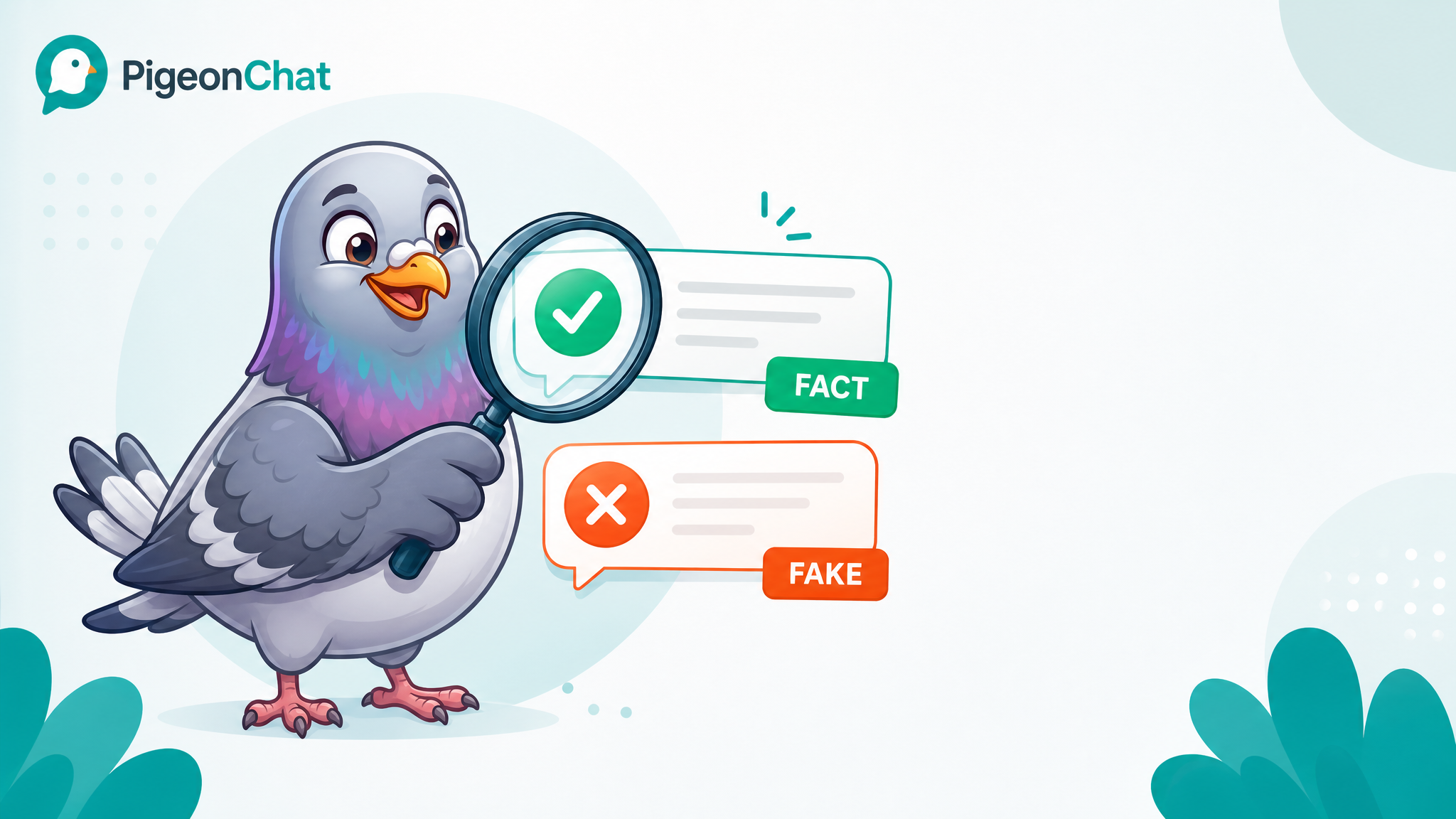
How to Spot Fake News and Misinformation in Group Chats
Group chats spread information faster than ever — including false information. Here's how to recognise misinformation, verify what you read, and stop the spread without the drama.
It usually starts innocently. A relative forwards a dramatic health warning. A friend shares a screenshot with a shocking claim. A community group lights up with breaking news that turns out to be anything but true. Group chats have become one of the fastest ways information travels — and that includes misinformation, which spreads just as easily as the truth, often faster.
The challenge is that false information in a group chat doesn't feel like a faceless internet rumour. It comes from people you know and trust, which makes it far more persuasive and far more likely to be believed and reshared. Learning to spot misinformation, verify what you read, and respond thoughtfully is now an essential digital skill. Here's how to do it.
Why Group Chats Are a Perfect Storm for Misinformation
Several forces combine to make group chats especially fertile ground for false information.
Trust transfers. When your aunt forwards something, you don't evaluate it as a stranger's claim — you evaluate it as something your aunt endorsed. That borrowed credibility lowers your guard.
Speed beats verification. Group chats reward fast resharing. A sensational message can reach hundreds of people before anyone stops to check whether it's actually true.
Emotion overrides logic. Misinformation is engineered to provoke strong feelings — fear, outrage, hope. When we're emotional, we're far less likely to pause and think critically.
Private spaces lack correction. Public posts often get fact-checked by strangers. A closed group chat has no such safety net, so false claims can circulate unchallenged.
The Warning Signs of Misinformation
You don't need to be an investigative journalist to catch most false information. A handful of red flags will help you spot the overwhelming majority of it.
1. It Triggers a Strong Emotional Reaction
If a message makes you instantly furious, terrified, or thrilled, treat that as a signal to slow down. Misinformation is specifically designed to bypass your rational mind by hitting your emotions hard. The stronger your gut reaction, the more important it is to verify before believing or sharing.
2. It Lacks a Credible Source
Real news points to verifiable sources — named organisations, official statements, identifiable experts. Misinformation tends to rely on vague attributions: "a doctor said," "scientists have proven," "my friend who works there told me." If you can't trace a claim back to a real, checkable source, be deeply skeptical.
3. It's a Screenshot or Forwarded Text
Screenshots and copy-pasted text are easy to fabricate and impossible to verify at a glance. Anyone can type alarming words and present them as a quote or an official notice. Be especially wary of "forwarded many times" messages with no original source.
4. It Demands Urgent Sharing
"Forward this to everyone you know immediately!" is one of the clearest hallmarks of misinformation. Legitimate information doesn't usually beg to be spread in a panic. That urgency is a manipulation tactic designed to make you act before you think.
5. The Details Don't Quite Add Up
Look for inconsistencies: dates that don't match, places that don't exist, claims that contradict basic logic, or images that seem unrelated to the story. Misinformation often falls apart under even mild scrutiny.
How to Verify Before You Believe
When something raises a red flag, a few quick checks will usually settle it.
- Search for the claim. If a major event really happened, credible sources will be reporting it. If only obscure or no sources mention it, that tells you something.
- Check the date. Old news is frequently recirculated as if it's current, causing needless alarm. Confirm when something actually happened.
- Trace the image. A reverse image search can reveal whether a photo is genuine, old, or taken completely out of context.
- Consult fact-checkers. Established fact-checking organisations exist precisely to investigate viral claims. A quick look often resolves the question.
- Ask the source. If a contact shared it, politely ask where they got it. Often they can't say — which is itself revealing.
How to Respond Without Causing Drama
Here's the delicate part. Correcting misinformation in a group chat — especially among family or friends — can feel awkward and even spark conflict. But staying silent lets falsehoods spread. The key is to correct with kindness, not condescension.
Assume good intent. The person who shared it almost certainly believed they were being helpful. Treat them as a well-meaning friend, not a villain.
Lead with curiosity, not accusation. "Interesting — I looked into this and it seems it might be outdated. Here's what I found" lands far better than "This is fake, stop sharing nonsense."
Share a credible source, not just an opinion. A calm link to a reputable explanation is far more persuasive than insisting you're right.
Consider a private message. Correcting someone privately spares them public embarrassment and makes them far more receptive.
Know when to let it go. Not every battle is worth fighting. If someone is determined to believe something, endless arguing rarely helps and often hardens their position.
Your Responsibility: Don't Be a Spreader
The single most powerful thing you can do about misinformation is to stop it at yourself. Before you forward anything, pause and ask: Do I actually know this is true? If the answer is no, don't share it. That one habit, practised by enough people, would dramatically slow the spread of false information.
Being the person who verifies before sharing isn't being a killjoy — it's being a trustworthy node in your community's information network. Your contacts learn that what you share is reliable, and that's a genuinely valuable reputation to have.
How PigeonChat Supports Healthier Conversations
At PigeonChat, we believe that a calm, respectful messaging environment makes it easier for people to think clearly and communicate honestly. Our clean, uncluttered design reduces the frantic, reactive atmosphere that fuels misinformation. Group admins have thoughtful tools to set norms, pin trustworthy resources, and gently guide conversations toward respect and accuracy.
We can't make people verify their sources — that's a human responsibility — but we can build a platform that encourages thoughtful, genuine connection over panic and noise. A healthier space makes for healthier conversations.
The Bottom Line
Misinformation thrives in group chats because it travels on the trust we have for the people we know. Protecting yourself and your community starts with recognising the warning signs: strong emotional triggers, missing sources, unverifiable screenshots, and demands for urgent sharing.
Verify before you believe, correct with kindness rather than contempt, and above all, refuse to forward anything you haven't confirmed. In a world where information moves faster than ever, being thoughtful isn't old-fashioned — it's one of the most valuable things you can be.

Writer & Editor at PigeonChat
Related Articles

What a European chat app should offer now
What an EU chat app needs beyond privacy claims
What a browser-based end to end encryption chat app needs
How PigeonChat.site fits the EU privacy app search

Why browsers are becoming the new private chat home