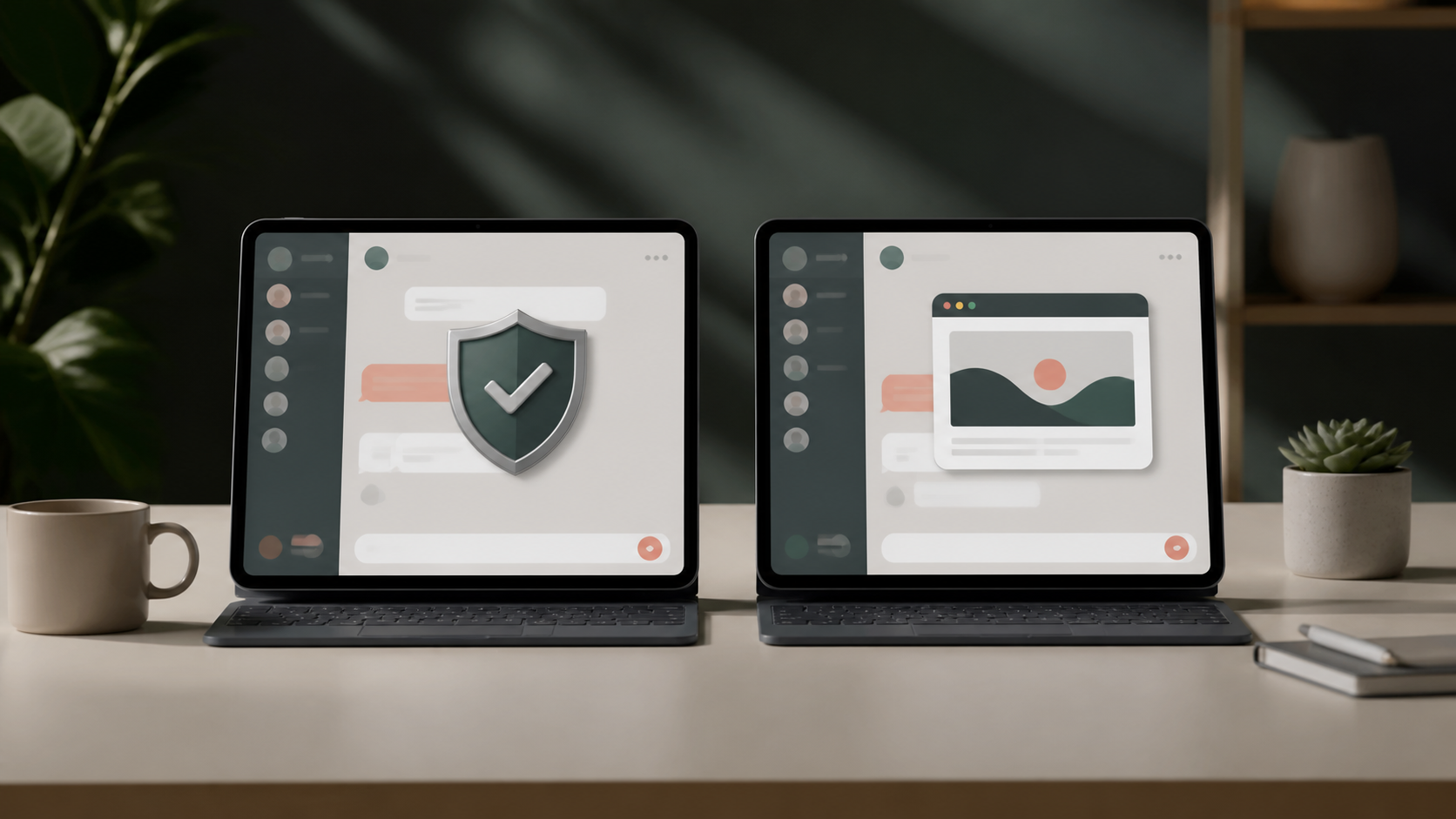
What a true Signal alternative chat app should include
Compare privacy, encryption, login flow, and usability to see what people really mean when they ask for a Signal alternative chat app.
If you are comparing a signal alternative chat app, the most important question is not whether it looks similar. It is whether it meets the same privacy expectations while being easier to use in the places people now communicate, especially in a browser.
That means more than end-to-end encryption. A real alternative chat app should be understandable at a glance, fast to start, reliable across devices, and careful about what it stores. If it is meant to stand alongside Signal, it should also respect the fact that many users are choosing privacy because they want less clutter, less tracking, and fewer surprises.
For people who want a simpler or broader browser experience, the bar is slightly different again. You do not just want secure messages. You want a chat app that opens quickly, works where you already are, and does not make private communication feel like a complicated project. That is the standard to keep in mind when judging any browser-first messenger, including PigeonChat.
Privacy is the first requirement, not an optional feature
A genuine signal alternative chat app must treat privacy as a design principle, not a marketing line. Messages should be protected in transit, and the app should avoid collecting more personal data than it needs to operate. If it asks for your contacts, your location, or broad device access, there should be a clear reason.
It is also worth thinking beyond message content. Metadata can matter just as much as the words themselves. Who can see when you signed in, how often you use the app, and what identifiers are tied to your account? A privacy-respecting app should be transparent about these points, even if the answers are not perfect.
When comparing options, ask whether the app gives you control over things like disappearing messages, notifications, blocked contacts, and account deletion. Good privacy is not only about hiding data. It is also about helping people reduce the traces they leave behind.
Encryption should be expected, but clarity matters too
End-to-end encryption is now a baseline expectation for serious private messaging. If an app claims to be a signal alternative chat app, it should explain in plain English what is encrypted, when it is encrypted, and what exceptions might exist. Vague promises are not enough.
Users do not need a technical lecture in order to make informed choices. They need a short, honest explanation of how messages are protected, whether group chats are included, and what happens on linked devices. The best privacy tools are the ones people can actually understand and use confidently.
It also helps when security settings are visible, not buried. A good app should make it easy to verify who is in a conversation, manage sessions, and spot unusual activity. If the privacy model is sound but the interface hides the controls, many people will never benefit from it.
A broader browser experience can be a real advantage
One reason people look for an alternative chat app is convenience across devices. A browser-based experience can remove friction for people who work on shared machines, move between operating systems, or simply prefer not to install another app. That does not mean security should be weakened. It means the product should be designed carefully for the browser from the start.
A strong browser experience should load quickly, stay stable on slower connections, and avoid unnecessary steps before you can read a message. Browser access is especially useful if the app supports a simple login flow, session management, and a layout that feels familiar without being cluttered.
This broader approach can also make private chat more accessible. Not everyone wants to manage yet another mobile install, desktop client, or synchronisation process. If a product like PigeonChat can make secure messaging feel lighter and more immediate in the browser, that is a genuine practical benefit rather than a gimmick.
What users should expect from the interface
Privacy alone does not make a chat app pleasant to use. A real signal alternative chat app should also be easy to read, easy to search, and quick to navigate. If people cannot find their conversations, adjust settings, or understand the difference between a private chat and a group, the app will feel frustrating no matter how secure it is.
Good interface design is often about removing small points of friction. Clear timestamps, obvious attachment controls, readable message spacing, and predictable menu labels all matter. These details help users trust the app because they know what is happening at every step.
In practice, the best apps also keep the experience calm. They avoid overloading the screen with alerts, badges, and social noise. Private communication works better when the interface gets out of the way and lets the conversation be the focus.
Practical features that deserve attention
When comparing any signal alternative chat app, it helps to think in terms of practical features rather than slogans. Not every feature needs to be there, but the important ones should be done well.
- End-to-end encryption with clear explanations of what it covers
- Minimal data collection and transparent privacy documentation
- Fast browser access without a complicated setup
- Reliable delivery of one-to-one and group messages
- Controls for blocking, muting, and deleting conversations
- Support for multiple devices where appropriate
- Simple account recovery or re-entry without exposing private data
It is also worth checking whether the app behaves sensibly when something goes wrong. Does it explain connection issues clearly? Does it preserve drafts? Does it keep your place in a conversation after a refresh? These are small things, but they are exactly what separate a polished app from a promising one.
For browser-first tools, compatibility matters too. A better app should work across modern browsers without forcing users into one ecosystem. That is part of what makes an alternative feel broader rather than narrower than Signal.
How to judge a true alternative in practice
The simplest test is this: does the app protect private communication while also making it easier to use in the environments people already rely on? If it does one but not the other, it is not yet a complete alternative. It may be secure, but not flexible. Or convenient, but not trustworthy.
A strong comparison also depends on honesty. No app is perfect, and no privacy model is magic. What matters is whether the product is clear about its trade-offs, respectful of the user, and thoughtfully built around actual communication needs rather than feature marketing.
That is why the phrase signal alternative chat app should mean more than "another messenger". It should mean a tool that matches privacy expectations, keeps the experience simple, and expands where and how secure chat can happen, especially in the browser.
Frequently asked questions
Is a browser-based chat app less private than a native app?
Not automatically. Privacy depends on how the app is designed, what data it stores, and how messages are protected. A browser-based app can still be a strong choice if it uses sound encryption, keeps data collection limited, and gives users clear control over sessions and account settings.
What should I look for before trying a Signal alternative chat app?
Focus on the basics first: encryption, transparent privacy terms, simple account controls, and a clear explanation of what data is stored. Then judge the day-to-day experience. A good alternative should be easy to use, quick to load, and not need extra effort just to send a private message.
Why does browser support matter so much?
Browser support makes secure messaging more flexible. It can be helpful on work machines, different operating systems, or devices where installing software is inconvenient. When done well, it lowers friction without sacrificing the privacy features people care about.
Ultimately, the best private chat tools combine restraint with usability. They do not ask for more trust than they earn, and they do not make security feel like a burden. That is the standard worth using when you compare any alternative chat app to Signal.
Ready to try PigeonChat?

Writer & Editor at PigeonChat
Related Articles

Best European based chat app for privacy first users

Best European based chat app for private messaging

WhatsApp, Telegram, Viber and Messenger compared for privacy

WhatsApp, Signal, Viber, and Telegram compared

What chat features users expect in modern private apps