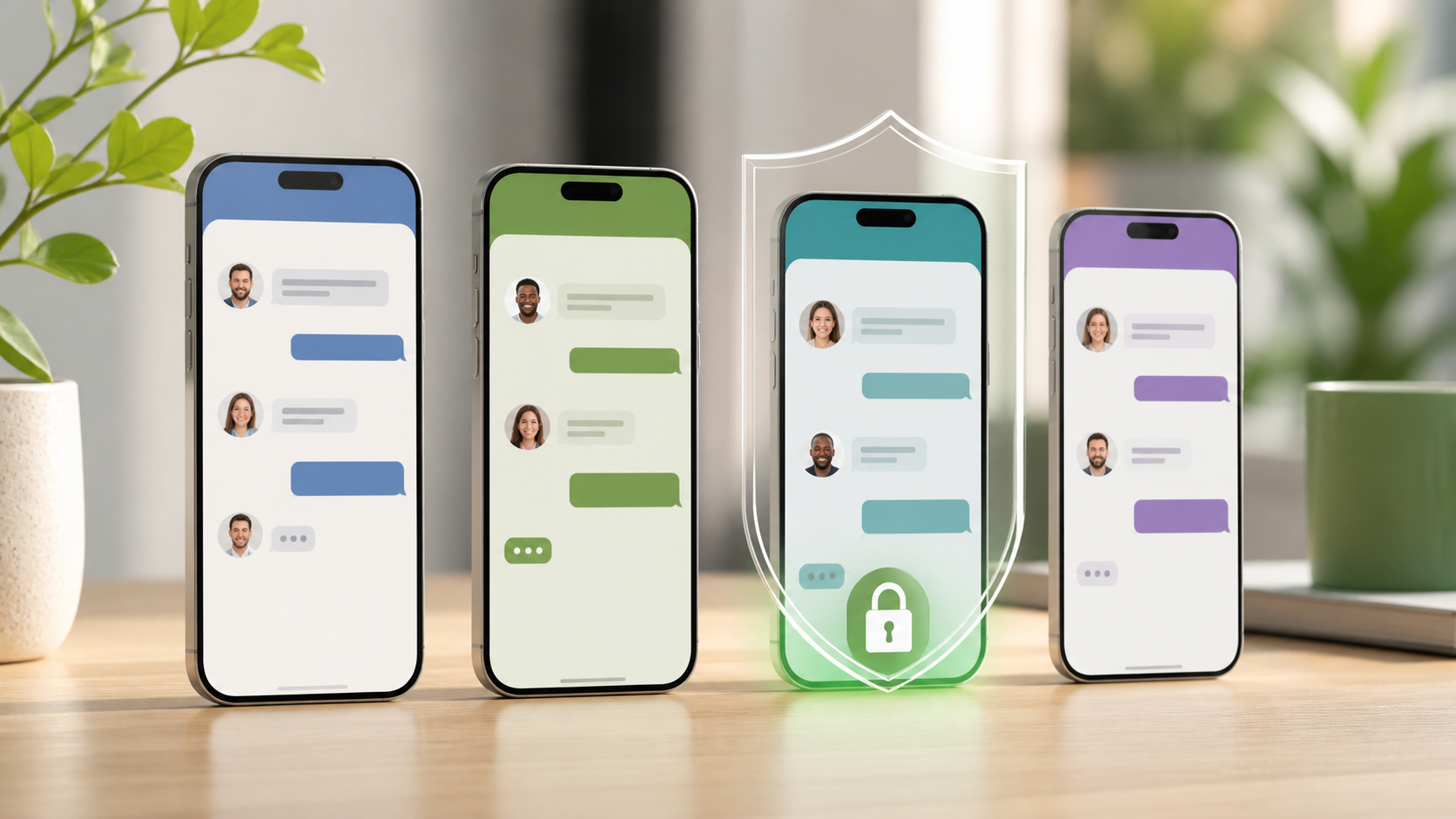
WhatsApp, Signal, Viber, and Telegram compared for privacy
A practical comparison of WhatsApp, Signal, Viber, Telegram, and PigeonChat for privacy, encryption, account setup, and everyday chat use.
Choosing the best private chat app is less about brand loyalty and more about trust. If you are comparing WhatsApp, Signal, Viber, and Telegram, the key questions are simple: who can read your messages, what data the app needs to work, and whether you can sign up without handing over a phone number.
There is no perfect option for everyone. Some apps are strong on end to end encryption chat by default, while others are better for large groups, channels, or convenience. The practical answer depends on what you want to protect and from whom. If privacy matters most, it helps to separate “secure transport” from “good metadata habits”, because those are not always the same thing.
This comparison keeps things grounded. Rather than treating every app as either “safe” or “unsafe”, it looks at where each one is easiest to trust, where it asks for more of you, and where compromises show up. That makes it easier to choose the right tool for your use case, whether you are a casual user, a privacy-conscious organiser, or someone who simply wants a quieter chat experience. PigeonChat takes a similar approach: practical privacy, with fewer assumptions baked in.
WhatsApp, Signal, Viber, and Telegram at a glance
For most people, the first question is whether messages are encrypted end to end. In plain terms, that means only the people in the chat can read the content. WhatsApp and Signal both offer end to end encryption chat for personal conversations, and Signal is widely viewed as the more privacy-focused of the two because it collects less account data and is built around minimising metadata.
Viber also supports end to end encryption for many personal chats, but it is less often the first choice for privacy-first users. Telegram is different: its regular chats are not end to end encrypted, only its Secret Chats are. That means Telegram can be convenient and feature-rich, but it is not usually the first answer if your main requirement is the best private chat app for sensitive conversations.
If you want the short version, think of it like this:
- Signal - strongest privacy posture overall, especially for personal chat.
- WhatsApp - good message encryption, but tied closely to Meta and more metadata-heavy.
- Viber - decent encryption features, but less compelling as a privacy-first default.
- Telegram - excellent for features and communities, weaker as a default private messenger.
What “privacy” really means in a private chat app
Privacy is not just about whether a message is encrypted in transit. It also includes who has to know your phone number, what contact data gets uploaded, whether chat backups are protected, and how much the service learns about who you talk to and when. Two apps can both say “encrypted” and still be very different in practice.
It also matters whether encryption is on by default or something you need to switch on for specific chats. A good end to end encryption chat app makes the secure path the normal path. If you have to remember extra steps, there is always a risk that an important conversation ends up in the less private mode.
For many readers, no-phone-number signup is the most meaningful privacy test. A phone number is often a persistent identifier that links your chat app account to your real-world identity or SIM history. If that matters to you, the comparison changes quite a bit.
Signal: easiest to trust for privacy first
Signal is usually the simplest recommendation when privacy comes first. It uses end to end encryption by default for messages and calls, and its design tends to avoid collecting extra information that it does not need. If you want a private messenger that does not try to become a social platform, Signal is the clearest fit.
The main drawback is that Signal still centres the phone number as the basic account identifier. That is workable for many people, but it is not ideal if you want to avoid sharing a number entirely. If you are comparing apps specifically on no-phone-number signup, Signal is strong on security but not the most flexible.
Signal is also relatively easy to explain to non-technical friends. That matters because privacy tools only help if the people you talk to will actually use them. In that sense, it is often the best balance between strong privacy and everyday usability.
WhatsApp: strong encryption, broader reach
WhatsApp is the app most people already have, which makes it practical. It does provide end to end encryption for personal chats and calls, so the content of those conversations is protected from casual interception. For many users, that is enough to make it feel like a private chat app.
The bigger issue is trust beyond message content. WhatsApp is part of Meta, so some users are uncomfortable with the broader data picture even when message content is encrypted. Phone number sign-up is also central to the experience, so it is not an ideal choice if you want to reduce the link between your account and your real identity.
If your priority is getting people into a secure conversation with the least friction, WhatsApp has a strong case. If your priority is the most privacy-preserving design, it is not the strongest choice.
Viber: capable, but not usually the first privacy pick
Viber supports encrypted chats and can be used for private communication, but it rarely comes out on top in privacy comparisons. One reason is simple visibility: fewer people treat it as their default secure messenger, so it is less often the first app privacy-conscious users install and test.
Like WhatsApp, Viber still relies heavily on phone numbers. That makes account setup easy, but it also means you are not getting the anonymity benefits that some users want from the best private chat tools. For everyday messaging, that may be fine. For sensitive work, it is a limitation worth noting.
If your contacts already use Viber, it can be a reasonable option. If you are starting from scratch and privacy is the main criterion, Signal is usually the better place to begin.
Telegram: feature-rich, but not the same as private by default
Telegram is often misunderstood because it feels secure and modern, but its default chats are not end to end encrypted. That means Telegram can access the contents of standard cloud chats in ways that Signal and WhatsApp cannot for their default personal chats. Telegram does offer Secret Chats, and those are the privacy-focused mode, but they are not the default experience.
This makes Telegram excellent for large groups, channels, and convenience, but less compelling as a default private messenger. If your goal is the best private chat app for sensitive one-to-one conversations, Telegram needs more care and more user discipline than Signal. That extra step matters, because privacy tools work best when the safe setting is automatic.
Telegram also sits awkwardly in no-phone-number discussions. Depending on how you set things up and what features you use, you may still need to think carefully about account linkage and discoverability. It is useful, but it is not the obvious first choice for privacy-first users.
No-phone-number signup and metadata concerns
If you care about privacy, the phone number question is often more important than people expect. A number can make it easier for others to find you, but it can also create a durable link between your messenger account and your identity. That is why no-phone-number signup is a major feature for some users, even if they do not care about anonymity in a dramatic sense.
Among the apps in this comparison, Signal, WhatsApp, Viber, and Telegram all have different relationships with phone numbers, but none of them is designed around complete detachment from identity in the way some privacy-focused tools are. If that is your core goal, you may want to look beyond the big mainstream names.
For people exploring that space, the useful question is not just “is it encrypted?” but “what can the service infer about me?” This is where smaller privacy-first products, including PigeonChat, try to make the trade-offs more explicit.
Frequently asked questions
Which app is the best private chat overall?
For most privacy-focused users, Signal is the easiest recommendation. It offers end to end encryption by default and is designed to minimise unnecessary data collection. If you want the simplest “trust this first” answer, Signal usually wins.
Is WhatsApp safe because it has end to end encryption?
WhatsApp’s message content is protected by end to end encryption, which is good. But privacy is broader than message content alone. You should also consider metadata, account linkage, backups, and the fact that it is part of Meta’s ecosystem.
Can I use Telegram for private conversations?
Yes, but only if you use Secret Chats, and even then it is not as privacy-forward as Signal by default. Standard Telegram chats are not end to end encrypted, so it is better to treat Telegram as a feature-rich messaging platform rather than your default secure messenger.
The practical conclusion is straightforward. If you want the easiest app to trust for privacy, Signal is the strongest all-round choice. If you need reach, WhatsApp is more convenient. If you want feature-heavy community tools, Telegram is useful but not the most private by default. Viber sits somewhere in the middle, though it is rarely the standout option.
If you are choosing between them, start with the threat you actually care about. For some people that is message interception, for others it is phone number exposure, and for many it is simply keeping conversations out of the wrong business model. Once you are clear on that, the comparison becomes much easier, and the right app tends to stand out quickly.
Ready to try PigeonChat?

Writer & Editor at PigeonChat
Related Articles

Viber, Telegram, and Messenger compared for private chat

Signal alternative chat app: what users actually want
What a true WhatsApp alternative should include
WhatsApp, Signal, Viber, and Telegram compared
Why chat folders matter for busy group conversations