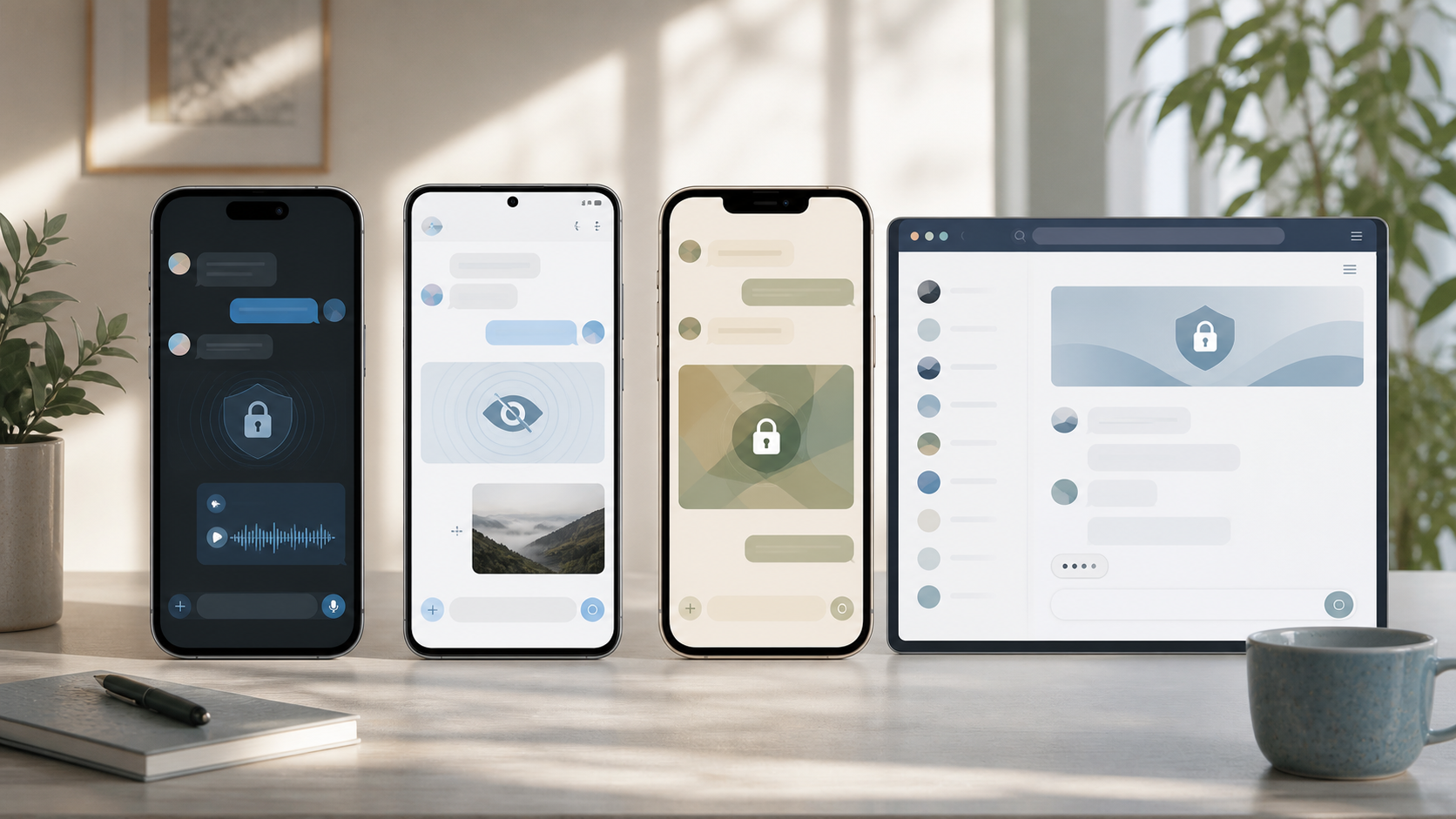
WhatsApp, Signal and Telegram compared for privacy
Compare WhatsApp, Signal, Telegram and PigeonChat.site on privacy, onboarding, browser access, and the chat features people actually use.
When people compare WhatsApp, Signal and Telegram, the discussion often gets reduced to slogans: one is “secure”, another is “private”, another is “best private chat”. In practice, privacy is less about labels and more about what each app can actually see, store and require from you.
If you are choosing for privacy-first use, the useful question is not which app sounds safest in marketing copy. It is which app fits your habits, your contacts and the kind of risk you are trying to reduce. That means looking at account setup, encryption defaults, metadata, backups, group features and how easy it is to make a mistake.
This comparison keeps things practical. It focuses on the trade-offs that matter day to day, so you can decide whether WhatsApp, Signal or Telegram is the right fit, or whether a different tool such as PigeonChat makes more sense for your situation.
What privacy means in a messaging app
Privacy in messaging is not only about whether message contents are encrypted. It also includes who can see who you talk to, when you are active, what device data is collected, and how much is stored on servers. A chat app can hide the content of messages while still revealing a lot about your social graph and usage patterns.
For most users, the biggest practical concerns are simple: can the service read your messages, can it access your backups, how much personal information is needed to sign up, and how easy it is to reduce exposure without breaking the app for everyday use. Those details matter more than broad claims.
It also helps to separate privacy from anonymity. An app can be private in the sense that it protects message contents, while still requiring a phone number or showing your profile to people who know your number. If you want the best private chat for a given context, decide first whether you need content privacy, identity privacy, or both.
WhatsApp: convenient, but privacy depends on the ecosystem
WhatsApp benefits from being widely used. For many people, that is the real reason they stay on it. If your contacts are already there, it is easy to communicate without persuading everyone to switch. For privacy-conscious users, that convenience is useful, but it comes with trade-offs.
Message content can be protected in transit, but the app still sits inside a large commercial ecosystem and often relies on phone-number-based identity. That means the service can still learn a significant amount about your communication patterns. The biggest practical privacy issue for many users is not the chat itself, but the surrounding account and backup setup.
If you use WhatsApp, pay close attention to backups, device permissions and account recovery. Cloud backups can weaken your privacy posture if they are not handled carefully, because encrypted messages are only one part of the picture. In daily use, WhatsApp is best seen as a mainstream messenger with some strong protections, not as the most privacy-minimised option.
Signal: strongest default privacy for most people
Signal is usually the clearest answer for users who want a privacy-first chat app without having to become security experts. Its design places a strong emphasis on minimising what the service can learn. In practice, that means fewer business incentives tied to your data and fewer features that pull in the opposite direction.
The main appeal of Signal is its default approach. You do not need to assemble a private configuration from lots of settings menus. That matters because privacy often fails through neglect rather than through sophisticated attacks. A private app that is awkward to use tends to get configured poorly, then abandoned. Signal is built to reduce that friction.
There are still trade-offs. Like many modern messengers, it is not anonymous by default and usually involves a phone number. It also depends on your contacts adopting it, which is a real hurdle if you are trying to move an entire group. But for most people asking which app is the most privacy-respecting in everyday use, Signal is the strongest starting point.
Telegram: flexible and feature-rich, but not the same privacy model
Telegram is often mentioned in the same breath as WhatsApp and Signal, but it works differently. It is popular because it is fast, feature-rich and good for large groups, channels and communities. That makes it very attractive for coordination, broadcasting and casual group chat.
Privacy-wise, though, Telegram is not the same kind of app as Signal. Users who assume it is a direct replacement for a private messenger can be caught out by its architecture and defaults. For privacy-first users, the important question is not whether Telegram is “good” in the abstract, but whether its model fits the sensitivity of what you plan to discuss.
As a signal alternative chat, Telegram is often chosen for flexibility rather than maximum privacy. If your main need is a large, feature-rich network with broad compatibility, it can work well. If your main need is to minimise exposure, you need to be much more deliberate about which conversations stay there and which should move elsewhere.
Practical trade-offs that matter day to day
Instead of comparing apps by reputation, it is more useful to compare the practical friction points. These are the things users actually run into when they try to make a private habit stick.
- Contacts: the most private app is not useful if no one you need to reach uses it.
- Account identity: phone-number dependence can link your chat identity to your real-world identity.
- Backups: cloud backups can quietly undermine otherwise strong message protection.
- Metadata: who you talk to, when, and how often can matter almost as much as message contents.
- Default settings: privacy is safer when the app makes the private option the easy option.
- Group use: large groups and communities often push people toward less private defaults.
These trade-offs explain why there is no universal answer to “whats app, signal or telegram: which is best?”. If you want a private one-to-one chat with minimal fuss, Signal usually wins. If you need the largest mainstream network, WhatsApp may be the practical choice. If you need groups and channels more than strict privacy, Telegram may fit better.
For some users, the answer is not to force everything into one app. Keep sensitive conversations on the most privacy-respecting option available, and use another app for low-risk coordination. That split approach is often more realistic than trying to make one tool do everything.
How to choose the right app for your situation
If you are privacy-first, start by ranking your needs. Do you care most about message content, contact privacy, or reducing the amount of data the provider can collect? The right app changes depending on which of those matters most.
Signal is usually the safest recommendation for personal privacy. WhatsApp is the most convenient if your social circle already lives there. Telegram is the most flexible for communities and public-style communication, but it is not the obvious choice if your goal is the best private chat experience.
PigeonChat is worth considering if you want to think beyond the usual three and focus on a different communication pattern. Even if you never sign up, the broader lesson is useful: privacy is not a feature you tick once. It is the result of many small design choices, and the best app is the one whose choices match your needs.
Frequently asked questions
Is Signal always better than WhatsApp for privacy?
For most privacy-first users, Signal is the stronger choice because its design is more clearly focused on minimising data exposure. That said, WhatsApp is still widely used and offers encrypted messaging, so the practical answer depends on who you need to talk to and how sensitive the conversation is.
Is Telegram a private messenger?
Telegram can be useful and secure in some contexts, but it is not the same privacy model as Signal. If your priority is to reduce data exposure as much as possible, you should treat Telegram as a flexible communications platform rather than the default best private chat option.
What should I check before trusting any chat app?
Look at whether it protects message content, how it handles backups, whether it requires a phone number, what metadata it may collect, and how the default settings behave. A chat app can look private on the surface while still sharing more than you expect in practice.
In the end, the best choice is the one you will actually use consistently without weakening it through convenience settings, risky backups or mismatched expectations. For most people seeking privacy-first messaging, Signal is the strongest default, WhatsApp is the most practical mainstream option, and Telegram is best treated as a feature-rich tool with a different privacy profile.
Ready to try PigeonChat?

Writer & Editor at PigeonChat
Related Articles

Viber, Telegram, and Messenger compared for private chat

Signal alternative chat app: what users actually want

What a true WhatsApp alternative should include

WhatsApp, Signal, Viber, and Telegram compared
Why chat folders matter for busy group conversations