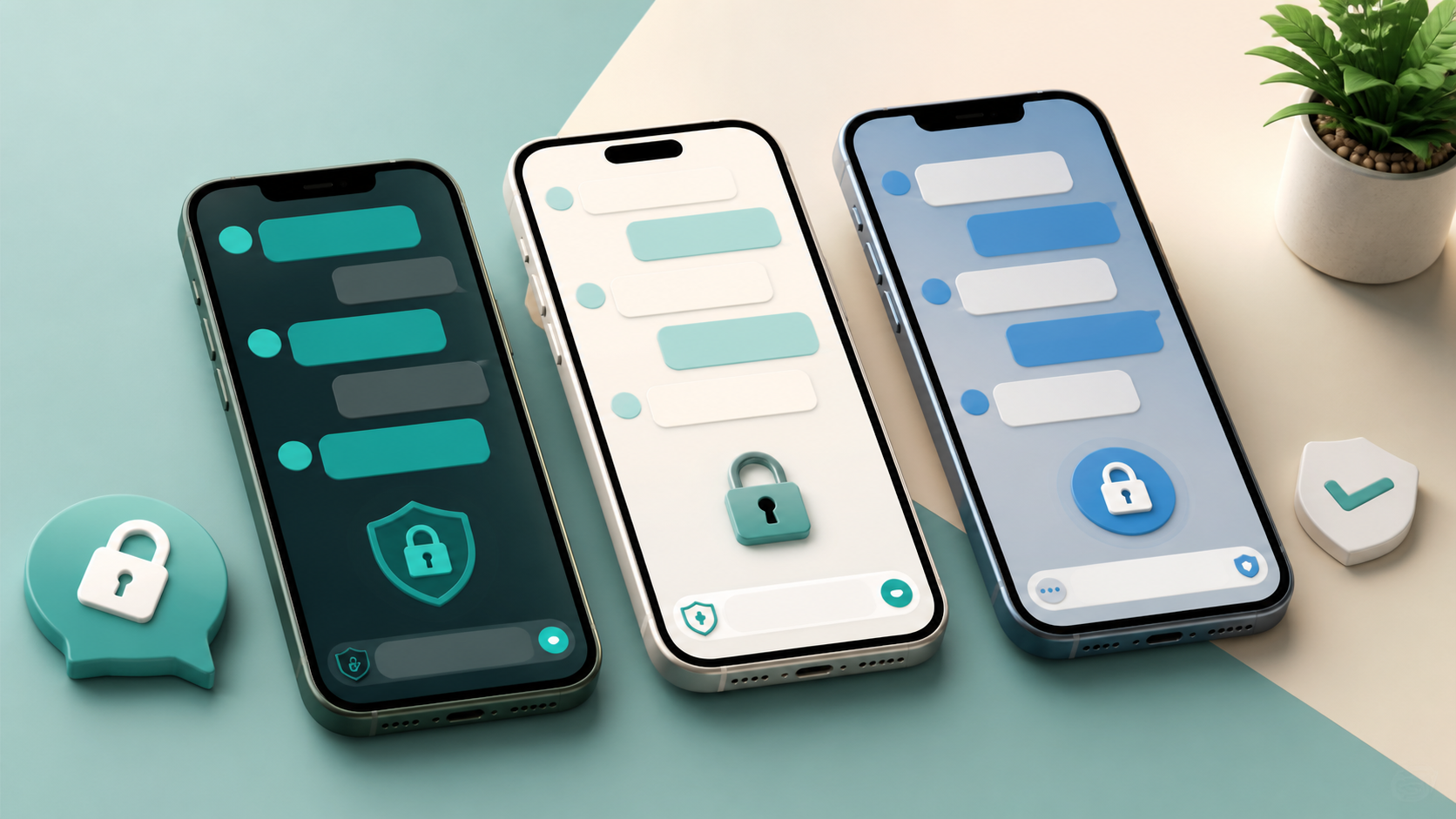
Signal vs WhatsApp vs Viber for private messaging
Compare Signal, WhatsApp, and Viber on privacy, phone number use, encrypted messaging, and the features people actually care about.
When people compare Signal, WhatsApp and Viber for private messaging, they are usually asking three practical questions. How much control do I have over my privacy settings? What identity does the app require? And is it easy to use every day without making my contacts jump through hoops?
That is the right way to approach the choice. The best app for private messaging is not always the one with the strongest headline privacy story. It is the one that fits your actual habits, your contacts and your tolerance for friction. A secure app that nobody else uses can be less useful than a slightly less strict one that your family, friends or colleagues will actually open.
This guide compares Signal, WhatsApp and Viber on the points that matter most in practice. If you are also looking for a more general PigeonChat style view of private communication, the same principle applies: start with who can reach you, what they need to know about you, and how much control you want over the conversation.
Privacy controls: what you can actually manage
Signal is usually the first app people mention when privacy is the main concern. It is designed around strong default protections and gives you useful controls for disappearing messages, registration lock and who can see details such as your profile. For many people, that makes Signal a strong signal alternative chat when privacy is the priority.
WhatsApp offers a broader set of privacy settings than many people expect, including controls over last seen, profile photo, status and read receipts. It is still tightly tied to the larger Meta ecosystem, which matters to some users more than the settings themselves. Viber also gives you privacy-related controls, but it tends to sit in the middle of the pack in how prominent and intuitive those settings feel.
The most important difference is not just the number of switches. It is how the app behaves by default. In a private messaging app, good defaults often matter more than a long settings menu you never open.
Identity requirements: phone numbers, contacts and discoverability
All three apps use a phone-number based identity model in some form, but they do not feel the same in use. WhatsApp is deeply tied to your phone number and contact list, which makes onboarding straightforward for most people. You are effectively using the same identity that already lives in your address book, which is convenient but not especially private.
Signal also uses your phone number, though it has moved towards reducing how visible that number is to others. That matters if you want to chat without exposing your full contact details to everyone who messages you. For people searching for an alternative chat app, that balance between reach and restraint is often a deciding factor.
Viber likewise leans on phone-number identity and contact discovery, which makes it easy to find people you already know. If your private messaging needs are mainly about keeping everyday chats inside a known network, this can be enough. If you want stronger separation between your identity and your messaging account, Signal usually feels more thoughtful.
- Signal - better suited to users who want tighter control over who sees their number and profile details.
- WhatsApp - convenient if most of your contacts are already there and you want the least onboarding friction.
- Viber - familiar and simple for phone-number based messaging, especially where it already has local popularity.
Everyday usability: where friction shows up
Privacy features are important, but daily usability decides whether an app gets used consistently. WhatsApp is often the easiest to recommend here because many people already have it, messages are delivered reliably, and the interface is widely understood. If you want the smoothest group chat, media sharing and calls experience, WhatsApp is hard to ignore.
Signal is also straightforward, though it can feel slightly more purposeful and less cluttered. That is a benefit for some users. It generally avoids the feeling that the app is trying to be an all-in-one social layer. For others, that same simplicity can feel a little spare compared with WhatsApp’s more familiar rhythm.
Viber sits somewhere in between. It is usable and familiar, but in many regions it is less universal than WhatsApp, which can mean more explaining and more cross-app switching. That is often the real cost of choosing a less dominant alternative chat app: not technical difficulty, but social friction.
Features that matter for private messaging
For most people, private messaging is not only about encryption. It is also about what happens in groups, calls and shared media. Signal is strong on secure messaging fundamentals and offers the kind of features you need without pushing you towards attention-heavy extras. That makes it a good choice if you prefer a focused tool.
WhatsApp brings a more comprehensive everyday toolkit. It is especially useful when your communication pattern includes large family groups, voice notes, photos and quick coordination. Viber also has a broad feature set, including chat and calling options that appeal to users who want a familiar messenger with a few extras.
The trade-off is simple. More features often mean more complexity, and more complexity can make a privacy story harder to understand. When an app does many things, it can be harder to see which settings affect what, and that is where a calmer product like Signal often earns trust.
Which app suits which kind of user?
If your top priority is privacy controls and minimising what others learn about you, Signal is usually the clearest choice. It is the app that most consistently aligns with the idea of private messaging as a deliberate design goal rather than a side effect. For people who want a signal alternative chat with a privacy-first mindset, it is often the benchmark.
If your priority is convenience, network effect and everyday communication with the broadest set of contacts, WhatsApp is difficult to beat. It is often the default because it works with the people you already know. That practical advantage can outweigh abstract privacy concerns for many users.
If you want a familiar messenger with phone-number based discovery and a decent feature set, Viber can still be a sensible choice. It may not be the first app that privacy-focused users recommend, but it can suit people who value straightforward communication and already have contacts there.
- Choose Signal if privacy controls and a restrained design matter most.
- Choose WhatsApp if ease of use and contact availability matter most.
- Choose Viber if you want a practical middle ground and your contacts already use it.
How to decide without overthinking it
A useful way to choose is to rank your needs in this order: privacy, identity, then usability. If privacy comes first, start with Signal. If identity convenience and reach come first, WhatsApp will probably feel easiest. If you are somewhere in the middle, Viber may be enough for your day-to-day needs.
Also think about what you are trying to protect. Some people want to avoid exposing their number to strangers. Others mainly want to keep conversations out of a general social feed. Others simply want messages to feel private in a normal, everyday sense. Those are related goals, but they are not identical.
That is why the best comparison is not about declaring a single winner. It is about matching the app to the job. PigeonChat, like any thoughtful private communication tool, works best when the trade-offs are clear rather than hidden.
Frequently asked questions
Is Signal better than WhatsApp for privacy?
In most practical comparisons, Signal is considered the more privacy-focused option because it is built around stronger default protections and fewer distractions. WhatsApp has useful privacy settings, but it is also tied to a much larger platform ecosystem. If privacy is your main concern, Signal usually feels like the safer starting point.
Does Viber work well as an alternative chat app?
Yes, Viber can work well if your contacts already use it and you want a straightforward messenger for calls and chats. It is not usually the first choice for people who are deeply privacy-focused, but it can be perfectly serviceable for everyday messaging. Its value depends a lot on whether your network is already there.
Do I need to give up convenience to get better privacy?
Not always, but there is usually some trade-off. The more privacy-focused an app is, the more likely it is to ask you to accept a little extra friction. Signal is a good example of that balance. WhatsApp is often more convenient because so many people already use it. The right answer depends on whether you care more about ease or control.
In the end, Signal vs WhatsApp vs Viber is less about choosing the objectively best app and more about choosing the best fit for your habits. If you want the clearest privacy stance, start with Signal. If you want the least resistance, WhatsApp will probably win. If you want a familiar middle ground, Viber is still worth a look.
Ready to try PigeonChat?

Writer & Editor at PigeonChat
Related Articles
Viber, Telegram, and Messenger compared for private chat

Signal alternative chat app: what users actually want
What a true WhatsApp alternative should include
WhatsApp, Signal, Viber, and Telegram compared
Why chat folders matter for busy group conversations