
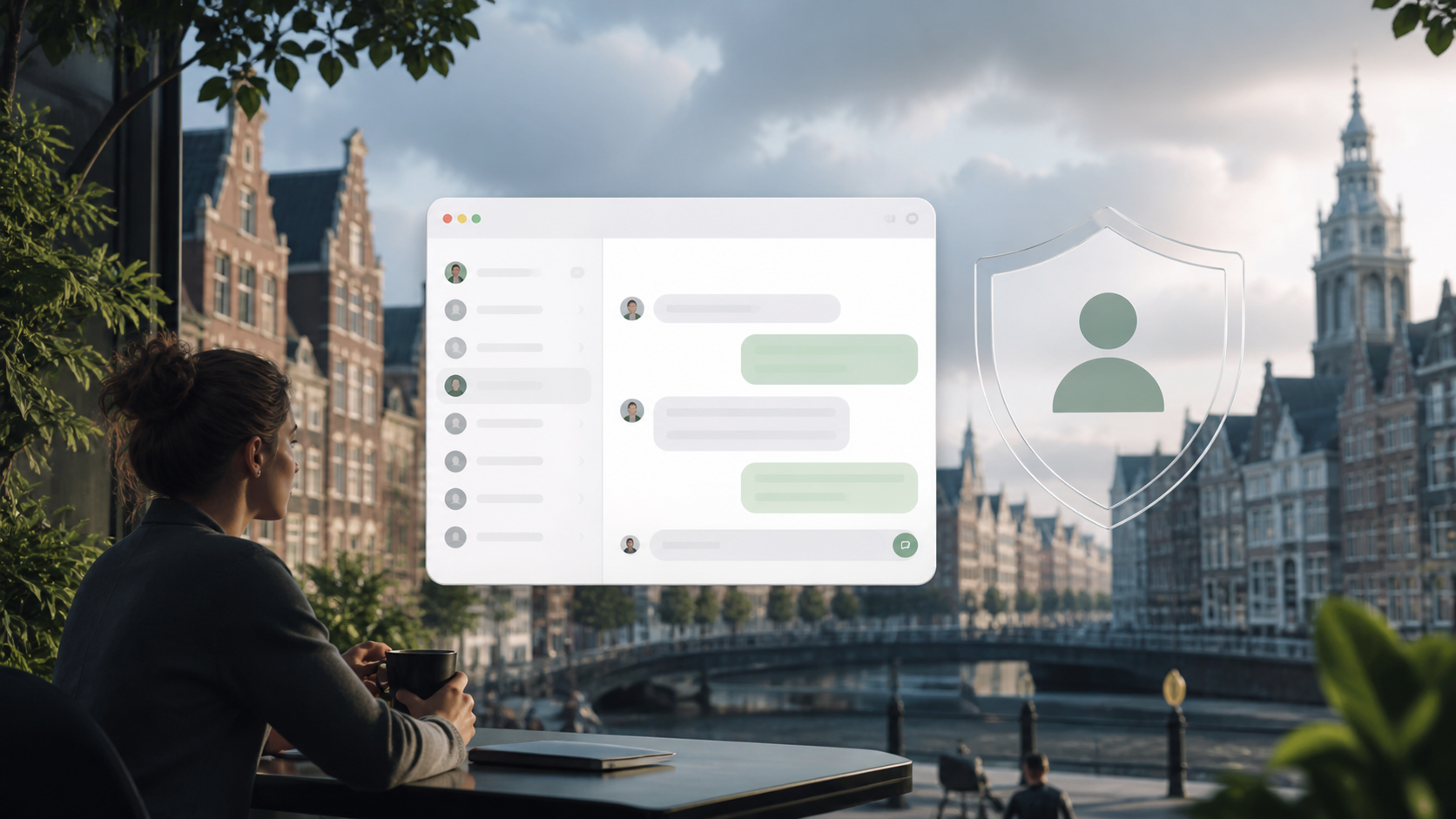
Why users want a privacy first EU chat app
People searching for an EU chat app often want stronger privacy expectations, clearer regulation, and a European-based alternative.
Across Europe, messaging is increasingly seen as more than a convenience. For many people it is part of daily work, family life, community organising and personal coordination, which means it carries a lot of sensitive context. That is why interest in a privacy first chat app keeps growing. People do not just want messages to arrive quickly. They want to know who can see them, where they are stored, and which laws govern the service.
This is especially true when choosing a European chat app or an EU chat service. Users are often comparing products on trust as much as features. They may be asking whether the company is based in Europe, whether data stays under EU rules, and whether the service is designed to minimise data collection from the start. Those concerns are practical, not abstract. They shape how comfortable people feel using an app every day.
At PigeonChat, we hear the same pattern again and again: users want clarity. They want a service that feels careful by default, not one that asks them to become security experts just to send a message. That preference tells us something important about the market for the best European based chat app. Trust now matters as much as speed, stickers, or group features.
Why privacy matters more in everyday chat
Chat apps carry a surprising amount of personal detail. Even without reading the content of a message, metadata and account information can reveal relationships, routines, work habits and location patterns. People may not always think about this when they are choosing a messenger, but they do notice when an app asks for too much.
In Europe, there is also a stronger public awareness of digital rights and data protection. Users are used to hearing about consent, data minimisation and lawful processing. As a result, a privacy first chat app often feels more aligned with expectations than a service built around data extraction or broad analytics.
For many people, privacy is not about secrecy. It is about control. They want to decide who receives a message, how long it exists, and what the platform itself can learn from it. That is a reasonable standard for a modern messaging product.
What people mean by a privacy first chat app
The phrase can mean different things, so it helps to be specific. A privacy first chat app usually suggests that the service is built to collect less data, expose less information to third parties, and keep the messaging experience as private as possible by design. It is not just about adding encryption as a feature label.
Users often expect end-to-end encryption where appropriate, but they also look for smaller design choices. For example, does the app require a phone number? Does it keep detailed logs? Are backups protected? Can users control disappearing messages, device access and notification previews? These details build confidence.
A good privacy story should also be understandable. If a provider cannot explain its model in plain language, many users will assume the worst. The strongest services tend to be the ones that can describe their security choices clearly and consistently.
- Minimal data collection at sign-up
- Clear encryption and key management explanations
- Transparent retention policies
- User controls for message history and devices
- Plain, readable privacy documentation
Why an EU chat or European chat app feels more trustworthy
Location alone does not make a service trustworthy, but it does influence expectations. An EU chat service is often associated with familiar legal protections, clearer rights for users, and a more understandable route for complaints or support. That can matter a great deal when a person is comparing two otherwise similar apps.
Many users also prefer a European chat app because it suggests a different business culture. They may expect less aggressive monetisation, fewer hidden data-sharing arrangements, and more respect for user boundaries. Whether or not those assumptions always hold, they shape perception and purchasing decisions.
There is also a practical side. If a service is designed for European users, it may be more likely to reflect local languages, support norms and regulatory expectations. For businesses in particular, that can make adoption feel safer and easier to justify internally.
The trust signals users look for before signing up
When people are deciding whether to use a fully compliant EU chat app, they usually look for signs that the company understands responsibility, not just marketing. One strong signal is transparency about jurisdiction and data handling. Another is a privacy policy that is readable rather than buried in vague legal language.
Users also look for technical and operational credibility. They want to know whether the app has independent reviews, public security information, and a sensible approach to account recovery. If a provider takes security seriously, it tends to show up in small ways across the product, support pages and onboarding flow.
These are the kinds of questions many people ask before trusting a messenger:
- Where is the company based and which laws apply?
- What data is collected at signup and during use?
- Is message content protected end to end?
- How are backups, devices and recovery handled?
- Are privacy settings easy to find and change?
- Does the company explain its practices without jargon?
Compliance is necessary, but not sufficient
Some users search for a fully compliant EU chat app because they need more than a good feeling. They may be choosing tools for a company, school, association or public sector team. In those settings, compliance helps reduce risk, but it is not the same as real privacy design.
An app can follow the rules and still collect more data than users are comfortable with. It can also be technically legal while still feeling intrusive. That is why people increasingly care about both the legal framework and the product philosophy behind it.
In practice, the best services combine both. They respect legal requirements, but they also reduce unnecessary exposure by default. That is a stronger basis for trust than compliance wording alone.
How product design affects user confidence
People often judge privacy through experience rather than policy. If an app asks for too many permissions, sends confusing prompts, or makes security settings hard to find, users notice. If a service feels calm, clear and restrained, trust tends to build naturally.
This is one reason well-designed messaging apps can stand out even before people read the documentation. Simple onboarding, obvious privacy controls and sensible defaults are not cosmetic. They are part of the security story.
PigeonChat is built with that principle in mind, and the same lesson applies across the category. When the product reduces friction without increasing exposure, users tend to feel more in control. That feeling often matters more than any slogan about safety.
Frequently asked questions
What is the main difference between a privacy first chat app and a normal messenger?
A privacy first chat app is built to limit unnecessary data collection and reduce exposure by default. A normal messenger may still be secure, but it does not always prioritise minimising what the provider can see or store. The difference is often in the design choices, not just the headline features.
Why do users prefer a European based chat app?
Many users prefer a European based chat app because it feels easier to trust the legal framework, support structure and product approach. They may expect stronger data protection norms and more transparency about how information is handled. For some, that sense of proximity and accountability is a major factor.
Does compliance mean an app is automatically private?
No. Compliance is important, but it does not automatically mean the app is private in the way users expect. A service can meet legal obligations while still collecting more data than necessary. Users usually want both compliance and good privacy engineering.
In the end, the demand for a privacy first chat app is really a demand for respect. European users are asking for services that treat their conversations as personal by default, explain themselves clearly, and avoid unnecessary data use. That is not a niche preference any more. It is becoming the baseline for trust in modern messaging, whether someone chooses PigeonChat or simply uses this as a checklist for evaluating the next app they try.
Ready to try PigeonChat?

Writer & Editor at PigeonChat
Related Articles

What makes an end to end encryption chat app secure
What a fully compliant EU chat app should include

Why people search for a WhatsApp alternative without a number

What end to end encryption chat really protects
Why chat folders matter for busy group conversations