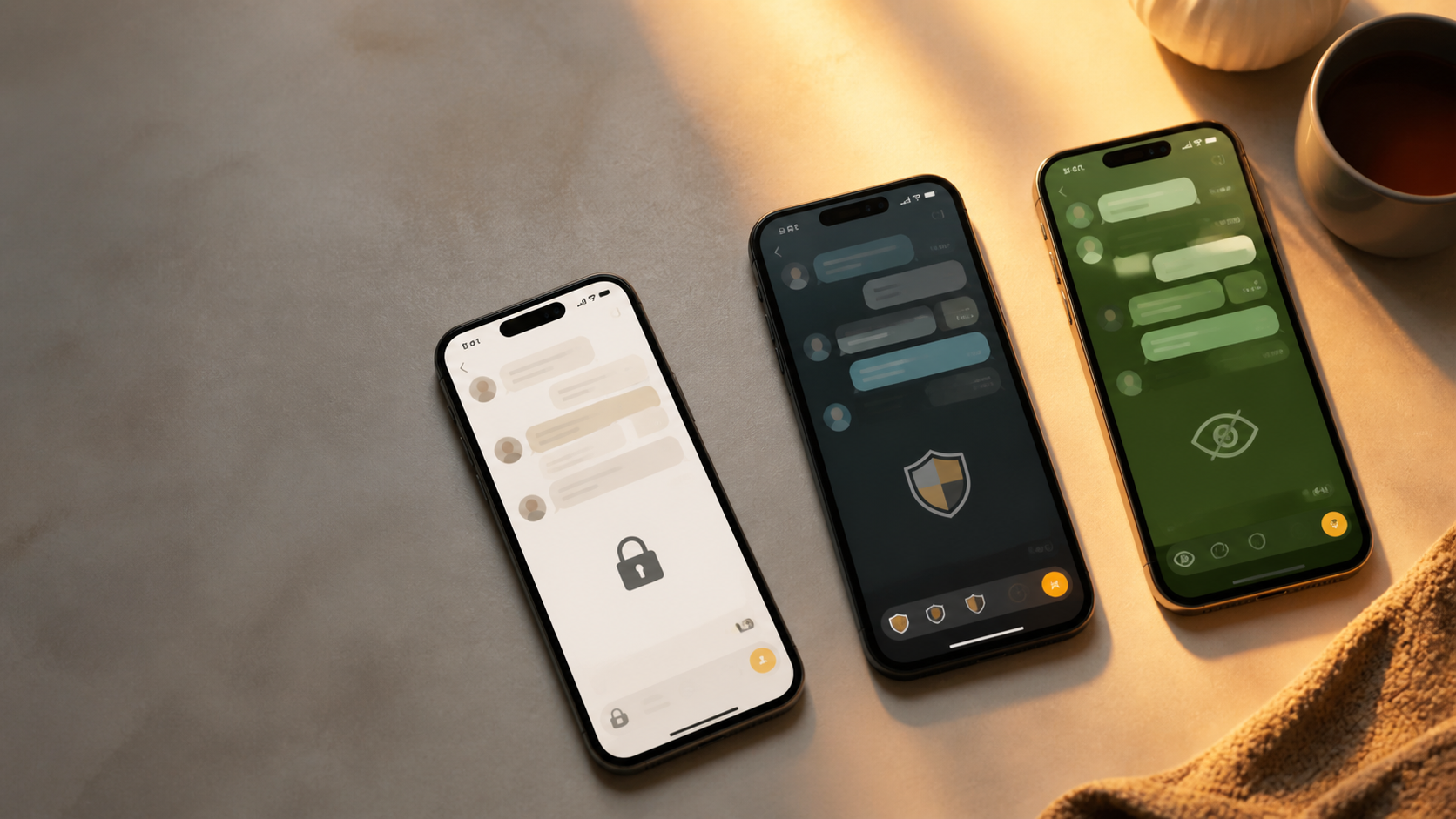
WhatsApp, Signal and Telegram for private chats
A clear comparison of WhatsApp, Signal, and Telegram for private chats, group organization, encryption, and browser based access.
When people compare WhatsApp, Signal and Telegram, they are usually trying to answer three practical questions. Which app is best for private chats? Which one is easiest for everyday use? And which one handles groups, channels and media without becoming awkward?
The short version is that each app makes a different trade-off. WhatsApp is familiar and simple. Signal is the strongest default choice for privacy. Telegram is popular for large groups, channels and flexible features, but it does not work the same way as a full end to end encryption chat by default.
If you only want a quick orientation before choosing a messenger, think in terms of purpose. For trusted one-to-one conversations, Signal is often the most privacy-focused option. For talking to almost anyone, WhatsApp is usually the most convenient. For communities, broadcasts and big group management, Telegram is often the most capable.
WhatsApp, Signal and Telegram: the basic privacy difference
The biggest point of confusion is that these apps do not protect your messages in quite the same way. Signal is built around privacy first, with end to end encryption turned on for messages and calls by default. WhatsApp also uses end to end encryption for personal chats and calls, which means the contents are protected in transit. Telegram, by contrast, uses end to end encryption only in its Secret Chats. Standard chats are encrypted between your device and Telegram’s servers, but not end to end.
That distinction matters if your priority is message confidentiality. A private chat in the everyday sense is not the same thing as a fully encrypted conversation. If someone asks for the best private chat app, Signal is usually the clearest answer among the three. WhatsApp is still strong for message protection, but it sits inside a broader platform owned by a large company. Telegram is more of a feature-rich messenger than a privacy-first tool.
For many readers, the practical question is not whether an app has encryption somewhere in the product. It is whether encryption is the default, easy to understand, and applied in the places where they actually chat. On that measure, Signal is the simplest to trust without extra setup.
Ease of use and everyday chatting
WhatsApp remains popular because it feels familiar. Most people can install it, link a number, and start chatting straight away. The interface is straightforward, voice notes are easy, and sending photos, documents or location details rarely requires much thought. For ordinary family and work-adjacent chat, that convenience is often the main reason people keep using it.
Signal is also easy to use, but it can feel a little less universal because fewer people have it installed already. Once both sides are on it, the app itself is not hard to learn. The main difference is social friction, not technical difficulty. That is often the real barrier with any private messenger - you need the other person to join you.
Telegram is generous with features, but that can make it feel busier. There are channels, bots, large groups, folders and lots of customisation. If you like power-user tools, that is a benefit. If you just want a calm, simple messenger, the app can feel more like a platform than a chat tool. PigeonChat takes a similar principle seriously in its own design philosophy, even though this comparison is about the major apps most people search for.
Group tools, channels and community features
If your main use case is group chat, Telegram often stands out. It is built for large groups, broadcast-style channels and flexible moderation features. That makes it useful for clubs, public communities, event groups and topic-based discussion spaces. Telegram’s structure is particularly suited to situations where one or a few people speak to many.
WhatsApp is much more familiar for family groups, school groups and smaller circles. It does groups well enough for most everyday use, and many people prefer its simplicity. But once a group starts becoming large and noisy, the management tools can feel limited compared with Telegram.
Signal supports groups too, and it does them in a privacy-conscious way. The group features are perfectly usable for small to medium chats, but they are not as expansive as Telegram’s. If your priority is an end to end encryption chat with a small circle, that is fine. If you want a huge public community, Signal is not trying to compete on that front.
- WhatsApp - best for familiar everyday group chats with people who already use it
- Signal - best for private groups where security matters more than advanced features
- Telegram - best for large groups, channels and community-style messaging
Which app is best for privacy?
If privacy is the deciding factor, Signal is usually the strongest choice. It keeps the experience simple and makes encryption the standard rather than a special mode. It also avoids many of the platform-style extras that can distract from that purpose. For people searching for the most private messanger, that simplicity is the point.
WhatsApp is more complicated. The message contents in personal chats are protected by end to end encryption, which is good, but the app still sits inside a wider data ecosystem. That does not make it a bad choice for private conversation, but it does make it less privacy-focused overall than Signal.
Telegram is the least straightforward if privacy is your primary concern. Many people assume all Telegram chats are fully private, but that is not how the app works. If confidentiality is central, you need to be careful about which chat mode you are using. For many readers, that alone makes Telegram a weaker default recommendation for sensitive conversations.
Which one is best for different kinds of users?
For most people, the right choice depends on the job. If you mainly chat with family, friends and colleagues who already use it, WhatsApp is the path of least resistance. If you want privacy first and do not mind persuading contacts to switch, Signal is the better fit. If you are managing communities, announcements or very large groups, Telegram is often the most capable tool.
It also helps to think about habits rather than ideals. The best private chat app is not the one with the best marketing. It is the one you and the people you talk to will actually use consistently. A secure app that nobody opens is less useful than a decent app that gets used properly.
Some people keep more than one app installed. That is a sensible approach. You might use Signal for personal sensitive chats, WhatsApp for broad social contact, and Telegram for communities or channels. There is no rule saying one messenger has to do everything.
Practical tips before you decide
Before choosing, check three things: who you need to talk to, what kind of conversations you have, and how much complexity you are willing to tolerate. If the app is for a few trusted people, privacy should probably come first. If it is for organising a busy group, tools and usability may matter more.
Also think about backups, devices and notifications. The best privacy settings in the world are not much help if your phone screen reveals message previews in public. Good chat hygiene includes sensible notifications, device passcodes and knowing which app stores your chat history where.
To keep the comparison simple, here is the plain-language summary:
- WhatsApp - easiest for widespread everyday use
- Signal - strongest default for private conversations
- Telegram - best for groups, channels and feature-heavy messaging
Frequently asked questions
Is WhatsApp end to end encrypted?
Yes, WhatsApp uses end to end encryption for personal chats and calls. That means the message contents are protected between the people chatting. It is still worth remembering that encryption is only one part of privacy, and the overall app experience includes other data and account considerations.
Is Signal better than Telegram for private chats?
For most people, yes. Signal is designed with privacy as its core purpose, and end to end encryption is the default. Telegram can be private in Secret Chats, but standard chats do not use end to end encryption. If you want a simple best private chat option, Signal is usually the safer recommendation.
Why do people still use Telegram if it is less private by default?
Because it is very strong for groups, channels, media sharing and flexible community features. Many people choose Telegram for functionality rather than strict privacy. It can be a useful messenger, but it should be understood for what it is, not mistaken for a fully encrypted chat app in every mode.
In the end, the right choice is less about hype and more about matching the tool to the conversation. WhatsApp suits convenience, Signal suits privacy, and Telegram suits scale and features. If you want a calmer, privacy-aware alternative to the usual messanger clutter, PigeonChat is worth a look too, but the main thing is to choose an app that fits your actual habits. If you do that, your private chats will be safer and far less annoying to manage.
Ready to try PigeonChat?

Writer & Editor at PigeonChat
Related Articles

Viber, Telegram, and Messenger compared for private chat

Signal alternative chat app: what users actually want

What a true WhatsApp alternative should include

WhatsApp, Signal, Viber, and Telegram compared
Why chat folders matter for busy group conversations