
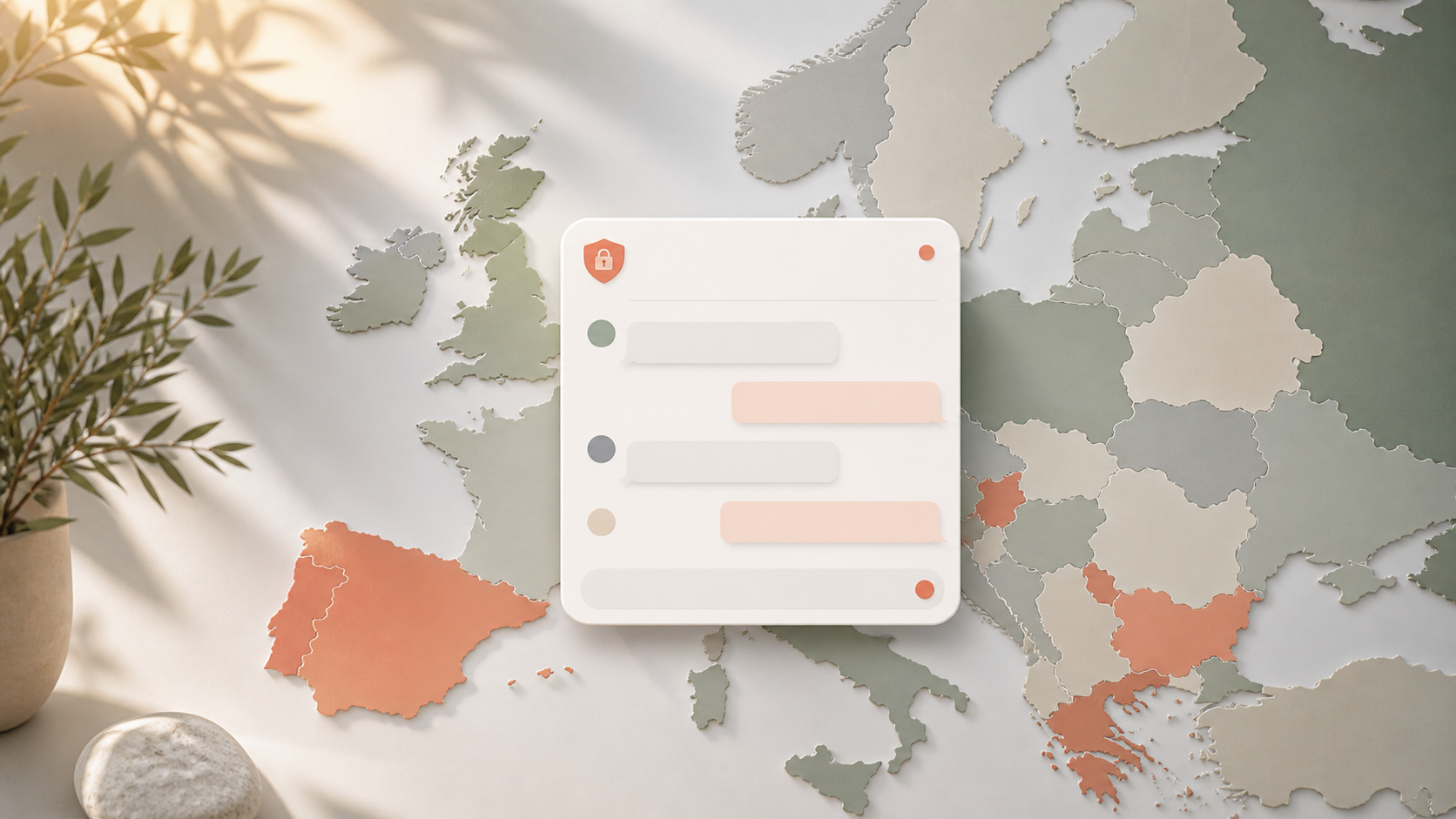
Why people search for the best European based chat app
If you want a best European based chat app, this article explains why jurisdiction, privacy culture, and browser access matter to users.
People do not usually search for the best European based chat app just because they want a different flag on the homepage. They are usually looking for something more concrete: a service that feels governed by clearer rules, a company answerable under familiar law, and a product that treats privacy as a default rather than a marketing line.
In practice, “European based” has become shorthand for trust. It suggests a different legal and cultural context from many global platforms, especially when users are trying to understand where data lives, which laws apply, and what happens when a service changes hands or expands into new markets. For anyone comparing a European chat app with a global one, that context matters just as much as features.
This is why interest in a privacy first chat app rarely stops at encryption or message history. People want to know whether the provider is built around European expectations of consent, data minimisation, and transparency. That is also why newer services such as PigeonChat can attract attention, even from people who may never sign up. They are part of a broader shift towards chat tools that are easier to trust at a glance.
What people mean by the best European based chat app
When someone says they want the best European based chat app, they are often not making a technical comparison first. They are expressing a trust preference. They want a service that feels closer to local accountability, whether that means European hosting, European ownership, or simply a product designed with EU privacy expectations in mind.
This matters because chat is intimate infrastructure. People use it for family conversations, work coordination, customer support, community groups, and private planning. If the app is unclear about who runs it, where it is based, or how it handles data, that uncertainty can be enough to push users elsewhere.
The phrase also reflects a practical search habit. Many people look for an EU chat because they assume, often reasonably, that a provider based in Europe is more likely to communicate clearly about GDPR-style obligations, retention policies, and cross-border data handling. That does not automatically make a service perfect, but it gives users a better starting point.
Why “European based” signals trust and legal clarity
One reason the term resonates is that Europe has a strong public language around privacy, consumer rights, and data governance. Users may not know every legal detail, but they do know that a European company is operating in a framework where privacy expectations are taken seriously and where the rules are more familiar to many individuals and businesses in the region.
That familiarity reduces friction. If you are choosing a chat app for a team, a school, or a small organisation, it is easier to evaluate a provider that explains its policies in plain language and operates under a jurisdiction you recognise. You are not just buying software. You are choosing a relationship with a service provider.
In that sense, “European based” is often a proxy for legal clarity. People want to know whether data is subject to EU law, whether support and governance are close to home, and whether the company is likely to be transparent when policies change. Those are not abstract concerns. They are part of everyday risk management.
Privacy expectations in a privacy first chat app
A privacy first chat app should do more than mention encryption in a footer. Users expect sensible defaults: limited data collection, clear retention periods, and settings that are understandable without a technical manual. In Europe, that expectation is especially strong because privacy is often treated as a baseline requirement, not an advanced feature.
For many people, the best European based chat app is the one that answers simple questions well. What is stored? For how long? Who can access it? Can the user delete it? Is metadata handled differently from message content? These are the questions that shape trust before anyone looks at stickers, groups, or file sharing.
It is also worth remembering that privacy is not only about hidden surveillance. It is about reducing unnecessary exposure. A thoughtful chat app can minimise account data, limit logs, and avoid forcing users to hand over more information than the service genuinely needs.
- Clear ownership and company location
- Plain-language privacy policy and terms
- Minimal data collection by default
- Transparent retention and deletion options
- Well-explained security controls, not vague claims
- Support for users in European legal and business contexts
How to compare an EU chat against global alternatives
When comparing an EU chat with a larger global platform, avoid starting with brand recognition. Start with governance. Ask where the company is based, which laws apply, and whether the provider clearly states how it handles user content and metadata. If those answers are difficult to find, that is already useful information.
Then look at the product behaviour. Does the app collect contacts by default? Does it require a phone number? Does it allow easy account deletion? Are group chats and backups handled in a way that aligns with your privacy expectations? These details often matter more than a long feature list.
A good European chat app should also be honest about trade-offs. Some services prioritise simplicity, others focus on enterprise controls, and some choose stronger privacy at the cost of convenience. None of these approaches is inherently wrong. The key is whether the service is candid about what it does and does not do.
Why the phrase matters to businesses and communities
For businesses, choosing a European-based provider can simplify procurement conversations. Teams often need to explain data handling to legal, compliance, or procurement stakeholders, and an app that is clearly rooted in Europe can make that process easier. It does not remove the need for due diligence, but it can reduce ambiguity.
For communities, the appeal is slightly different. Group chats, member coordination, and volunteer communication work best when people trust the platform enough to use it naturally. If users worry about opaque data practices, participation drops. If they feel the service is locally accountable, they are more willing to engage.
This is one reason new entrants like PigeonChat can stand out. Not because they promise magic, but because they align with a simple expectation: a privacy first chat app should feel understandable, credible, and rooted in a legal environment people can recognise.
What to look for before choosing a European chat app
If you are comparing options, a few practical checks can save time. The strongest services are usually the ones that make important information easy to find. You should not need to dig through marketing pages to understand the basics of privacy, security, and jurisdiction.
Use this shortlist as a sensible starting point:
- Where is the company registered and operated?
- Does the service clearly state where data is stored?
- Is end-to-end encryption available where it matters?
- Can users delete accounts and messages without confusion?
- Are business and consumer terms written clearly?
- Does the provider explain any third-party processors or integrations?
There is no single answer that fits everyone. A freelancer, a family group, and a regulated business will all prioritise different things. But the best European based chat app for any of them will usually be the one that is direct, predictable, and honest about its design choices.
Frequently asked questions
Does European based mean the same as privacy focused?
Not exactly. A European based company may be better aligned with European privacy expectations, but it is not automatically privacy focused. Always check the app’s actual policies, settings, and data handling practices rather than relying on location alone.
Is an EU chat always better for compliance?
Not always, but it can be easier for organisations that need to work within European legal and procurement frameworks. The benefit is often about clarity and jurisdiction, not an automatic guarantee of security or compliance.
What makes a privacy first chat app worth trusting?
Look for clear ownership, minimal data collection, sensible defaults, transparent retention rules, and understandable account controls. Trust grows when a provider explains what it does plainly and avoids vague promises.
The search for the best European based chat app is really a search for confidence. People want software that respects boundaries, communicates clearly, and fits the legal and cultural expectations they already live with. Whether you are comparing a large platform or a newer option like PigeonChat, the useful questions stay the same: who runs it, what it collects, and how much control you keep.
Ready to try PigeonChat?

Writer & Editor at PigeonChat
Related Articles

What makes an end to end encryption chat app secure

What a fully compliant EU chat app should include

Why people search for a WhatsApp alternative without a number

What end to end encryption chat really protects
Why chat folders matter for busy group conversations