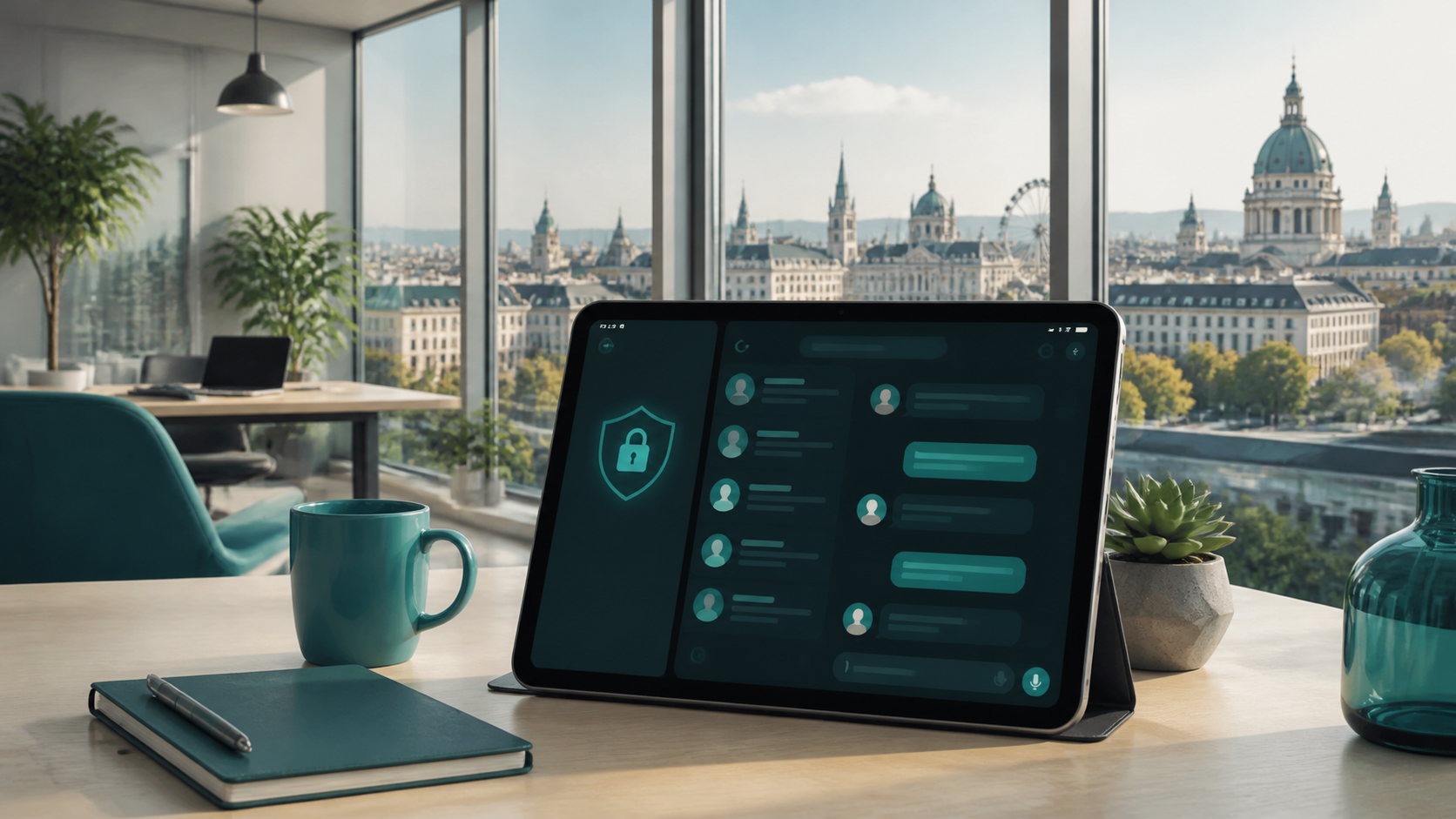
What a privacy first EU chat app should offer
If you want an EU chat app, this guide covers the privacy, data handling, and compliance features people should check before signing up.
A privacy first chat app is not defined by where its servers happen to sit on a map. A regional badge can be useful, but it is not a guarantee of strong protection. If you want a truly privacy-first EU chat app, you need to look at how the service handles encryption, data control, retention, and the rules it publishes for users to inspect.
That matters because chat is where personal, professional, and sensitive conversations often overlap. The right European chat app should reduce what it knows about you, not merely promise to keep data in the region. The best European based chat app is one that makes privacy understandable, enforceable, and consistent in day-to-day use.
This article sets out what to expect from a genuine privacy-first offering, whether you are comparing tools for a team, a community, or personal use. The same principles apply if you are browsing options like PigeonChat or simply trying to judge whether a platform deserves your trust.
What privacy first really means in an EU chat app
A privacy first chat app begins with data minimisation. It should collect only what is needed to run the service and explain why each piece of data is required. If a product asks for broad permissions or stores more than is necessary, the regional branding does not change the privacy risk.
Location also matters, but in a narrower sense than many people assume. An EU chat can benefit from being operated under European data protection rules, yet the important question is still how the company processes, stores, and shares information. A fully compliant EU chat app should make those practices visible, not hide them behind marketing language.
In practical terms, look for a service that is clear about account creation, message handling, device syncing, and deletion. If those points are vague, the service may still be convenient, but it is hard to call it privacy-first.
Encryption is essential, but it is not the whole story
End-to-end encryption is one of the clearest signs of a serious privacy posture. It means only the people in the conversation can read the message content, assuming the implementation is sound. A European chat app that lacks strong encryption should not be treated as privacy-first, no matter how polished it looks.
Even so, encryption alone is not enough. A service can still reveal metadata, such as who contacted whom, when messages were sent, or which devices were active. That information can be highly revealing, so a Privacy first chat app should be candid about what metadata it keeps and for how long.
You should also check how backups work. If messages are encrypted on the device but then copied into readable backups elsewhere, the promise weakens. Good design closes as many weak points as possible rather than relying on a single technical feature.
Data control should be easy, not hidden in settings
One of the strongest signs of a trustworthy EU chat app is how much control it gives you over your own information. Can you delete your account cleanly? Can you remove message history without having to contact support? Can you export your data in a usable format? These are not luxury features, they are part of basic respect for the user.
Retention policy is equally important. A privacy first chat app should explain what is stored, for how long, and what happens after deletion. If a service keeps old content or logs indefinitely without a clear reason, that is a red flag.
It is also worth checking whether the app supports separate control over profile details, contact discovery, and notification data. The less you are forced to surrender by default, the stronger the privacy posture tends to be.
- Clear account deletion without needing support intervention
- Export tools for messages and account data
- Short, understandable retention periods
- Controls for profile visibility and discoverability
- Transparency about backups and synced devices
Transparent rules matter as much as technical design
Trustworthy services do not bury important practices in dense legal text and hope nobody reads them. A fully compliant EU chat app should present privacy terms in plain language, with enough detail that users can understand what the company does and does not do.
That includes the policy on law enforcement requests, subcontractors, analytics, and any advertising partnerships. A good European chat app does not need to be perfect in every situation, but it should be upfront about where pressure points exist and how it responds to them.
This is where many services that claim to be the best European based chat app fall short. They may mention Europe prominently, yet their privacy policy still leaves room for broad collection, ambiguous sharing, or future changes without meaningful notice. Transparent rules reduce that uncertainty.
Compliance should support privacy, not replace it
People often use compliance as a shorthand for trust, but compliance and privacy are not identical. A service may satisfy legal obligations and still gather more data than most users would expect. A privacy first chat app uses compliance as a floor, not a ceiling.
For an EU chat, look for alignment with recognised European privacy principles, but also judge the service on design choices. Does it avoid unnecessary tracking? Does it limit internal access to message content? Does it keep operational logs lean? Those habits usually matter more than slogan-level promises.
If you are evaluating a service for work or community use, ask whether it supports responsible administration without overexposing members. A good platform makes moderation and account management possible while still protecting private conversation.
How to assess a European chat app before you trust it
You do not need to be a security engineer to make a sensible judgement. Start with the basics and work outward from there. Read the privacy policy, look for details about encryption, and see whether the company explains data retention and deletion in direct language.
Then test the product experience itself. Does it ask for unnecessary permissions? Does it encourage contact syncing by default? Are notifications and backups handled in a way that feels proportionate? Small design choices often reveal a lot about a company’s priorities.
If you are comparing a few options, use the same questions for each one. A genuinely strong privacy-first chat app will make the answers easy to find. That transparency is often more persuasive than any slogan.
Frequently asked questions
Is an EU-based service automatically privacy-first?
No. Being based in Europe may help because of the regulatory environment, but it does not automatically make a service private. The real test is how the app handles message content, metadata, retention, deletion, and third-party access.
What is the most important feature in a privacy first chat app?
End-to-end encryption is usually the first thing people look for, and rightly so. However, it should be paired with data minimisation, clear retention rules, and easy account control. Without those, the privacy story is incomplete.
How can I tell if a fully compliant EU chat app is trustworthy?
Look for clear documentation, plain-language privacy terms, and practical controls for deleting or exporting your data. A trustworthy service explains what it stores, why it stores it, and for how long. If those answers are hard to find, be cautious.
In the end, a real privacy-first EU chat app earns trust through restraint, transparency, and careful design. Regional identity can be part of that story, but it is never the whole story. If you keep your focus on data control, encryption, and honest rules, you will be much better placed to choose a service that respects your conversations, whether that is PigeonChat or another tool entirely.
Ready to try PigeonChat?

Writer & Editor at PigeonChat
Related Articles
What makes an end to end encryption chat app secure
What a fully compliant EU chat app should include

Why people search for a WhatsApp alternative without a number
What end to end encryption chat really protects
Why chat folders matter for busy group conversations