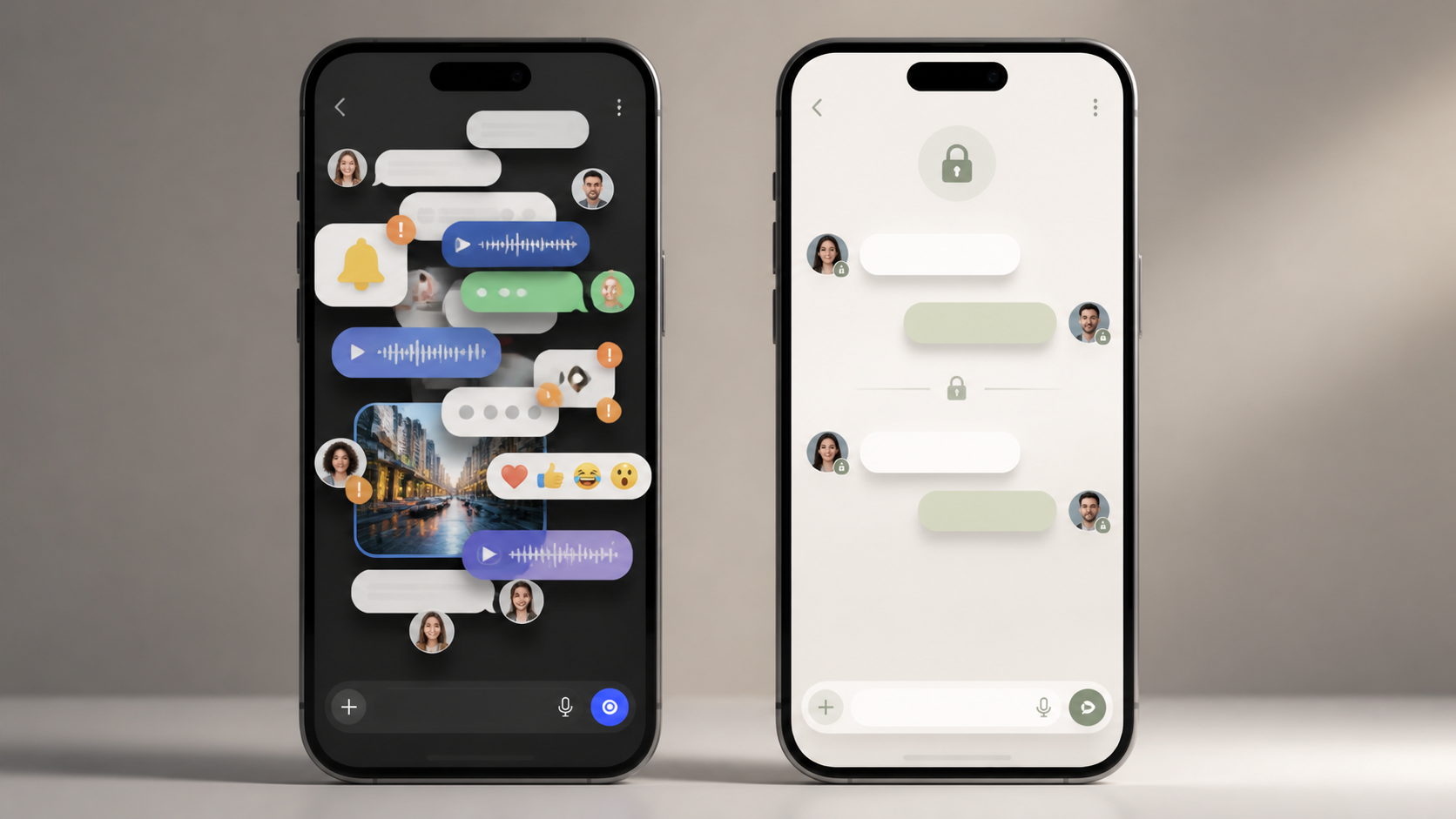
What people want in WhatsApp alternatives now
See the real reasons people search for WhatsApp alternatives, including privacy, no phone number login, and better ways to handle groups.
When people search for WhatsApp alternatives, they are rarely just looking for a different chat app. They are usually looking for a better feeling. More trust. More control. Less friction in everyday group chats. The comparison is not only about features, but about whether a tool fits the way people actually talk with friends, family, communities, and small teams.
That is why the strongest alternatives tend to focus on privacy, simpler setup, and better group management. Many people want to move away from relying on a phone number as the only identifier, or from feeling locked into one giant network. Others simply want chats that are easier to organise, less noisy, and less dependent on endless notifications.
If you are weighing up options, it helps to think less about hype and more about the practical questions people keep asking: who can find me, who can add me, who can see my details, and how much effort does it take to keep a group under control? Those are the real reasons people compare apps like WhatsApp.
What drives the search for alternatives
Trust is usually the first issue. People want to know how much personal information they need to share, whether their contact details are exposed, and whether the app feels designed around their interests or the platform’s interests. Even when users stay on WhatsApp, these questions often shape what they wish it did differently.
Control is the second issue. Users want predictable privacy settings, clear consent around being added to groups, and the ability to leave or mute conversations without losing their place in the wider network. In practice, that means people prefer products that make basic boundaries easy to set and easy to understand.
Then there is simplicity. Many alternatives succeed not because they do everything, but because they make everyday communication less messy. A clean invite flow, a sensible group structure, and fewer distractions can be more persuasive than a long list of advanced features.
Why no phone number matters more than it used to
For many people, a phone number feels too personal to be the key to every conversation. It ties messaging to a single identity, and that can make it awkward to separate work, community, and private life. Alternatives that let you chat without revealing your number answer a real concern, especially in larger groups or semi-public communities.
This is not about being secretive for its own sake. It is about reducing exposure. If you join a hobby group, a local network, or a project chat, you may not want every participant to see your personal number. A no phone number model can make people feel safer while still keeping communication direct.
When evaluating options, look for the details. Does the app use usernames? Can people message you without seeing contact information? Can you control how discoverable you are? These are the kinds of questions that matter more than a glossy feature page.
- Prefer usernames or handles over visible phone numbers
- Check whether invites work by link, username, or contact sync
- Look for clear settings around discoverability and profile visibility
- Consider whether you can use separate identities for different contexts
Privacy is not just encryption
Many apps talk about private messaging, but privacy is broader than encryption alone. Encryption is important, of course, but users also care about metadata, contact syncing, profile visibility, and how much information is required to sign up. A private app should minimise what it asks for and make its defaults easy to understand.
People comparing WhatsApp alternatives often want fewer assumptions baked into the product. They want to know what happens when they join a group, who can forward messages, whether message history is easy to export, and how the app handles notifications on shared devices. Those are practical privacy questions, not abstract ones.
If you are choosing for a family, a club, or a small team, a good rule is to pick the app that explains itself clearly. The more understandable the controls, the more likely people are to use them correctly. A tool like PigeonChat fits into that conversation by making the basics feel straightforward rather than hidden behind settings menus.
Groups are where most frustration starts
Group chats are often the real reason people leave one platform for another. What starts as a simple conversation can quickly turn into a flood of messages, unclear membership, and awkward admin work. People want groups that are easy to create, easy to name, and easy to manage without constant babysitting.
Good group management usually means sensible permissions, visible admins, and a clear way to handle invitations. It also means reducing the chances of people being added without consent or being lost in a large, noisy thread. The best apps help groups stay organised without making the setup complicated.
For comparison searches, this is a major clue. If someone is typing “WhatsApp alternative groups”, they may be less interested in the app’s overall ecosystem and more interested in whether a neighbourhood chat, sports team, or project group will stay usable after a few weeks.
What people should compare before switching
It is tempting to compare apps feature by feature, but a better approach is to compare outcomes. What do you want the app to do for you every day? If the answer is “let me chat privately with people I know”, then the shortest path is usually the best. If the answer is “help me run groups without chaos”, then group tools matter more than stickers or extras.
Useful comparison points include how sign-up works, whether the app needs a phone number, how invites are managed, whether chats can be organised, and how much control users have over their own visibility. These are the practical details that affect whether people keep using the app after the novelty wears off.
It can help to test one or two real scenarios. Try creating a small group, inviting someone outside your contacts, and adjusting privacy settings before you need them. If the process feels clumsy in a low-stakes trial, it will probably feel worse once real conversations depend on it.
Why simpler products often win
Some of the most appealing alternatives do less, not more. They remove the need to explain a complicated privacy model, they avoid forcing everyone through the same identity system, and they make it easier to start a conversation without extra steps. That kind of simplicity is often what users mean when they say they want something more private or more controlled.
Simplicity also helps groups. When the interface makes admin tasks obvious, people are less likely to make mistakes or ignore the settings entirely. That matters for communities where not everyone is technically minded. A good messaging tool should reduce the amount of coordination needed to keep a conversation healthy.
If you are exploring options, PigeonChat is worth a look as part of that broader search for calmer, more manageable chat. Even if you never switch, the comparison can clarify what you actually want from a messaging app.
Frequently asked questions
Why do people look for WhatsApp alternatives?
Most people are not leaving because of one single feature. They want more privacy, less dependence on a phone number, and better control over groups. Sometimes they simply want a chat app that feels easier to use and easier to trust.
Is no phone number really important?
For many users, yes. A phone number can feel too personal to use as the main identity for every chat. Alternatives that use usernames or other identifiers can make it easier to separate private life from work, clubs, or public communities.
What should I check before moving a group?
Check how invites work, who can add members, whether admins have useful controls, and how private profiles are by default. It is also worth testing how easy the app is for less technical people in the group, because adoption often fails on usability rather than features.
In the end, the best WhatsApp alternative is not necessarily the one with the longest feature list. It is the one that gives people confidence, keeps personal details under control, and makes group communication feel manageable. That is the real shape of demand now, and it is why practical, privacy-aware tools keep getting attention.

Writer & Editor at PigeonChat
Related Articles

How PigeonChat.site fits the Messenger and Telegram search

How PigeonChat.site differs from WhatsApp and Telegram

How PigeonChat.site compares with WhatsApp and Signal

When Signal is not enough: comparing private chat apps

What a European chat app should offer now