
WhatsApp alternative features people actually ask for
Searchers want a WhatsApp alternative that feels familiar but offers more privacy, no phone number, and better group and channel tools.
When people look for a WhatsApp alternative, they often start with privacy and end up comparing a much wider set of everyday features. The best app is rarely the one with the loudest security claims. More often, it is the one that fits how you actually message: who you talk to, which devices you use, whether you need groups, and how much friction you are willing to accept.
That is why comparisons between Signal, Telegram and other private messaging tools can feel messy. Each app tends to do some things very well and others only adequately. If you are choosing for yourself, or helping a team or family group move across, it helps to separate the features people genuinely ask for from the marketing claims that sound impressive but do not affect daily use.
Below is a practical way to think about what matters most. It should help even if you never sign up for anything new, because the same questions apply to any messaging app: how reliable is it, how much does it reveal, and how easy is it for other people to join you there?
Privacy matters, but it is not the whole decision
For many people, privacy is the first reason to consider a WhatsApp alternative. End-to-end encryption, fewer data sharing concerns, and less reliance on contact discovery can all matter a great deal. But privacy is usually a means to an end, not the end itself. Most people want to feel safe, keep conversations out of the wrong hands, and avoid unnecessary tracking.
That said, privacy trade-offs are easier to accept when the app is also pleasant to use. If a tool is secure but awkward, the first complaint is often not about security at all. It is about missed messages, clumsy setup, or the frustration of persuading friends to install something they do not yet need.
In practice, private messaging is one part of a broader choice. People also ask whether messages sync across devices, whether they can hide their phone number, whether media uploads are quick enough, and whether the app is likely to become the next place everyone gathers. Those are practical questions, not ideological ones.
The features people ask for most often
When people compare messaging apps, a short list comes up again and again. These are the features that affect the feel of daily communication rather than the fine print of the privacy policy.
- Easy contact discovery, so you can find existing friends without a long setup process
- Multi-device support, especially if you switch between phone and desktop
- Group chat tools that are simple for families, communities and work chats
- File and media sharing that does not get in the way
- Call quality for voice and video, where those features matter
- Account recovery or portability, so you are not locked out by one lost device
- Controls for phone numbers, usernames and who can message you
None of these sounds glamorous, but they shape adoption. A messaging app does not win because it has one excellent feature hidden behind a steep learning curve. It wins when it solves a cluster of ordinary problems well enough that people are willing to move their conversations there.
This is also where PigeonChat and similar tools can be useful to explore. Even if you are not looking to switch immediately, comparing features side by side can clarify what really matters to you. Often the exercise reveals that your priority is not just encryption, but something more specific, like privacy from phone-number exposure or better desktop use.
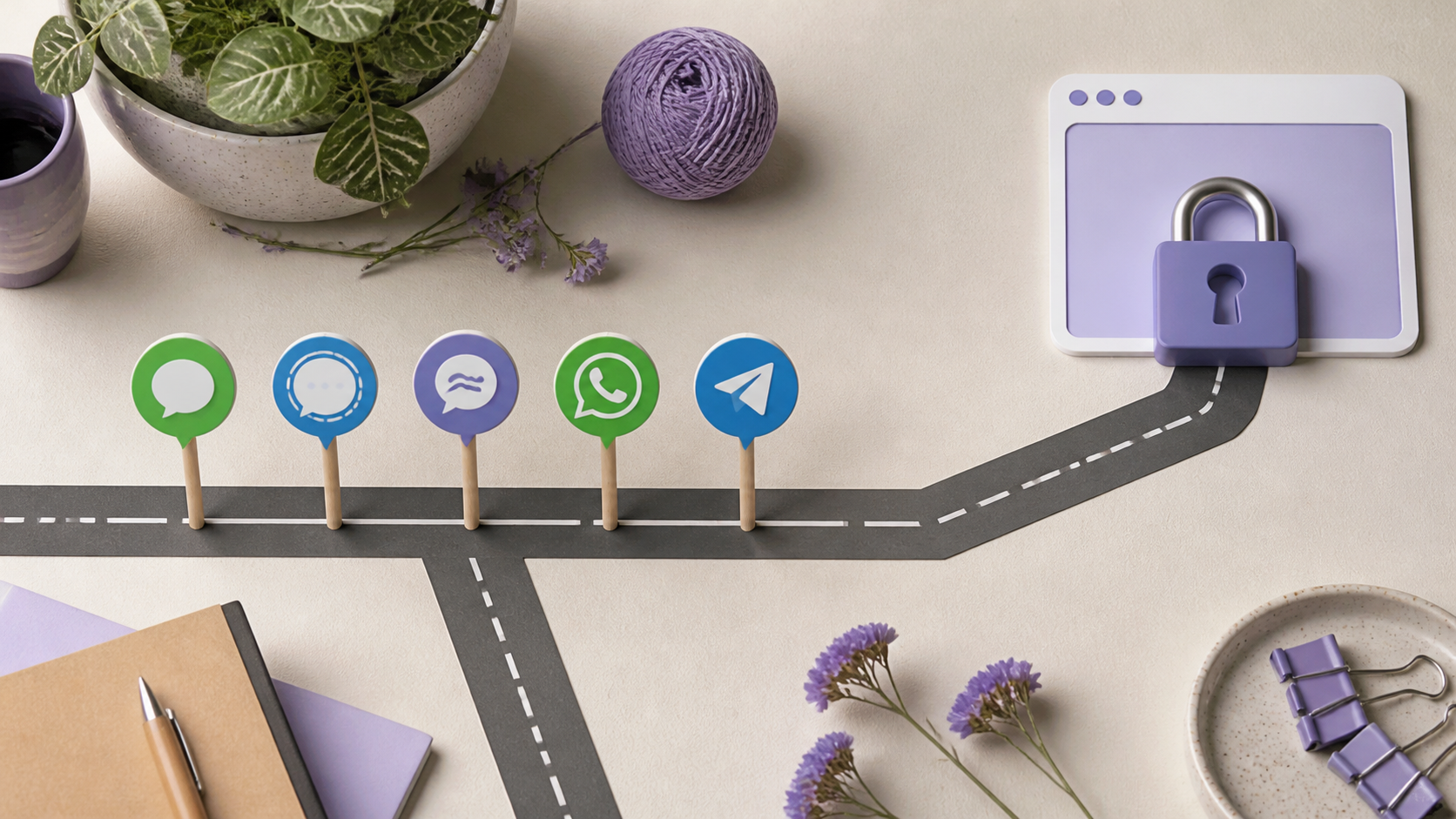
Signal, Telegram and the different strengths people notice
Signal is often the first app people mention when they want a more private messenger. It is widely associated with strong security, straightforward design and a focus on messaging rather than social features. For many users, that is exactly the appeal. It feels like a communication tool rather than a platform.
Telegram attracts a different audience. People often choose it because it feels flexible, supports large groups and channels, and has a broader feature set. That can be attractive when the goal is community coordination, broadcast-style updates or quick sharing across large audiences. The trade-off is that the conversation around Telegram often includes questions about which chats are protected in the same way, and how much the app is used as a public platform rather than a private messenger.
The interesting part is that many users do not choose based on a single principle. They choose based on the mix. A person may value Signal for private conversations and still keep Telegram for large groups, or vice versa. The decision is usually driven by the people already using the app, not by an abstract preference for one philosophy.
Why adoption is often about convenience, not ideology
Messaging apps have a network effect problem. If your friends, colleagues or community are already on one platform, that platform becomes the default regardless of its feature list. This is why the best app on paper is not always the one people end up using. Convenience tends to beat idealism in daily life.
That does not mean privacy never wins. It does, but usually when there is a clear reason to care. Someone may want to reduce reliance on a phone number, avoid a service tied closely to an advertising ecosystem, or separate private conversations from social profiles. Those are concrete motivations, not abstract preferences.
For groups, the winning feature is often simply continuity. If an app handles migrations badly, people will resist it. If it makes joining a chat easy and does not force them to learn a new pattern for every task, it has a far better chance of success than a more “secure” app that demands patience from everyone involved.
How to compare apps without getting lost in the noise
It helps to ask a few direct questions instead of reading feature lists in isolation. The point is not to find the theoretically best messenger. The point is to find the one that fits your communication habits with the fewest compromises.
- Can I reach the people I message most often?
- Do I need an app that works well on desktop as well as mobile?
- Is my phone number visible to everyone, or can I use a username or another identifier?
- Do I care more about private one-to-one chats or large public groups?
- How important are calls, file transfers and message search?
- Would my main frustration be privacy, usability, or getting other people to move?
If you answer those questions honestly, the choice becomes much clearer. A truly private messenger that is hard to use may still be right for a sensitive conversation. A more feature-rich app may be better for a community or team. There is no universal winner because people are not looking for the same thing.
It is also worth remembering that “private” can mean different things. Some people want fewer data collected by the service. Others want stronger message protection. Others simply want less exposure through their contacts, profile or phone number. A good comparison makes those differences visible instead of treating privacy as one single box to tick.
What a sensible switch actually looks like
If you are thinking about changing apps, start small. Pick one or two people you talk to regularly and test the new app there first. Make sure notifications work, messages arrive promptly, and any desktop or web support feels comfortable enough for daily use. If that works, expand from there.
Be careful about forcing a full migration too quickly. Most people will tolerate an extra app if there is a clear reason, but they will not adopt a new one simply because it is newer or more secure. A useful WhatsApp alternative has to respect habits as well as principles.
In that sense, the best choice is often the one that removes the most friction from the conversations you already have. Privacy is important, but the real test is whether the app helps you communicate more naturally, with fewer compromises and less noise.
Frequently asked questions
Is Signal always the best WhatsApp alternative?
Not always. Signal is often the strongest choice for straightforward private messaging, but the best app depends on what you need. If you want large groups, public channels or extra flexibility, another app may fit better. The right choice depends on your priorities, not a single ranking.
Is Telegram a private messaging app?
Telegram can be used privately, but people often choose it for its broader features and community functions. That means it is worth checking how each type of chat is handled and what level of privacy you actually want. The term “private messaging” covers more than one design approach.
What feature matters most for most people?
Usually it is convenience. That includes finding contacts easily, sending messages across devices, and getting other people to join without friction. Privacy matters a great deal, but if the app is awkward or isolated, many people will not stick with it.
If you are comparing messaging apps, the clearest guide is not the loudest promise but the quietest frustration. Choose the tool that handles your everyday conversations well, protects the parts of communication that matter to you, and does not make simple things feel difficult.

Writer & Editor at PigeonChat
Related Articles

How PigeonChat.site fits the Messenger and Telegram search

How PigeonChat.site differs from WhatsApp and Telegram

How PigeonChat.site compares with WhatsApp and Signal
When Signal is not enough: comparing private chat apps
What a European chat app should offer now