How Encrypted Messaging Works: A Plain-English E2EE Guide (2026)
A jargon-free explanation of how encrypted messaging works in 2026 - end-to-end encryption, keys, forward secrecy, metadata and what makes a high security chat app.
Almost every messaging app in 2026 promises security. Very few explain what that promise actually means, and the gap between the marketing word "encrypted" and the engineering reality is where most people get a false sense of safety. This guide explains how encrypted messaging works in plain English — no maths degree required — so that when an app calls itself a high security chat app, you can tell whether that is architecture or advertising.
By the end you will understand what end-to-end encryption is, how E2EE messaging differs from the weaker kind, what a secret chat app really offers, and why the phrase "the most secure chat app" only means something when you know what it is being measured against.
The Core Idea: Locking a Message So Only Two People Can Open It
Encryption is the process of scrambling a message so that it looks like meaningless noise to anyone who intercepts it, and can only be unscrambled by someone holding the right key. Think of it as putting your note inside a box with a lock. Anyone can carry the box; only the person with the key can open it.
The critical question — the one that separates real privacy from theatre — is simple: who holds the keys?
Encryption in transit (the weak version)
Many apps encrypt your message while it travels from your phone to their servers, and again from their servers to your recipient. That protects you from someone snooping on the wifi in a coffee shop. But the message is decrypted on the company's server in the middle. The company holds a key. That means the message can be read by the provider, handed to a government on request, exposed in a data breach, or scanned to build an advertising profile. This is better than nothing, but it is not private from the company itself.
End-to-end encryption (the strong version)
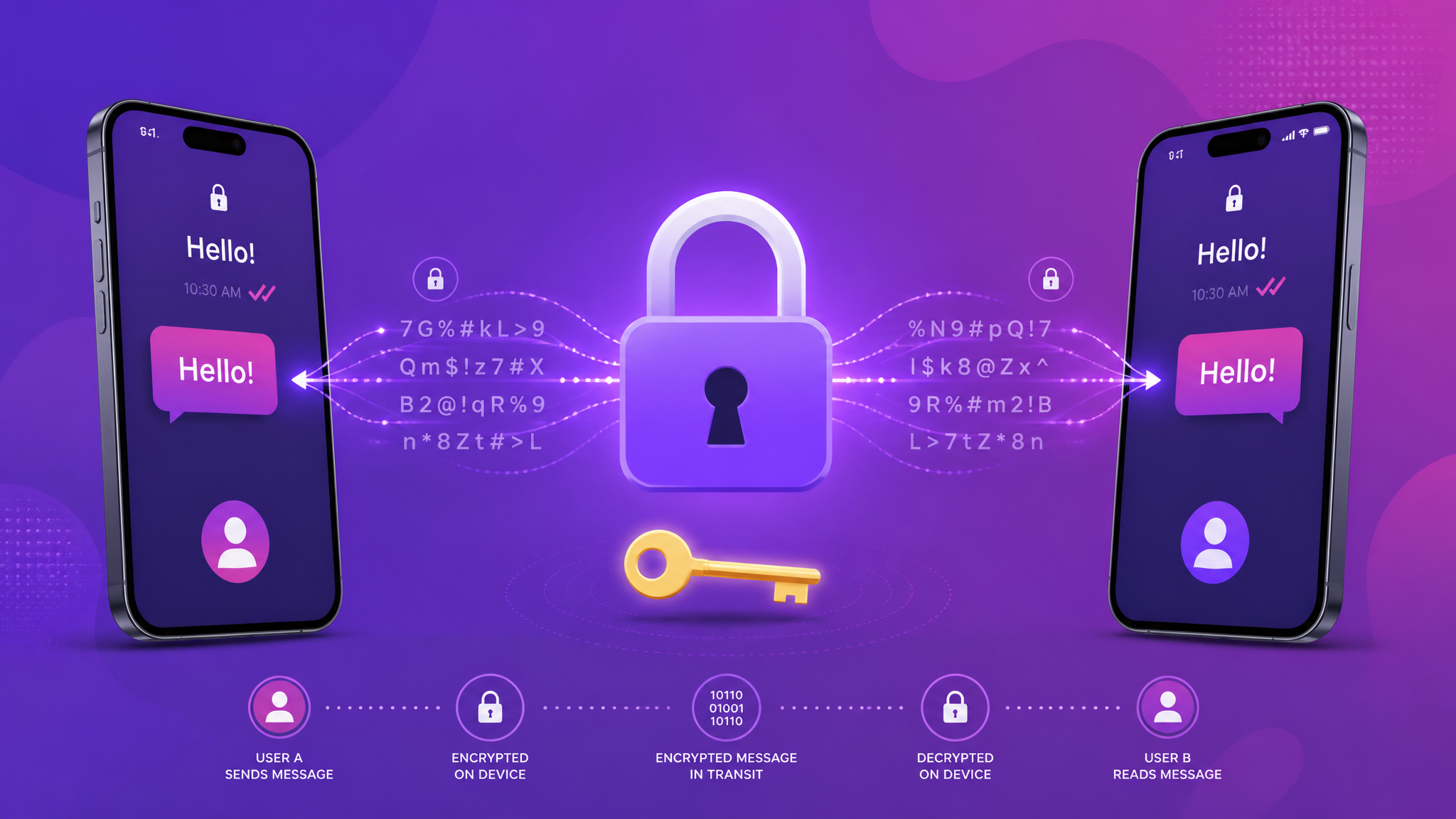
End-to-end encryption (E2EE) means the message is encrypted on your device and can only be decrypted on your recipient's device. The keys live on the two phones — the "ends" — and never on the server. The provider carries a sealed box it genuinely cannot open. It cannot read your message, cannot hand over readable content, and cannot leak what it never had. This is the standard that matters, and it is the foundation of every genuine end-to-end encryption application.
How the Keys Actually Work
Modern E2EE messaging relies on a clever bit of maths called public-key cryptography. Here is the intuition without the equations.
Every user has two keys that are mathematically linked: a public key and a private key. The public key is like a padlock you hand out freely — anyone can use it to lock a box addressed to you. The private key is the only thing that can open those boxes, and it never leaves your device.
When someone sends you a message, their app uses your public padlock to lock it. Only your private key can open it. Even the person who sent it cannot unlock it again once it is sealed for you. The server that relays the box has never seen either private key, so it is carrying something it cannot read.
Forward secrecy: new keys for every message
The best protocols go a step further. Instead of using one key forever, they generate fresh keys constantly — often for every single message — using a technique called a "ratchet". This property, called forward secrecy, means that even if one key were somehow compromised, an attacker could not use it to decrypt your past or future conversations. Each message is locked with its own disposable key. This is the engineering behind what people loosely call a secret chat app or an invisible chat app: not that the messages are hidden from view, but that they are cryptographically sealed and leave almost nothing behind.
Metadata: The Part Encryption Does Not Cover
Here is the point most "how encryption works" explainers skip. Encrypting the content of a message does not automatically hide the metadata — the record of who messaged whom, when, how often and from where. Metadata is generated by the act of communicating, not by the content, so encryption alone does not protect it.
Intelligence agencies have said for over a decade that metadata is often more revealing than content. "They know you called a suicide hotline at 3am, spoke for twenty minutes, then called your doctor" tells a story without a single word of the conversation. A genuine high security chat app therefore does two jobs: it encrypts content end-to-end and it collects and retains as little metadata as technically possible.
What Makes One App More Secure Than Another
| Security property | What to look for |
|---|---|
| E2EE by default | On for every chat automatically, not a mode you enable |
| Forward secrecy | Fresh keys per message so old keys cannot unlock new messages |
| Minimal metadata | Little collected, little retained, no social graph harvesting |
| No identity requirement | Username-based accounts, no mandatory phone number |
| Real deletion | Delete removes the message, not just hides it from your view |
| Open, reviewable design | Protocol and claims that experts can inspect, not "trust us" |
An app that ticks all six is meaningfully entitled to describe itself as among the most secure chat apps. An app that encrypts content but requires your phone number, retains rich metadata and only turns encryption on inside a special "secret chat" is doing one part well and several parts badly.
How PigeonChat Handles Encryption
PigeonChat was designed around these principles rather than retrofitting them. End-to-end encrypted messaging is on by default for private conversations — there is no separate "secret" mode to remember. Accounts are created with a username instead of a phone number, so your identity is not tied to a telecom record. There are no adverts, which removes the commercial incentive to harvest the metadata that encryption does not cover.
The goal is that being an invisible chat app in the meaningful sense — leaving as little readable trace as possible — should not require technical effort from you. Security that depends on the user remembering to switch it on protects only the conversations they remember to protect. Security that is the default protects all of them.
End-to-end encrypted team messaging
The same foundation extends to groups. End-to-end encrypted team messaging means a work channel or a community group gets the same cryptographic treatment as a one-to-one chat, so sensitive team conversations are not sitting readable on a server waiting to be breached or subpoenaed.
A Real-World Analogy: The Sealed Box and the Padlock Wall
If the key talk still feels abstract, here is an analogy that captures it. Imagine a public wall where everyone hangs open padlocks with their name on them. Anyone who wants to send you a private parcel takes one of your padlocks, puts the parcel in a box, and snaps your padlock shut. Now only you — the one person with the matching key at home — can open it. The courier who carries the box, and even the person who packed and locked it, cannot reopen it once it is sealed.
That is public-key cryptography in a sentence. Your public key is the padlock you hang on the wall for anyone to use; your private key is the key you never let out of your house. The genius of the system is that locking and unlocking use different keys, so handing out your padlock freely does not compromise your ability to be the only one who can open what is sent to you.
Forward secrecy adds one more twist: instead of using the same padlock forever, the system quietly swaps in a brand-new padlock and key for practically every parcel. So even if someone somehow stole one key, it would open exactly one box — not your entire history of correspondence.
Common Encryption Myths, Debunked
"If I have nothing to hide, encryption does not matter." Encryption is not about hiding wrongdoing; it is about controlling context. You seal letters, curtain your windows and lock your phone without having anything to hide. Encryption is the same instinct applied to the most revealing record you generate — your conversations.
"All encrypted apps are basically the same." They are not. The difference between encryption in transit and end-to-end encryption is the difference between the company being able to read you or not. And even among E2EE apps, metadata handling and identity requirements vary enormously.
"End-to-end encryption means I am completely anonymous." No. Encryption protects the content of your messages. Anonymity is a separate property that depends on metadata and whether you had to hand over identifying details like a phone number to sign up. A truly private app addresses both, but they are not the same thing.
"Governments have secret backdoors into all encryption." Correctly implemented modern encryption has no secret master key. This is exactly why there are recurring public debates about mandating backdoors — they do not currently exist in well-built E2EE systems, and adding one would weaken security for everyone, not just the intended target.
Frequently Asked Questions
Is end-to-end encryption unbreakable?
The encryption itself is, for practical purposes, unbreakable with current technology when implemented correctly. The realistic weak points are the devices at each end (a compromised phone, a screen someone photographs) and metadata, not the maths. That is why default encryption plus minimal metadata plus device security together make an app genuinely secure.
What is the difference between a secret chat and a normal encrypted chat?
On some apps, "secret chat" is the only mode that is end-to-end encrypted, and normal chats are only encrypted in transit. On a well-designed app there is no such split — every private chat is end-to-end encrypted, so the "secret" distinction is unnecessary.
Can the app company read my end-to-end encrypted messages?
No. With true E2EE the keys live only on the sender and recipient devices, so the provider carries ciphertext it cannot decrypt. That is exactly what makes it different from ordinary "encrypted" apps where the server holds a key.
Does encryption make the app slower?
Not noticeably. Modern encryption is extremely fast on current hardware and adds no perceptible delay. Any speed difference between apps comes from their servers and design, not the cryptography.
The Bottom Line
Now you know how encrypted messaging works: content is locked with keys that live only on your devices, the best apps rotate those keys constantly for forward secrecy, and the real remaining exposure is metadata and device security rather than the encryption itself. The label secure messaging app 2026 is only worth anything when the app encrypts by default, minimises metadata and does not demand your identity to sign up.
If you want an app that was built to satisfy all of those at once, download PigeonChat or read our guide to the best privacy apps of 2026. To see how the encrypted approach compares with the mainstream messengers, read WhatsApp vs Telegram vs Signal vs Viber vs Messenger.

Writer & Editor at PigeonChat
Related Articles
What a European chat app should offer now

What an EU chat app needs beyond privacy claims
What a browser-based end to end encryption chat app needs
How PigeonChat.site fits the EU privacy app search
Why browsers are becoming the new private chat home