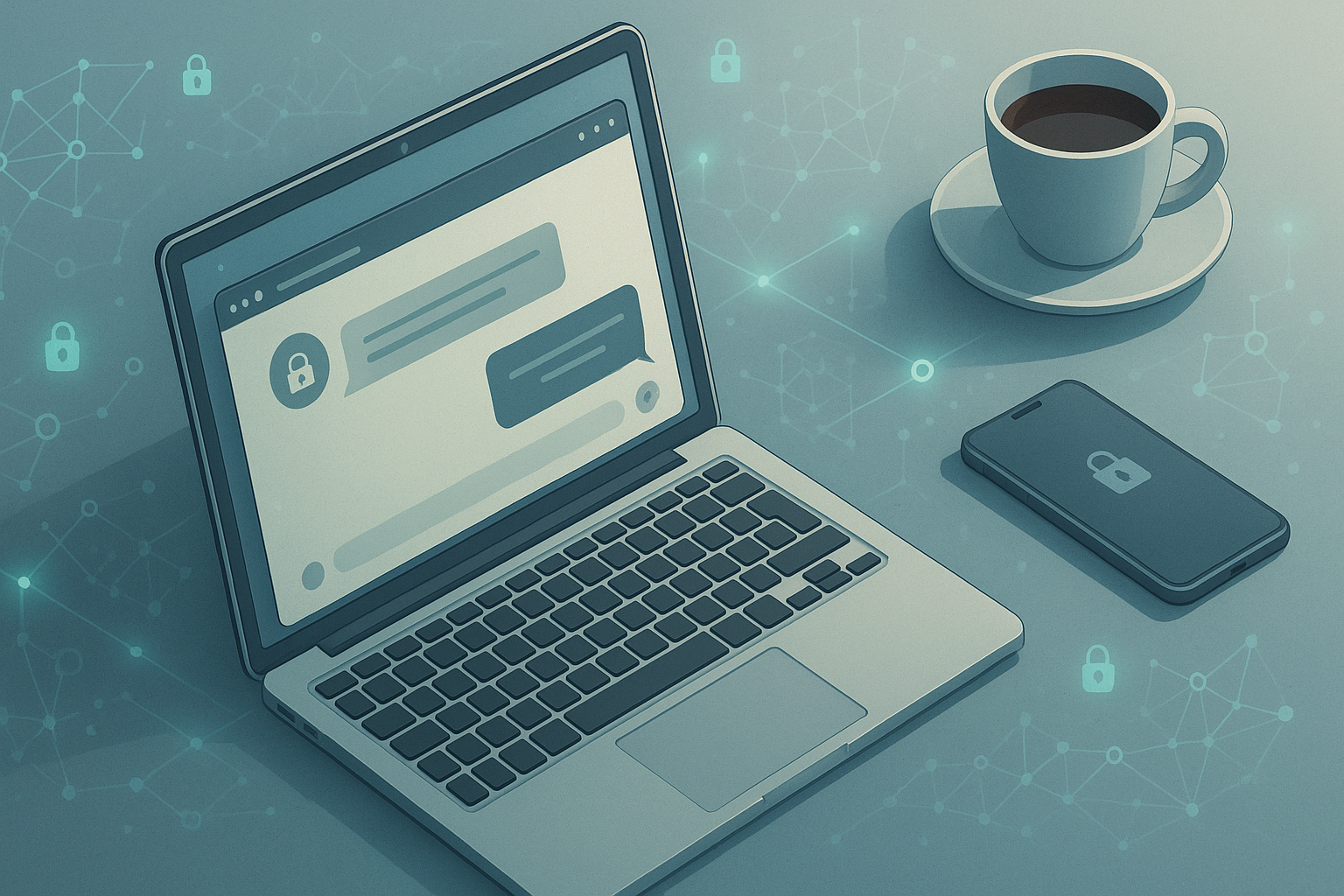
How encrypted private chats work in a browser app
A practical explanation of browser-based encrypted private chats, what encryption means in everyday use, and what users should check first.
Encrypted private chats sound technical, but the basic idea is simple. Your message is scrambled on your device before it leaves your browser, then only the other person’s device can turn it back into readable text. Anyone who intercepts it in transit sees encoded data rather than the conversation itself.
That matters because browser based private messaging has to work in a place that is naturally exposed: the web. A browser app runs in a shared environment, so good privacy design is less about magic and more about careful handling of keys, login sessions and message storage. If you understand those pieces, the whole system becomes much less mysterious.
This guide explains the moving parts in plain language. It is written for anyone who wants the privacy benefits of encrypted private chats without needing to study cryptography first. You can use the same principles whether you are comparing a messenger, thinking about Signal, or trying a product like PigeonChat.
What encryption is doing in a chat app
At its simplest, encryption is a lock. You write a message, the app locks it with a key, and the recipient’s app unlocks it with the matching key. Without the right key, the message should be unreadable.
In a browser app, this usually happens in your browser before the message is sent. That is important because it means the server is not supposed to see your plain text. The server may still help route the message, store it temporarily, or sync it between devices, but it should only handle scrambled content.
People often hear “encrypted” and assume that means everything is hidden from everyone. In practice, only the message content is protected by design. Other details, such as when a message was sent or which account is communicating, may still be visible to the service unless it is specifically built to minimise that information too.
How browser based private messaging works step by step
When you open a browser based private messaging app, the site loads the code needed to create and manage encryption in your browser. You sign in, create a chat, and the app sets up a secure way to talk to the other person.
Behind the scenes, the app is usually working with public and private keys. A public key can be shared, like a postbox address. A private key stays with you, like the key to your own mailbox. The browser uses these keys to encrypt outgoing messages and decrypt incoming ones.
Here is the typical flow in simple terms:
- You type a message in the browser.
- Your browser turns the message into encrypted text.
- The server receives only the encrypted version.
- The recipient’s browser decrypts it with the correct key.
- Only then does the message appear as readable text.
This is why browser apps can still be private even though they run on the open web. The important work happens locally on your device, not on the server’s side. That does not make every browser app equally safe, but it does explain the basic model.
What “private” should mean in a messenger
Private can mean different things depending on the product. In a strong privacy setup, only the participants in the chat can read the message content. In a weaker setup, the service may still be able to access messages, perhaps because it stores them unencrypted or can decrypt them on the server.
When people compare a messenger to Signal, they are usually asking whether the service protects message content end to end. That phrase, end to end encryption, means the message stays protected from the sender’s device to the recipient’s device, with the service in the middle unable to read it. It is one of the clearest models for private chats.
That said, privacy is broader than message secrecy. A practical private chat should also think about metadata, device trust, session security and how long messages are retained. A service can claim encryption and still make weak choices elsewhere.
What can still be exposed even when messages are encrypted
Encryption protects content, but it does not automatically hide everything around the conversation. This is where many people get caught out. A service may not know what you wrote, but it might still know that you messaged someone, when you did it, or which browser session was active.
Some common things that can remain visible include:
- Account identifiers such as email addresses or usernames.
- Connection timing, like when a message was sent or received.
- Device and browser information used for login or recovery.
- Message size, which can sometimes hint at activity patterns.
- Any content you choose to share outside the encrypted chat itself.
For most people, this is not a reason to avoid encrypted private chats. It is a reason to understand the limits. Privacy is usually about reducing what others can learn, not about making you invisible in every sense.
What makes browser apps different from installed messengers
A browser app has one big advantage: it is easy to access. You can open it on a laptop without installing anything, and updates happen in the background. That convenience is one reason browser based private messaging has become appealing.
But browser apps also depend on the environment they run in. Your browser, extensions, operating system and device security all matter. If another extension can read page content, or if your device is compromised, encryption may not protect you from that local risk. A well designed app can reduce the chances of exposure, but it cannot fix a badly secured device.
That is why privacy-minded products tend to focus on simple habits too. Keep your browser updated. Use trusted devices. Avoid logging in on shared machines unless you fully understand the session controls. Services like PigeonChat are useful not only for the chat itself, but also for reminding people that privacy is a system, not a single feature.
How to judge an encrypted private chat tool
If you are choosing a messenger, do not stop at the word encrypted. Look for signs that the privacy model has been thought through. A clear explanation is often more valuable than a complicated one.
Ask questions like these:
- Can the service read my messages, or are they protected end to end?
- Where are keys stored, and are they protected on my device?
- Does the app explain what metadata it keeps?
- Can I use it in a browser without installing extra software?
- What happens if I switch devices or clear my browser data?
A good service will not pretend these questions do not matter. It will answer them in plain language, because privacy should be understandable. If an app seems to rely on vague promises, that is a sign to be cautious. The safest choice is often the one that is honest about its limits.
Frequently asked questions
Is browser based private messaging less secure than a desktop app?
Not automatically. A browser app can be very secure if it is built well and your browser environment is trustworthy. The main difference is that a browser depends more heavily on the device, extensions and session hygiene. A desktop app may offer different controls, but it is not inherently safer just because it is installed.
Can the server read my messages if they are encrypted?
It should not be able to, if the app uses end to end encryption correctly. The server may still handle encrypted blobs, account data and message delivery, but the plain text should remain on the sender and recipient devices. If a service decrypts messages on its own servers, that is a different privacy model.
What should I do if I want private chats but do not want technical complexity?
Choose a messenger that explains its privacy model clearly, keeps the interface simple, and makes encryption part of the default experience rather than an optional setting. Look for tools that treat key handling and message protection as built-in. If you prefer browser access, start with a service that is transparent about how it works and what it stores.
In the end, encrypted private chats are less about mystery and more about design. The best browser based private messaging tools make strong privacy feel ordinary, with the hard work happening quietly in the background. If you remember only one thing, let it be this: encryption protects message content, but good privacy depends on the whole system around it, from the browser to the server to the device in your hands.

Writer & Editor at PigeonChat
Related Articles
PigeonChat.site in the UAE chat app search

What makes a strong European chat app today

What users expect from chat features in 2026

How PigeonChat.site fits private messaging needs today
What a European chat app should offer now