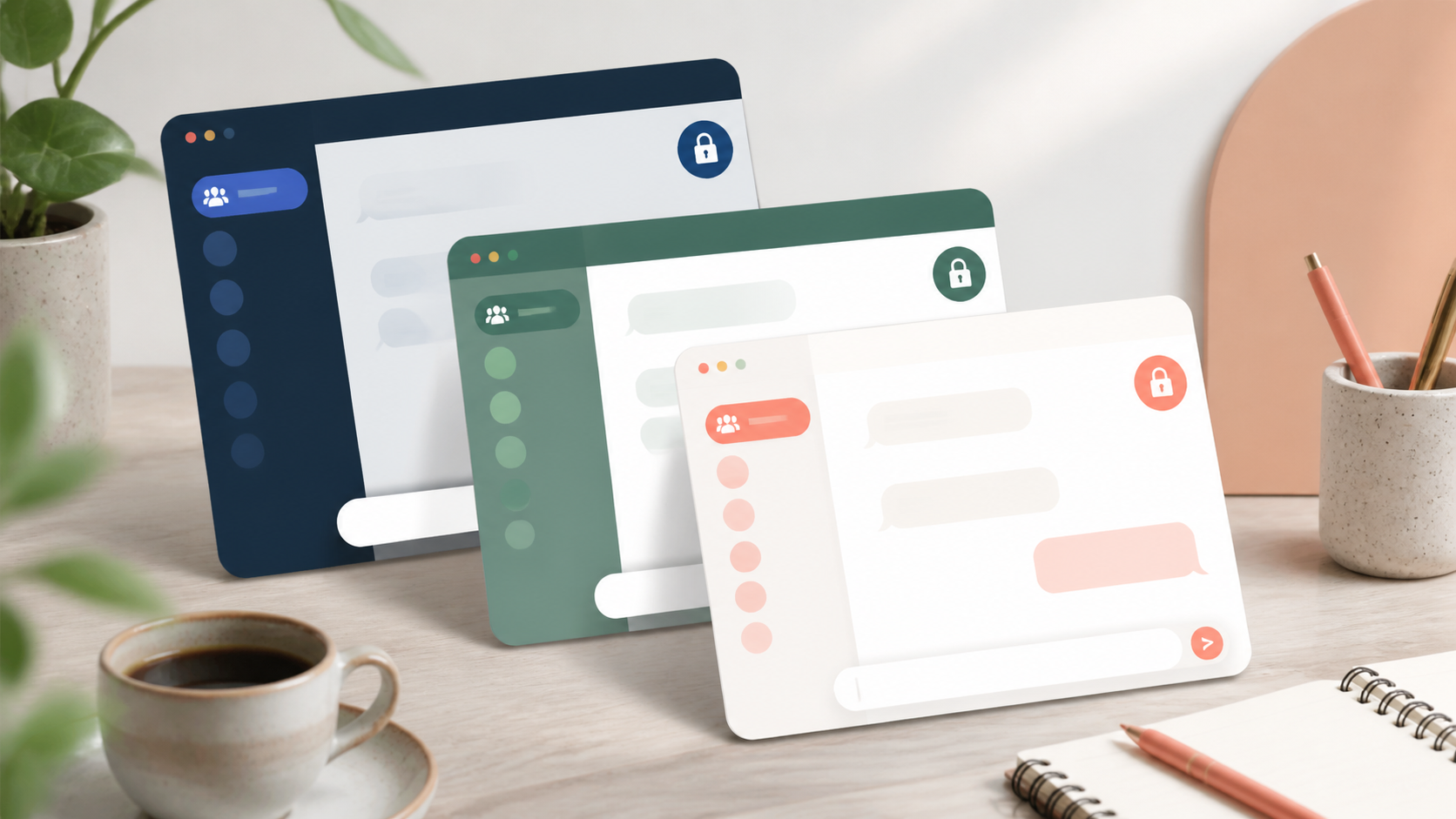
Viber and Messenger alternatives for private group chats
People comparing Viber and Messenger often want fewer distractions, better privacy, and group chat tools that work for communities and teams.
When people start looking for Viber and Messenger alternatives, privacy is usually the first reason they mention. The second is often group control. In other words, they are not simply looking for another app to send messages in. They want an alternative chat app that gives them clearer boundaries, fewer distractions, and better ways to manage chat groups.
That shift makes sense. Mainstream platforms are convenient, but convenience can come with trade-offs: broad contact syncing, looser group controls, and features that are designed for reach rather than for privacy. If your priority is a smaller, more deliberate space for friends, family, a project team, or a community, the right app will feel quite different.
This article looks at why people move away from viber and messanger, what to look for in a private group chat tool, and how to choose a platform that fits the way you actually talk.
Why people leave Viber and Messenger behind
Most people do not switch because they dislike the basics of messaging. They switch because their needs have changed. A family chat may become too noisy. A work group may need better admin controls. A hobby group may want more privacy than a mainstream network can comfortably offer.
For many users, the problem is not one single feature. It is the overall feel of the app. When a chat platform is tied closely to a larger social ecosystem, it can be harder to keep conversations contained. That is why a private group chat alternative often feels more appealing than sticking with familiar defaults.
People also want less pressure. In some apps, read receipts, contact suggestions, and social cues can make every conversation feel more public than private. A better alternative chat app tends to make the group itself the centre of attention, not the wider platform around it.
Privacy is the main reason for switching
Privacy means different things to different people, but in chat groups it usually comes down to control. Who can find the group? Who can see member details? Who can invite others? Can the group stay focused without leaking too much personal information?
This is one of the strongest arguments for moving away from larger consumer platforms. A privacy-focused app often reduces the amount of exposed profile data and gives admins more control over how the group operates. That matters whether you are organising a volunteer team, supporting a small club, or just keeping a close family group tidy.
It is worth being realistic, though. No app can promise perfect privacy in every situation. The practical question is whether the tool gives you sensible controls and clear defaults. If it does, you are already in a better place than with many mainstream chat groups.
- Look for clear group invite settings.
- Check whether member lists are visible to everyone.
- See if the app lets admins remove, mute, or restrict people easily.
- Pay attention to what profile information is shared by default.
- Prefer tools that explain privacy settings in plain language.
Better group management makes a real difference
If you are comparing viber and messenger alternatives, group management should be near the top of your list. A good group chat is not just a place to post messages. It is a space that stays organised when several people are active at once.
Useful admin tools can make a huge difference. Think of pinned messages, approval for new members, role-based permissions, message moderation, and the ability to segment different kinds of conversation. These features are especially helpful when the group has a purpose beyond casual chat.
For example, a school parent group may need a single place for announcements and a separate space for general discussion. A club may want one group for events and another for committee planning. The best tools help you structure chat groups without forcing everyone into one noisy stream.
What to look for in an alternative chat app
If you are evaluating any alternative chat app, start with the basics and then move into the details. Does it support the kind of group you need? Is it easy for people with different levels of technical confidence? Can admins keep the group readable without constant effort?
Good usability matters as much as privacy. A secure app that is awkward to use will still frustrate people. You want something that feels straightforward on day one, but still has enough depth to handle growing groups later.
Here are the features that are usually worth checking first:
- Invite links or approval-based joining
- Admin roles and moderation tools
- Muted threads or topic separation
- Clear notification controls
- Search within the group
- Cross-device support
- Simple settings for privacy and visibility
It can also help to ask how the app treats large and small groups differently. Some tools are fine for private family chats but awkward for broader communities. Others work well when there are clear admin controls but become cluttered when lots of people join. Matching the app to the actual use case is more useful than chasing a long feature list.
How to choose the right chat groups platform
The best choice depends on the group, not the marketing. A private group chat for friends may need only basic controls and easy onboarding. A community group may need stronger moderation and tighter join rules. A work-related group may need clearer separation between announcements and discussion.
If you are comparing options, try to think in terms of friction. Where do people get confused? Where do messages get lost? Where do privacy concerns appear? The right platform should reduce those problems, not create new ones.
Some people prefer to test a few tools side by side with a small group first. That can be a sensible way to avoid moving everyone too quickly. If you do want a place to start, PigeonChat is built around simple group communication with an emphasis on clarity and control. Even if you do not use it, that is the kind of product direction worth looking for.
Why the best alternatives feel calmer
The strongest Viber and Messenger alternatives are not necessarily the most feature-heavy. They are often the ones that feel calmer to use. That calm comes from a few things working together: fewer distractions, stronger group boundaries, and settings that make sense without a manual.
When people say they want a better chat app, they usually mean they want conversation to feel more intentional. They want to know who is in the room, who can post, and how the group stays manageable over time. That is where privacy and moderation meet.
As a result, the best choice is usually not the app with the biggest name. It is the one that gives your group a sensible home. If an alternative chat app helps people communicate without oversharing or losing track of the thread, it has already done something valuable.
Frequently asked questions
Why do people look for Viber and Messenger alternatives?
Most people are looking for more privacy, better control over who joins the group, and simpler ways to manage chat groups. They often want an app that feels more contained and less tied to a wider social network.
What makes a good private group chat app?
A good private group chat app gives admins useful controls, keeps member information limited where possible, and makes it easy to organise conversation. It should also be simple enough that everyone in the group can use it without much effort.
Is the most secure app always the best choice?
Not necessarily. Security matters, but usability and group management matter too. The best app is the one that fits the group’s actual needs, stays understandable for members, and gives you enough control without becoming hard to use.
If you are choosing between familiar platforms and a new alternative chat app, focus on the people in the group and the way they actually communicate. Privacy is important, but so is making the group easy to run. When those two things come together, chat groups become much more useful for everyone involved.
Ready to try PigeonChat?

Writer & Editor at PigeonChat
Related Articles

How PigeonChat.site fits the Messenger and Telegram search

How PigeonChat.site differs from WhatsApp and Telegram

How PigeonChat.site compares with WhatsApp and Signal

When Signal is not enough: comparing private chat apps

Why PigeonChat.site asks you to invite your partner first