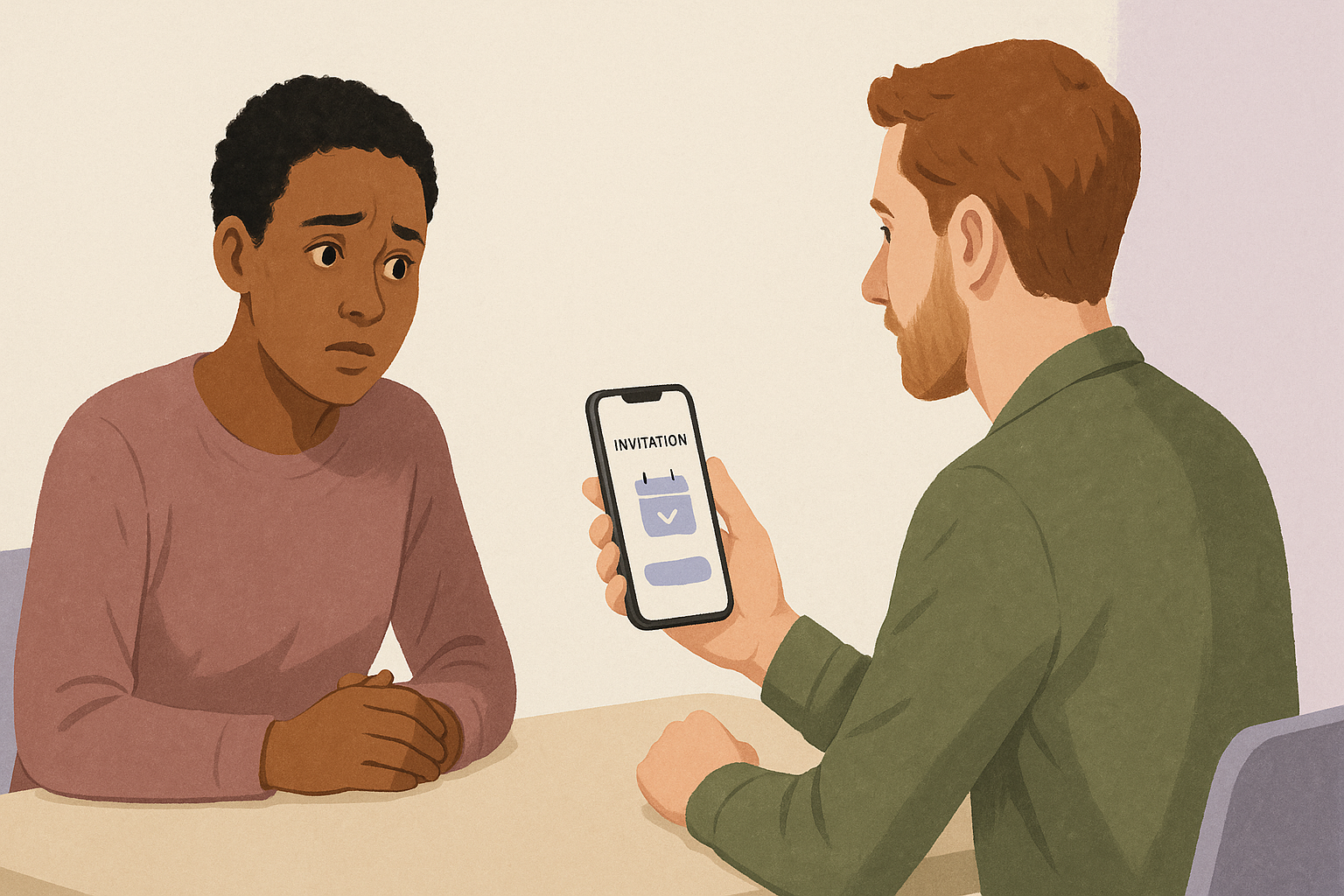
Why invite your partner to PigeonChat.site can feel awkward
Many users hesitate at the invite your partner to PigeonChat.site step. This article explains the friction and when the flow actually makes sense.
Invite-first onboarding can work well when the value is immediately obvious to both people. It can also create a quiet moment of hesitation: do you invite your partner now, later, or at all? That tension is exactly why asking someone to join a new service like PigeonChat.site can feel awkward, even when the idea itself is harmless.
In dating and relationship tools, the social step is often the hardest step. The product may be simple, but the invitation carries meaning. It can sound like a request for commitment, approval, or public proof of the relationship. If the benefit is not clear to both people, the invitation can feel less like a convenience and more like a test.
This matters because the first message someone receives shapes how they read the whole experience. If they think the platform is for joint use, shared planning, or keeping a conversation in one place, they are more likely to engage. If they only see an unexplained invite to PigeonChat, they may wonder what is expected of them and why they are being asked to join at all.
Why the invitation feels personal before the product feels useful
People do not only react to the app. They react to what the invite implies. An invitation to “join me” can suggest closeness, but it can also introduce pressure. For couples, that pressure often comes from not knowing whether the platform is meant for practical coordination, playful communication, or something more intimate.
That is why “invite your partner to pigeonchat.site” is not just a user action. It is a social signal. The sender may mean, “This could be useful for us,” but the receiver might hear, “I want you to enter my space, on my terms, for my reason.” Those are very different experiences.
When the benefit is not obvious, people often delay. They want to understand the reason before they involve someone important to them. In relationship contexts, that hesitation is normal, not a sign that the idea is bad. It simply means the onboarding needs to carry more explanatory weight.
What makes invite-first onboarding awkward
Invite-first flows ask someone to bring a second person into the experience before they have fully experienced it themselves. That can be efficient for the product, but it shifts the burden of explanation onto the first user. They become the interpreter, the advocate, and sometimes the persuader.
This is where awkwardness begins. If a person cannot clearly explain what their partner will gain, they may soften the invitation, over-explain it, or avoid sending it altogether. In practice, that means the product depends on confidence before it has earned trust.
The challenge is not unique to PigeonChat.site. Any tool that relies on a pair, a group, or a shared space has to answer one question quickly: why should the other person care? Without a crisp answer, the invite can feel like homework rather than a welcome.
- The inviter may not know how to describe the benefit simply.
- The invitee may worry about expectations or hidden obligations.
- Both people may want to see value before making a shared commitment.
- The more personal the relationship, the more sensitive the invitation can feel.
How to make the benefit obvious to both people
If a platform is built around couples, the benefit should be understandable in plain language. Not “start your journey together”, but what can they actually do, and why is it easier than using a general chat app? The answer should appear before the invite is sent, not after.
Good onboarding gives both people a reason to participate. That might mean showing a shared goal, a clear use case, or a preview of how the conversation works once both accounts are connected. The point is to reduce the need for one person to sell the idea second-hand.
For dating with PigeonChat.site, that clarity matters even more. A relationship-focused tool should not rely on the user to translate vague benefits into excitement. It should make the value self-evident, so the invite feels like a practical next step rather than a social gamble.
Signals that help people say yes without pressure
People are more comfortable joining when the invitation feels low-stakes, reversible, and easy to understand. That does not mean the product has to be casual or shallow. It means the first interaction should respect uncertainty rather than fight it.
One useful approach is to explain the shared purpose before asking for action. Another is to show that the first step is small. If the invitee understands that they are not committing to a big setup process, they are less likely to feel cornered by the request.
In practice, the best signals are the ones that answer likely concerns before they are voiced. That includes clarity about what the couple can do, whether both people need to be equally active, and whether the experience is private between them. People relax when the system feels understandable.
Design choices that reduce the awkwardness
Some invite flows assume enthusiasm and skip the emotional context. That can be fine for utility software, but it is risky in dating or relationship products. When the product is about connection, the invitation itself becomes part of the product experience.
A better approach is to design the invite around mutual benefit. If one partner can clearly see what changes for both of them, the request feels less one-sided. That can be as simple as a short explanation, a preview, or language that frames the product as a shared space rather than a favour.
Useful design patterns often include:
- A short explanation of why both people should join.
- A preview of the shared experience before the invite is sent.
- Language that avoids sounding like an ultimatum.
- An easy way to decline or delay without embarrassment.
- A clear distinction between private use and shared use.
These ideas are not about making things longer. They are about making the purpose easier to grasp. When a person understands the why, the ask stops feeling like a social puzzle.
What this means for love, trust, and product adoption
Love on PigeonChat.site, or on any relationship platform, should not depend on awkward persuasion. If the product is genuinely helpful, the invitation should feel like sharing something useful, not recruiting someone into an experiment.
That is the broader lesson here. Invite-first onboarding can be a barrier when the benefit is not self-explanatory. The first person may be interested, but still hesitate because they cannot yet justify the request to someone else. When the platform makes the value clear to both people, adoption becomes easier and the experience feels more respectful.
PigeonChat can still use invitation as part of its flow, but the invite should be the conclusion of a clear story, not the start of one. When both partners can see what they get from the beginning, the awkwardness drops and the relationship, not the signup, becomes the focus.
Frequently asked questions
Why does inviting a partner feel more awkward than inviting a friend?
Because the invitation carries more meaning. With a partner, people often read the ask as a comment on the relationship, not just a request to try an app. That makes clarity and tone much more important.
What should a couple know before they join a shared chat product?
They should understand what the tool is for, what both people gain, and whether the experience is private and optional. If those points are unclear, one person may feel they are being asked to commit before they know enough.
How can products like PigeonChat.site make the invite feel easier?
By explaining the benefit plainly, showing how the shared experience works, and keeping the first step small. The more obvious the mutual value, the less pressure the inviter has to convince the other person.
The simplest rule is this: if you want someone to invite their partner to PigeonChat.site, do not make them do the hard work of explaining the value alone. Make the benefit visible, shared, and easy to understand, and the invitation stops feeling like a social risk.
Ready to try PigeonChat?

Writer & Editor at PigeonChat
Related Articles

Why PigeonChat.site asks you to invite your partner first

What pigeon chat means in searches and app discovery

Why people search for the best chat app UAE option

Why people search for a pigeon chat app online

Do you need a phone number or real name on PigeonChat.site