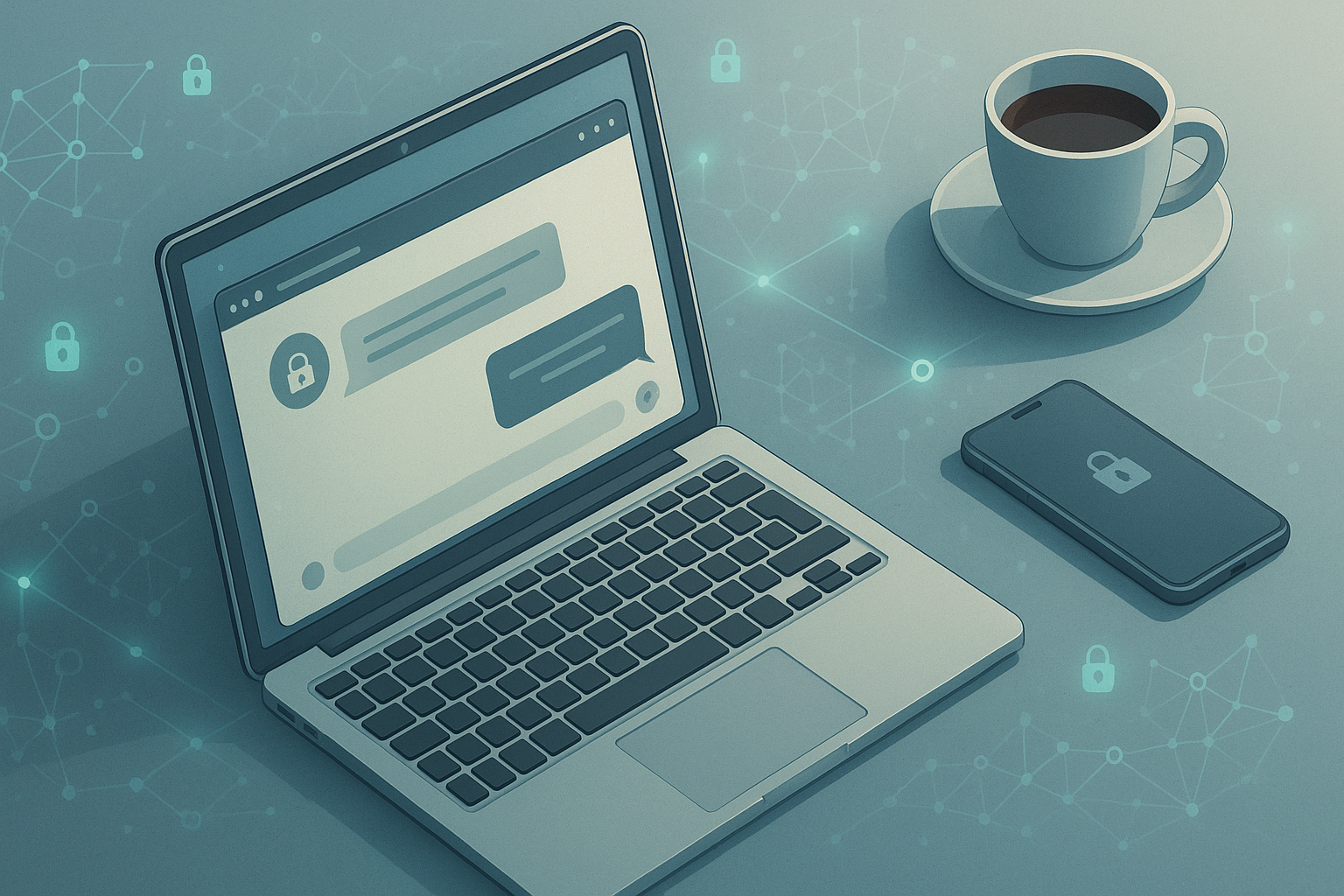

Why people want a private chat app without a phone number
People want messaging that starts with an email or username, not a phone number. This brief explains why that search keeps growing.
For many people, the appeal of a private chat app without a phone number is simple: it feels more private from the start. You do not have to hand over a number that is often used as a personal identifier, a recovery route, and sometimes a way to find you elsewhere. If you want a messaging app to be just a messaging app, that matters.
This is not a niche preference. It comes up whenever people compare a WhatsApp alternative, Signal, or any other messenger that asks for a phone number at sign-up. Some users want to separate chat from their SIM card. Others are avoiding spam, account linking, or the awkwardness of sharing a number just to speak to one person.
Phone-number-free login is also about convenience, not only privacy. A number can change, get recycled, or belong to a work line you would rather not use for personal conversations. If you are trying to set up an account quickly, or on a device without a SIM, an email address, username, or invite link can be far easier to manage.
Why the phone number feels like a privacy trade-off
A phone number is practical, but it is also sticky. It can connect messages to a real-world identity in a way many people do not want. Even if the app itself has strong encryption, the login method can still feel more revealing than necessary.
People are often comfortable sharing a number with a close contact, but less comfortable using it as the key to every conversation. That concern is especially common when they want a chat app for a community, a side project, dating, activism, or simply a separate personal presence.
The issue is not that phone numbers are automatically insecure. It is that they are broad identifiers. Once tied to an account, they can be harder to keep compartmentalised than a username or one-time invite.
Convenience is a major reason, too
Not everyone who avoids phone-number login is thinking about deep privacy strategy. Many just want a smoother start. If you have ever tried to sign up on a tablet, a desktop, or a secondary device, you will know that requiring SMS can be clumsy.
A no phone number flow can also reduce friction for teams and communities. You can invite people by link, let them choose a handle, and avoid the admin overhead of collecting numbers. That feels cleaner for onboarding and less awkward for first contact.
- No need to share a personal mobile number
- Easier sign-up on devices without a SIM
- Less dependence on SMS verification
- Better separation between work and personal life
- Lower risk of number-based contact syncing
For many users, that combination of privacy and convenience is the whole point. They do not want to wrestle with a system that assumes a phone number is the default identity.
What users are really asking for
When people say they want a private chat app without a phone number, they are often asking for control. They want to decide what information is required, what is visible to others, and how easily their account can be linked to the rest of their life.
That control can show up in several useful ways. A service might let you register with an email address, a username, or a private invite. It might hide your contact details by default. It might let you chat without exposing your number to every new contact.
In practice, users tend to value a mix of the following:
- Account creation without SMS
- Username-based discovery instead of number-based discovery
- Private by default profile settings
- Simple blocking and reporting tools
- Easy migration between devices
That is why the demand keeps growing. It is not only about being anonymous. It is about having a messaging identity that is separate, manageable, and not tied to one telecom detail.
How this compares with familiar messengers
Apps like WhatsApp and Signal are often mentioned in the same conversation, but they do not satisfy every use case equally. WhatsApp is deeply tied to phone numbers, which makes it familiar but also restrictive for people who want a cleaner separation. Signal has a stronger privacy reputation, yet many people still associate it with number-based identity.
That is where phone-number-free alternatives stand out. They are not necessarily better at everything, but they solve a specific problem that matters to a lot of users. If you are looking for a WhatsApp alternative because you want less exposure, the sign-up method may be just as important as the encryption model.
PigeonChat fits naturally into that conversation because it treats sign-up as part of the privacy experience, not an afterthought. You may not need to adopt a new app today to benefit from the idea, but it is worth noticing how often the login step shapes the rest of the product.
When a phone number can be the wrong fit
There are several common situations where requiring a number feels unnecessary or even inconvenient. None of these are rare edge cases. They are ordinary reasons people look for a different kind of messenger.
If any of the following sounds familiar, a no-phone approach may make more sense:
- You want to keep personal and public identities separate
- You use a work SIM and do not want personal chats tied to it
- You travel often and change numbers or SIMs
- You are setting up a shared or secondary device
- You prefer not to give every service your mobile number
In these cases, the question is not whether phone numbers are bad. They are just not always the best default. A modern messaging service should fit different levels of comfort, not force everyone into the same pattern.
Why this demand is likely to keep growing
People are paying more attention to how much of their identity is tied together online. Messaging, payments, accounts, and contact lists increasingly overlap. In that context, a phone number feels less like a neutral technical detail and more like a bridge between services.
That is why the appetite for private chat apps without a phone number keeps showing up. It reflects a broader preference for simpler data collection, clearer boundaries, and less dependence on one identifier for everything.
For app makers, this is a useful reminder: privacy is not only about message content. It starts earlier, at the point where someone creates an account and decides what they are willing to share.
Frequently asked questions
Is a chat app without a phone number always more private?
Not automatically. It depends on how the app handles messages, metadata, contacts, backups, and account recovery. But avoiding phone-number login does reduce one common link between your chat identity and your real-world identity.
What is the main benefit of using a username instead of a phone number?
A username is usually easier to separate from your personal life. It can be changed or hidden more easily than a mobile number, and it gives you more control over who can find you. That makes it a better fit for people who want a more private setup.
Should I switch from my current messenger just because it uses phone numbers?
Not necessarily. If your current app works for you, the decision depends on your needs. But if you regularly feel uneasy about sharing your number, or you want cleaner account separation, it is reasonable to look at alternatives such as Signal-style services or other private chat apps.
The main point is simple: wanting a private chat app without a phone number is not unusual, and it is not just for experts. It is a practical response to how people actually use messaging today. Whether you sign up with PigeonChat or choose another service, the principle is the same - your chat identity should be as private and flexible as the conversations you want to have.
Ready to try PigeonChat?

Writer & Editor at PigeonChat
Related Articles
PigeonChat.site in the UAE chat app search

What makes a strong European chat app today

What users expect from chat features in 2026
How PigeonChat.site fits private messaging needs today
What a European chat app should offer now