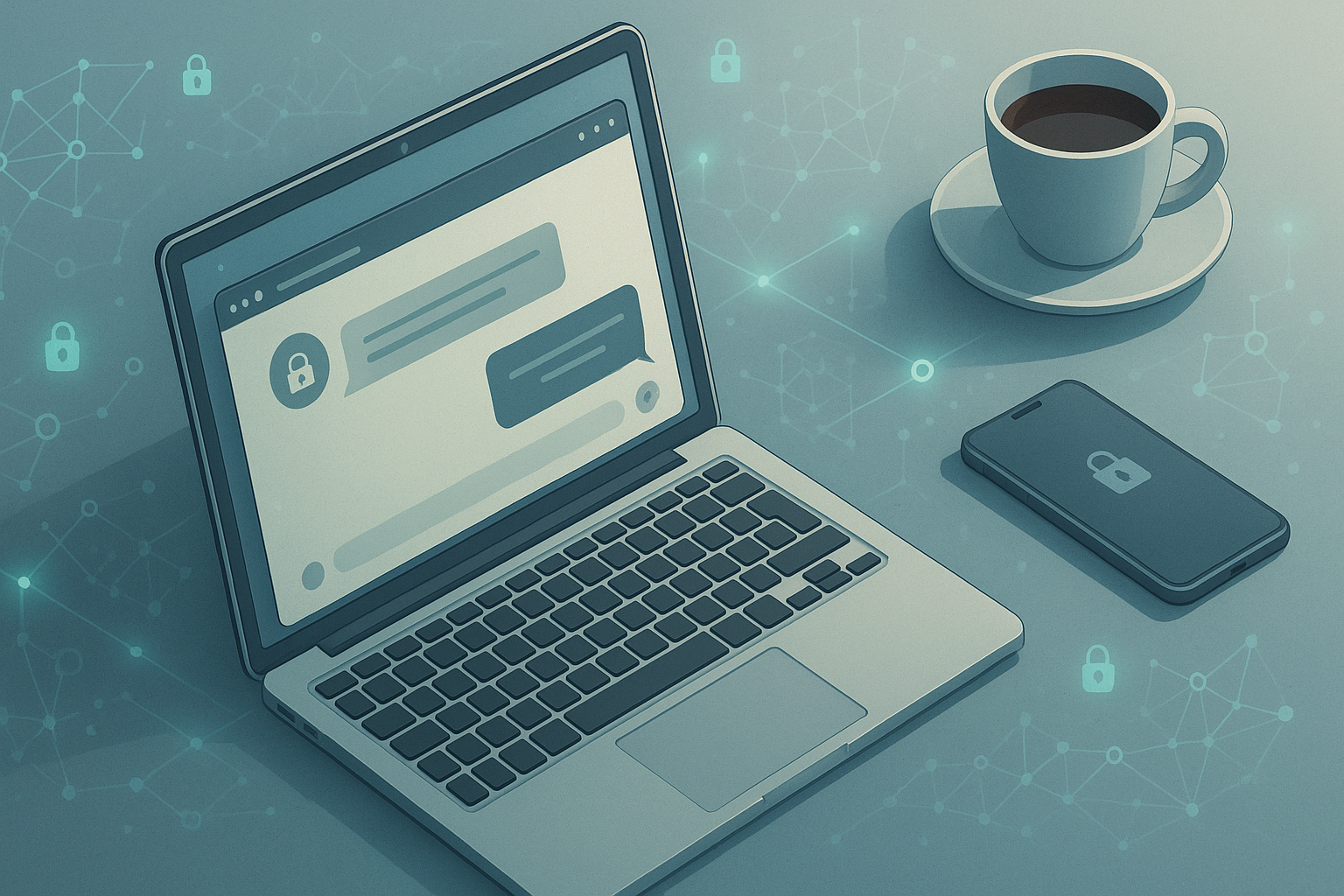
What a browser chat without install changes
See why people search for browser chat without install, and what that choice means for access, privacy, and quick team adoption.
Browser chat without install changes the feel of private messaging in a simple but important way. Instead of asking people to download an app first, create an account later, and then hope everyone else does the same, it lets conversation begin in the browser straight away. That removes a surprising amount of friction, especially when you need a quick, private place to talk with one person or a small group.
The appeal is not just speed. A browser based chat can be easier to open on a shared laptop, a work machine, or a borrowed device, because there is nothing to install and less to manage. For many people, that makes it a better fit than a heavy private chat app, particularly when the goal is simple communication rather than another icon on the home screen.
Used well, browser chat without install can still feel private, focused, and modern. The difference is that the product removes setup steps without forcing you to sacrifice the basics that matter: quick access, readable conversations, and a sensible approach to privacy. That is the balance PigeonChat aims for.
What browser chat without install actually changes
The first change is obvious: you can open a link and start. There is no app store visit, no waiting for an update, and no extra commitment before you see the interface. That matters more than it sounds, because every added step gives people another reason to stop halfway through.
It also changes how chat fits into everyday life. A browser session can be opened for a one off conversation, then closed without leaving much behind. That makes it useful for remote work, support chats, short projects, events, and private planning, where people want the communication to be easy but not permanent in the sense of requiring a long term app relationship.
For teams and individuals alike, the browser model lowers the barrier to entry. You are not asking someone to adopt a whole platform. You are simply giving them a place to talk. That is why a browser chat without install often feels less like a product decision and more like a practical courtesy.
How private messaging can still work in a browser
Some people assume browser chat is automatically less private, but that is not true by default. Privacy depends on design choices, not on whether the interface runs in a tab or a native app. A browser based service can still offer sensible protections if it is built carefully.
For users, the key question is what information is required to begin. If a chat service asks for a phone number, that creates a different kind of identity tie than if it lets people join with a link, a temporary name, or another lightweight method. When you are looking for a private chat app, reducing the amount of personal data needed upfront can be just as important as encryption or message controls.
It also helps when the service is transparent about what is stored and for how long. A private experience is not only about message content. It is also about metadata, sign in friction, and how much of your life you need to hand over before talking to someone. Browser chat can support a more restrained approach here, which is one reason it appeals to privacy conscious users.
Why no phone number can be a real advantage
Asking for a phone number is common, but it is not always necessary. For some users it is a convenience. For others it is a barrier. People may not want to share a number for a work discussion, a one off project, or a contact they do not yet know well. Browser chat without install can avoid that first hurdle.
There is also a practical side to this. A phone number creates expectations. It can feel tied to a person in a way that is harder to separate from everyday life. If you want to keep messaging more compartmentalised, being able to talk without a phone number is often a relief. It keeps the focus on the conversation rather than on identity plumbing.
That does not mean every service without a phone number is automatically better. The important thing is choice. A good private chat app should let people decide how much they want to reveal, and browser based access can support that by making low friction entry possible. PigeonChat uses that principle to keep the first step simple.
- No installation step before the first message
- No app store account or device permission dance
- Often easier to use on temporary or shared devices
- Lower friction for guests, clients, and new contacts
- Less pressure to hand over a phone number too early
Where browser chat is especially useful
Browser chat shines in situations where speed matters more than feature bloat. Think of a quick private exchange with a colleague, a short-lived project channel, or a customer conversation that should start now rather than after a download. The convenience is not an abstract benefit. It changes whether the conversation actually happens.
It is also useful when people are on different devices. If one person is on a laptop and another on a tablet, a browser based approach avoids the awkward question of whether the right app is installed everywhere. You can simply send a link and begin. That kind of simplicity is part of why browser chat without install has such broad appeal.
For organisations, this can make onboarding easier too. Guests do not need training on an app they may never use again. They just open the page. That can be especially helpful in support, events, internal coordination, and other situations where access matters more than long term adoption.
What to look for in a private chat app
If you are choosing a private chat app, it helps to think beyond branding. Look at the first five minutes of the experience. How much do you need to share? How quickly can you start a chat? Can you control who sees the room? Does it work well without extra software?
Security and privacy should feel understandable. You do not need to become a specialist to use messaging well, but you should be able to tell whether the service is making sensible trade offs. Good tools make the safe path straightforward rather than hidden behind technical language.
It is also worth asking whether the product respects attention. Some chat tools turn every conversation into a noisy feed. A better browser based service keeps the interface clean so the message itself stays central. That is a quieter, more humane way to communicate, and it is one reason people prefer browser based options like PigeonChat.
Common trade offs and how to think about them
No messaging format is perfect. Browser based chat can depend on an internet connection, and it may not feel as integrated with the operating system as a native app. Some users will also prefer the familiarity of an app they already use every day. Those are real preferences, not objections to dismiss.
The useful question is whether the trade off matches the task. If you want the fastest route to a private conversation, a browser often wins. If you want a heavyweight communication hub with deep device integration, a native app may suit you better. Convenience and privacy are not opposites, but they do need to be balanced carefully.
For many people, the sweet spot is a service that feels immediate without becoming careless. Browser chat without install can achieve that by removing unnecessary steps and keeping the privacy model simple enough to trust. That is the kind of design that makes people return to a tool, not just try it once.
Frequently asked questions
Is browser chat less private than an app?
Not necessarily. Privacy depends on how the service handles data, identity, access, and message protection. A browser based chat can be very private if it is designed that way. The browser itself is not the deciding factor.
Why would I choose browser chat without install?
Because it is quicker to start and easier to share with other people. If you want a conversation to begin immediately, without asking someone to install anything first, browser chat is usually the simplest route.
Can I use private messaging without a phone number?
Yes, in some services you can. That can be helpful if you want more control over what personal information you share. It is worth checking the sign up flow before you commit to a platform, especially if you are looking for a private chat app that feels low friction.
Browser chat without install is not about lowering standards. It is about removing unnecessary steps so private messaging feels easier to use in real life. When the entry point is simple, more people actually get to the conversation, and that is often the biggest improvement of all.
Ready to try PigeonChat?

Writer & Editor at PigeonChat
Related Articles

PigeonChat.site in the UAE chat app search

What makes a strong European chat app today

What users expect from chat features in 2026

How PigeonChat.site fits private messaging needs today

What a European chat app should offer now