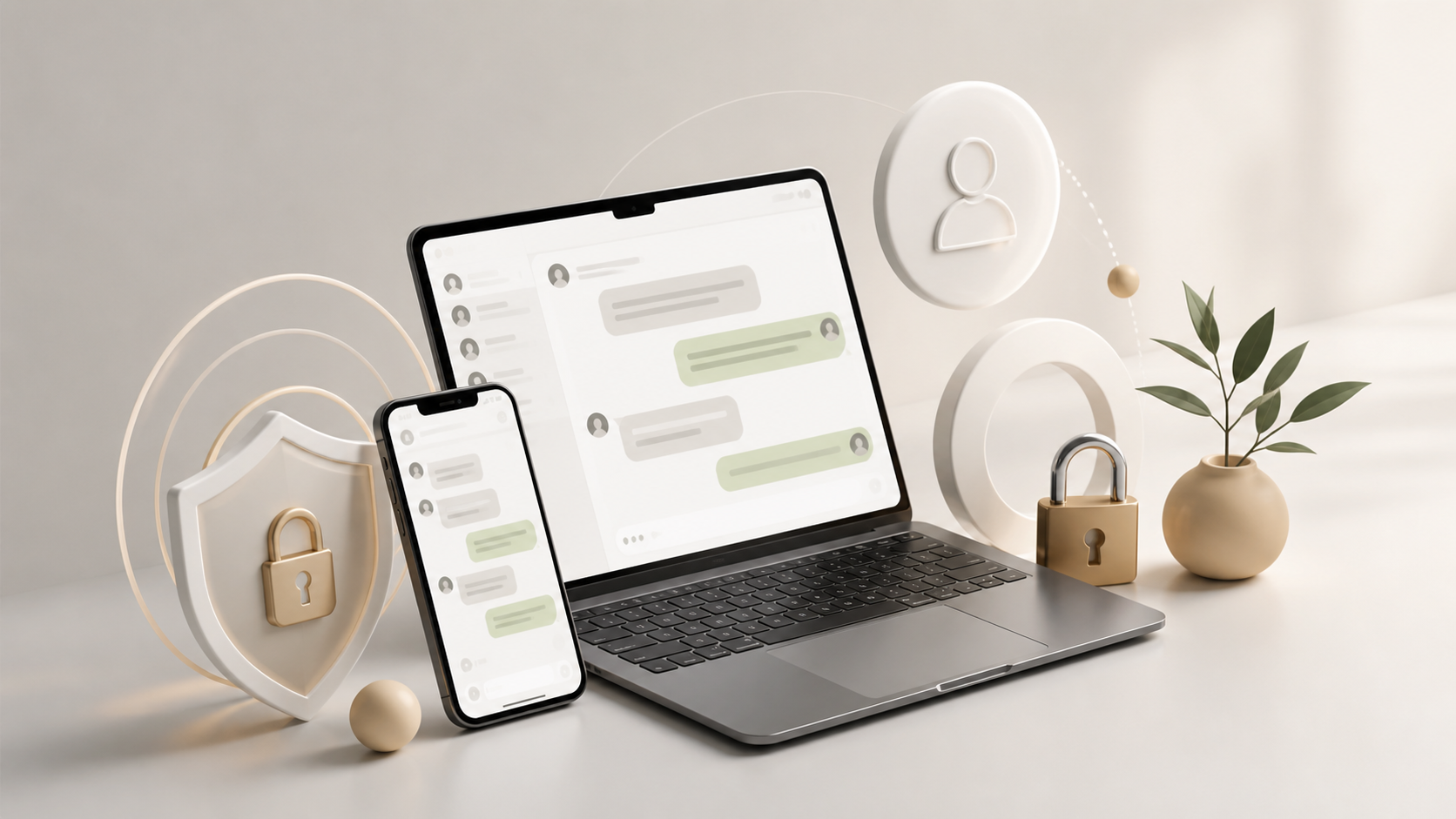
What makes a privacy first chat app different
A practical look at the design choices that separate privacy first chat apps from ordinary messengers and social platforms.
A privacy first chat app is not defined by a slogan on the landing page. It is defined by the product choices that shape what the service can see, store, infer, and expose. That is the real difference between a tool that sounds private and one that is built to reduce trust requirements from the start.
Many messaging products now use the language of privacy, but the details matter. An end to end encryption chat can protect message content in transit and at rest, but privacy first thinking goes further than encryption alone. It asks what metadata is collected, whether chats are searchable by the provider, how accounts are linked to identity, and whether the app can be used without handing over more personal data than necessary.
If you are comparing services, it helps to look past the headline claims and inspect the mechanics. The strongest privacy-first products tend to make fewer assumptions, ask for less, and reveal less by design. PigeonChat is a good example of how that mindset changes the experience, but the principles are useful even if you never sign up anywhere.
Privacy first chat app: the difference starts with data minimisation
The simplest way to understand a Privacy first chat app is to ask a blunt question: what does it need to know in order to work? A privacy-first service tries to keep that list short. It should avoid collecting unnecessary profile details, contact data, device data, and behavioural signals unless they are genuinely required.
That sounds obvious, but many chat services quietly collect more than users expect. They may store message previews, sync address books, log who spoke to whom, or keep history indefinitely by default. Even when message content is encrypted, surrounding information can still paint a detailed picture of your relationships and routines.
Good privacy design is often boring on purpose. Fewer defaults, fewer prompts, fewer hidden analytics tools, and fewer reasons to keep data around. This is one of the clearest signs that a product is built around user protection rather than growth at any cost.
End to end encryption chat is necessary, but it is not the whole story
An end to end encryption chat protects message content so that only the sender and recipient can read it. That is essential, but it does not automatically make an app privacy first. Encryption is one layer, not a complete privacy model.
For example, the service may still see account identifiers, timestamps, group membership, device information, and connection patterns. It may also retain backups, moderation logs, or recovery mechanisms that weaken the practical privacy story. In other words, a secure transport for messages is not the same as a private product overall.
When evaluating an app, look for the combination of encryption and restraint. Does it limit what it stores? Does it explain what happens to metadata? Can you use it without linking it to your full contact book or public profile? Those answers matter as much as the encryption label.
Chat features should support privacy, not undermine it
There is a common assumption that more chat features always mean a better app. In privacy-first design, the better question is whether each feature adds value without creating unnecessary exposure. Features should be intentional, not just decorative.
Useful privacy-supporting features can include disappearing messages, local-only storage, clear device controls, invitation-based access, and simple ways to manage private chats without exposing them to wider discovery. By contrast, features such as public directories, aggressive social graphs, or automatic broad syncing can create more risk than convenience.
- Default settings should favour limited sharing rather than broad visibility.
- Users should control who can find them, contact them, or see their presence.
- Metadata should be kept as small and short-lived as possible.
- Any optional convenience feature should be clearly explained and easy to disable.
- Private chats should remain private even if a user does not tweak advanced settings.
This is where privacy-first products distinguish themselves in practice. They do not merely add a privacy mode on top of a social app. They make privacy part of the default structure, so the product does not rely on expert configuration to behave responsibly.
Private chats need more than a lock icon
When people think of private chats, they often imagine a locked room inside a bigger platform. But a locked room is only private if the building itself does not record everything happening inside. The same logic applies to messaging.
A service can present private chats while still harvesting usage data, forcing identity verification, or encouraging public-by-default behaviour elsewhere in the app. Real privacy means the chat path, the account model, and the surrounding product all align with the same principle: minimise what others can learn.
That is why trust is not just about the cryptography. It is about how the product handles onboarding, contact discovery, message retention, export options, and account recovery. If those elements are clumsy or opaque, the privacy promise is weaker than it looks.
Browser chat can be private if the product choices are right
People sometimes assume browser chat is inherently less private than an installed app. That is not automatically true. A browser-based service can still be designed with careful limits on data collection, storage, and linkage. The real issue is what the browser experience asks for and what it leaves behind.
A privacy-first browser chat should be cautious about cookies, analytics, fingerprinting, and persistent session data. It should make clear when conversations are stored locally, when they are synced, and how long anything is retained. It should also avoid unnecessary permissions that extend the app beyond the browser context.
For users, browser access can actually be an advantage if it reduces device clutter and makes it easier to inspect settings or sign out cleanly. PigeonChat leans into that kind of straightforward access, but the broader lesson is simple: browser chat is only as private as the choices behind it.
What to look for when comparing messaging apps
If you are assessing a messaging tool, the best approach is to look for specific product signals rather than marketing language. A privacy-first service usually leaves a trail of careful decisions that are visible in the interface, the settings, and the documentation.
Here are some practical things to check:
- Is encryption explained plainly, including what it does and does not protect?
- Can you use the app with minimal personal details?
- Are private chats private by default, or do you need to change several settings first?
- Does the app collect contact data, presence data, or usage analytics?
- Are retention and deletion policies clear and easy to understand?
- Can you access the service through browser chat without excessive tracking?
These questions do not require technical expertise. They simply force the product to reveal whether privacy is part of the architecture or just part of the copywriting. That distinction is often the difference between a genuinely privacy-first tool and an ordinary chat app with stronger branding.
Frequently asked questions
Is encryption enough to make a chat app privacy first?
No. Encryption is important, but a privacy-first chat app also limits metadata collection, reduces account linkage, keeps retention short, and avoids unnecessary tracking. If the service still collects a lot around the messages, it is not fully privacy first.
Do I need a special app to have private chats?
Not always, but the app should be designed for privacy rather than retrofitted for it. Private chats work best when they are private by default, with clear controls over discovery, retention, and access. The interface should not make you fight the product to stay private.
Is browser chat less secure than a native app?
Not necessarily. Browser chat can be very private if the service avoids excessive tracking and handles sessions carefully. The important question is whether the provider minimises data collection and exposure, not whether the interface lives in a browser or an installed app.
The core lesson is that privacy-first messaging is a product philosophy, not a slogan. It shows up in defaults, data practices, feature design, and the amount of trust the service asks you to grant. If those choices are restrained and transparent, the app earns its privacy claim. If not, the claim is only surface deep, no matter how polished it sounds.
Ready to try PigeonChat?

Writer & Editor at PigeonChat
Related Articles
Why privacy claims on PigeonChat.site need details
What privacy guaranteed on PigeonChat.site really means
What a European chat app should offer now

What an EU chat app needs beyond privacy claims

Why PigeonChat.site asks you to invite your partner first