
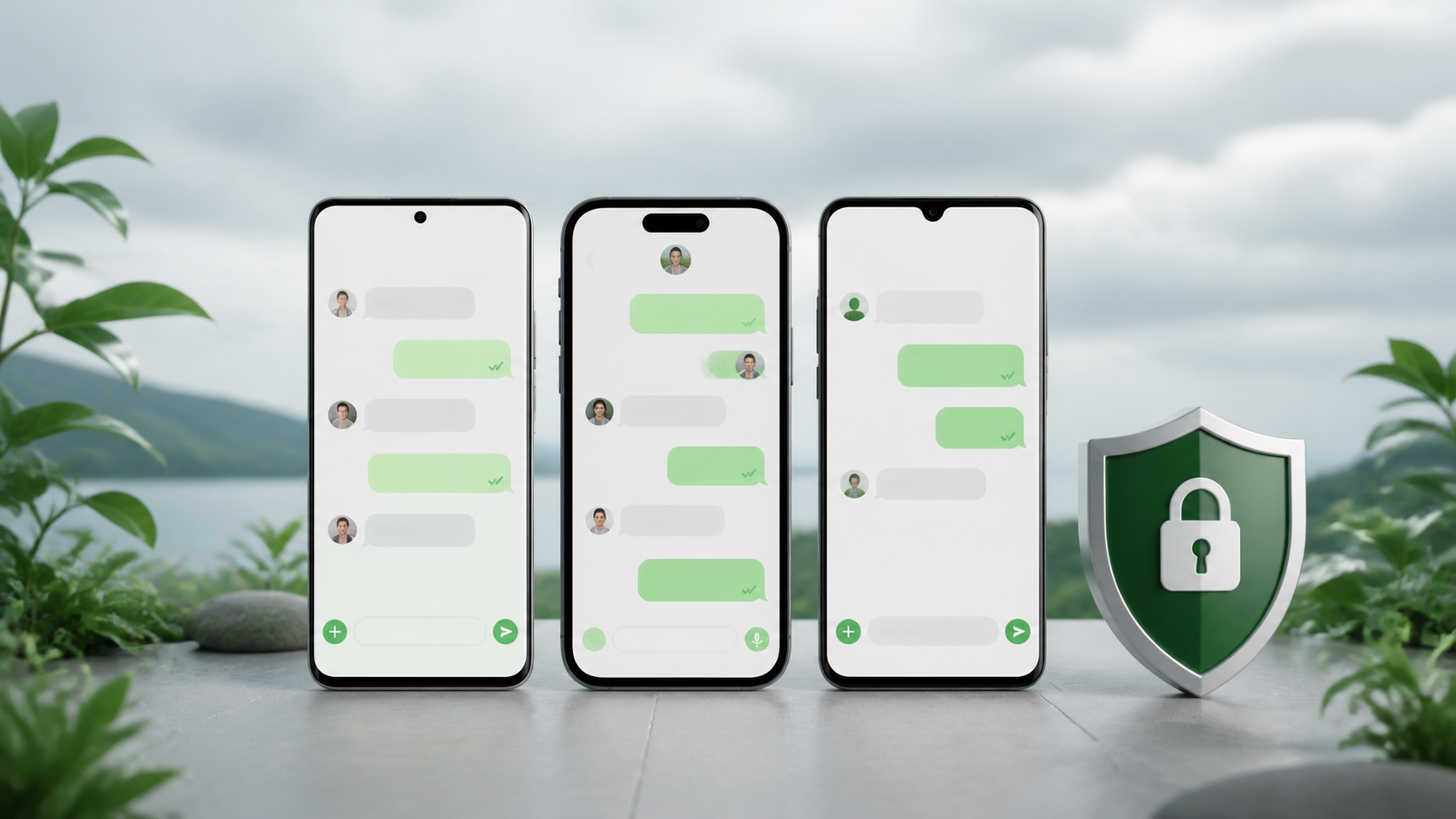
WhatsApp, Signal and Telegram alternatives for privacy
Compare WhatsApp, Signal and Telegram with privacy-first chat apps and see which features matter most for secure private conversations.
If you are comparing WhatsApp, Signal and Telegram alternatives for privacy, the first thing to do is look past brand familiarity. Popularity tells you very little about how much metadata an app keeps, how it handles identity, or what control you have over your chats once they are sent.
Privacy-first users usually compare messaging apps by a small set of practical questions. Is end-to-end encryption on by default? Do you need a phone number to sign up? Can you delete messages, lock chats or limit forwarding? Those details matter far more than whether an app is the default choice in your social circle.
This guide focuses on that decision-making process. It is not about picking a single winner, but about understanding what makes a good alternative chat app for different privacy needs, whether you are moving away from whats app, rethinking signal, or looking for a telegram. Best private chat setup that gives you more control.
What privacy-first users compare first
The most important distinction is between message content and metadata. Encryption protects what you say, but it does not automatically hide who contacted whom, when, from where, or how often. A private messenger should be strong on both fronts, even if no app can remove every trace.
Identity requirements are the second major filter. Some apps are tied tightly to a phone number, while others let you use a username, invite link or local account. If you care about reducing the amount of personal data attached to your chat history, that difference can be decisive.
Then come chat controls. Look for features such as disappearing messages, screenshot warnings, locked conversations, message editing, sender verification and granular notification settings. These are not just convenience features - they shape how much control you keep after a message has been delivered.
WhatsApp, Signal and Telegram through a privacy lens
WhatsApp is widely used, and its end-to-end encryption is a key reason many people trust it for everyday chats. The trade-off is that it remains closely tied to your phone number and sits inside a much larger ecosystem, so it is rarely the first choice for someone who wants the leanest possible privacy posture.
Signal is often treated as the benchmark for private messaging. It is a strong signal alternative chat option because it is built around encrypted communication, minimal data collection and a simple feature set. For many people, that restraint is the appeal: fewer extras, fewer ways for data to leak, and fewer distractions from the core privacy promise.
Telegram is different again. It offers a lot of flexibility, but privacy depends heavily on which chat mode you use and how you configure it. For people searching for a telegram. Best private chat experience, the crucial point is that not all Telegram conversations are equally private, so you need to understand the settings rather than assume every chat is protected in the same way.
Useful alternative chat app categories
If you want a better alternative chat app, it helps to think in categories rather than chasing one perfect replacement. Some apps prioritise secure one-to-one chats, some work better for large groups, and some are designed for people who want less dependence on a phone number.
In practice, the right choice depends on what you are trying to solve. You may want stronger encryption, more control over identity, easier group moderation, or a cleaner separation between your social life and your everyday phone number.
- Signal-like apps - Best when you want straightforward encrypted chat and a small, privacy-focused feature set.
- Username-based messengers - Useful if you want to limit exposure of your phone number.
- Self-hosted or federated tools - Better for people who want more control, though they can be harder to manage.
- Group-first platforms - Handy for communities, but privacy settings need careful checking.
- Lightweight invite-only apps - Good if you mainly want a private space for a small circle.
For many readers, the best private chat choice is not the app with the most features, but the one that aligns with their actual habits. If your main goal is private one-to-one messaging, the simplest solution is often the strongest. If your aim is community coordination, you may need better moderation controls and clearer identity management.
Encryption is necessary, but not sufficient
End-to-end encryption is a baseline, not a full privacy strategy. It protects message content in transit, but an app can still reveal useful information through notifications, contact syncing, backups or account recovery flows. A privacy review should go beyond the marketing headline.
Backups are a good example. If messages are encrypted on the device but copied into an unprotected cloud backup, your privacy can still be weakened. The same is true of contact uploading, which can expose your social graph even when the app itself is secure.
This is why experienced users read the settings page before they join a new platform. They want to know what is stored locally, what is synced, what can be deleted, and what is retained by the service provider. That habit is more useful than relying on reputation alone.
How to choose the right private messenger
A sensible comparison starts with your threat model. That sounds technical, but it simply means asking what you are trying to protect against. Do you want to reduce tracking by the platform, keep casual contacts from seeing your number, or make sure messages are hard to intercept?
From there, check whether the app supports your everyday needs without forcing compromises. If a messenger has excellent privacy but no desktop support, no reliable group tools or poor notification handling, you may quietly stop using it. The best privacy tool is one you can actually live with.
When comparing candidates, use a short checklist:
- Does it encrypt messages by default?
- Can you sign up without exposing your main phone number?
- Are disappearing messages, chat locks or forwarding limits available?
- How much metadata does the app appear to require?
- Does it support your devices and contact patterns?
- Can you easily explain its privacy model to the people you chat with?
If you are discussing options with friends or colleagues, tools like PigeonChat can help you compare privacy features without getting lost in hype. That matters because many conversations about messaging apps become tribal very quickly, when the better approach is simply to match the app to the job.
Frequently asked questions
Is Signal always better than WhatsApp for privacy?
Not always in every situation, but Signal is usually the stronger choice for privacy-focused users because it is designed with minimal data collection and encrypted messaging as its core purpose. WhatsApp offers end-to-end encryption too, but it is more tightly linked to a phone-number-based identity and a broader platform environment.
Is Telegram private if I use the right settings?
It can be more private than the default experience if you understand the controls, but privacy depends on the chat type and settings you choose. If you are treating Telegram as a telegram. Best private chat option, check whether the specific conversation is actually end-to-end encrypted and not just secure in a looser sense.
What should I prioritise in an alternative chat app?
Start with encryption, then look at identity requirements and chat controls. If an app asks for less personal data, gives you meaningful control over message retention and fits your everyday use, it is likely a better alternative chat app than one chosen purely because it is popular.
The best private messaging choice is usually the one that removes unnecessary exposure without making communication awkward. If you think in terms of encryption, identity and control, comparing apps becomes much clearer, and you can choose the right tool for each relationship rather than treating one messenger as a universal answer.
Ready to try PigeonChat?

Writer & Editor at PigeonChat
Related Articles

Viber, Telegram, and Messenger compared for private chat

Signal alternative chat app: what users actually want
What a true WhatsApp alternative should include
WhatsApp, Signal, Viber, and Telegram compared
Why chat folders matter for busy group conversations